Traverse City Firm ATLAS Space Operations Supports NASA Artemis II Lunar Mission
Amy Button-Denby called it coming full circle: ATLAS Space Operations' Hawaii antenna is active on Artemis II, the first crewed lunar flight since Apollo 17 in 1972.
Amy Button-Denby called it coming full circle.
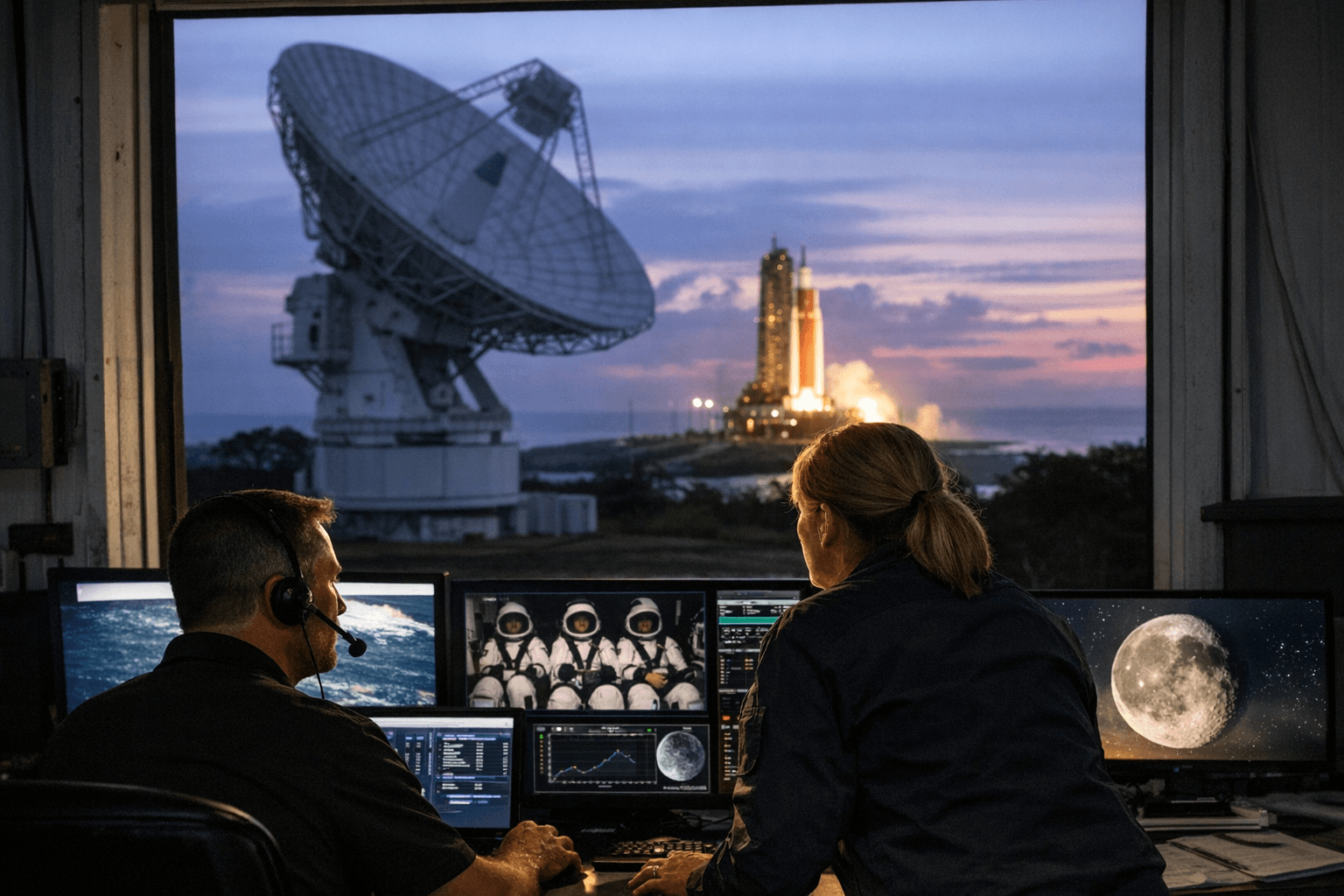
The senior program director at ATLAS Space Operations, the Traverse City space communications company, had reason to say so. ATLAS confirmed its ground station in Hawaii is providing antenna access for Korea's K-RadCube, a 12U CubeSat that deployed from Artemis II approximately five hours and seven minutes after the 6:35 p.m. EDT liftoff on April 1. Its task: measuring radiation inside the Van Allen belts, the bands of charged particles surrounding Earth that every crew heading to lunar space must pass through.
"It's exciting to come full circle and be helping to support Artemis again," Button-Denby said.
K-RadCube was developed by South Korea's Korea AeroSpace Administration and the Korea Astronomy and Space Science Institute. It is one of four international secondary payloads tucked inside the Orion Stage Adapter alongside CubeSats from Germany, Argentina, and Saudi Arabia. The primary mission is a 10-day lunar flyby commanded by Reid Wiseman, with Pilot Victor Glover, Mission Specialist Christina Koch, and Canadian Space Agency astronaut Jeremy Hansen, the first humans to travel near the Moon since Apollo 17 in December 1972.
The coordination required to support a single CubeSat spans continents of paperwork. "Every time we bring a customer on board to one of our ground stations, we are working in a different country that has different rules for licensing, different regulations for who can operate, what kinds of missions they can operate, what even what specific radio frequencies they can use," Button-Denby said. ATLAS does not directly support crewed operations on Artemis II, but the company supports weather satellite constellations that help evaluate launch conditions and space weather safety for crews traveling beyond low Earth orbit, and Button-Denby said the company is open to expanded involvement in future Artemis missions as NASA grows its commercial partnerships.
ATLAS Space Operations was founded in 2015 by U.S. Air Force veterans Sean McDaniel, Mike Carey, and Brad Bode, each drawing on backgrounds in satellite control built during and after the Cold War era. The company relocated from California to Traverse City in 2017, aided in part by local technology investor Casey Cowell of Boomerang Catapult. Its Freedom® software platform now connects more than 50 antennas across 20-plus countries through a single API, making ATLAS the only Ground Software as a Service provider headquartered in the United States. In 2024, the company supported the U.S. Space Force's VICTUS NOX mission, the fastest launch turnaround in Space Force history, going from warehouse to orbit in one week.
The workforce behind that network draws from Midwestern universities. Michigan, Michigan State, Michigan Tech, Western Michigan, and Marquette are all represented on the ATLAS team, and the company lists open roles through Northwest Michigan workforce resources covering positions in software engineering, radio frequency systems, and satellite network operations.
Tuesday's launch also arrives at a moment of corporate transition. In July 2025, ATLAS announced a pending acquisition by the parent company of York Space Systems, a Denver-based spacecraft manufacturer, subject to FCC approval. Under the deal, ATLAS will continue operating under its own brand, remain headquartered in Traverse City, and focus on expanding local employment.
NASA is streaming Artemis II coverage live on NASA+, Amazon Prime Video, and YouTube. The crew's lunar flyby is expected within the coming days, with splashdown targeted roughly 10 days after Tuesday's liftoff.
This article was produced by Prism’s automated news system from verified source data, official records, and press releases, then run through automated quality and moderation checks before publishing. The system is built and supervised by the people who set the standards it runs under. Read our full AI policy.
Did this article answer your question?