Volunteers sought to monitor stream health in Grand Traverse Bay watershed
More than 20 stream sites across four counties will be sampled this June, giving officials data that can steer stormwater fixes and bay restoration.

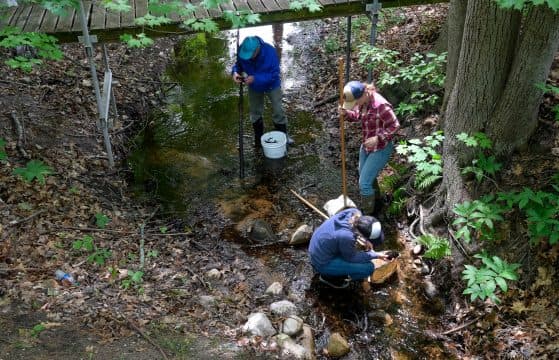
Poor macroinvertebrate readings in local streams can point to stormwater problems, and in the Grand Traverse Bay watershed those results can help drive restoration work before polluted runoff reaches the bay. That is why the Watershed Center Grand Traverse Bay is again recruiting volunteers to sample streams across northwest Michigan.
The center says trained volunteers will monitor more than 20 stream sites during a two-week effort in early June across Leelanau, Grand Traverse, Kalkaska and Antrim counties. A posted Adopt-A-Stream event is set for June 7, 2026, from 1 to 5 p.m. at Mitchell Creek Meadows Preserve in partnership with the Grand Traverse Regional Land Conservancy.
Adopt-A-Stream launched in 2003 and runs twice a year. The Watershed Center says more than 100 volunteers take part each year, and its 2024 annual report says nearly 100 volunteers contributed data in June and October. In 2022, the program recorded 103 volunteers, 908 volunteer hours and 27 sites, a sign of how much of the watershed depends on volunteer sampling to fill gaps in professional monitoring.
The work focuses on macroinvertebrates, the aquatic insects and other small organisms that serve as biological indicators of stream health. Volunteers follow Michigan Clean Water Corps procedures and use a biotic index to judge conditions in wadable streams. Because the organisms have known pollution tolerances and are relatively easy to identify after basic training, the program can generate usable data from streams that otherwise go mostly unmonitored.
That matters in a watershed that spans about 976 square miles and serves more than 150,000 people across Antrim, Grand Traverse, Kalkaska and Leelanau counties. The Watershed Center says the data collected by residents are used by local and state resource professionals when they weigh management and restoration decisions.
The Bay region’s restoration stakes are concrete. The Watershed Center says it has completed nearly 50 restoration projects since 1994, and that its work prevents more than 2,232 tons of sediment, 1,624 pounds of phosphorus, 5,361 pounds of nitrogen and 254 million gallons of stormwater from entering Grand Traverse Bay each year. Those numbers show why stream sampling is not just a civic exercise but part of the county’s long-term water protection strategy.
Kids Creek offers one local example. The Watershed Center says the stream is on Michigan’s Impaired Waters List because of a poor macroinvertebrate community tied largely to stormwater issues. Kids Creek drains almost 7 square miles and is a major tributary to the Boardman River, making its condition relevant not only to neighborhood flooding and water quality, but also to the health of downstream waters that feed Grand Traverse Bay.
This article was produced by Prism’s automated news system from verified source data, official records, and press releases, then run through automated quality and moderation checks before publishing. The system is built and supervised by the people who set the standards it runs under. Read our full AI policy.
Did this article answer your question?


