Blandwood Mansion Preserves Greensboro's Antebellum History Through Guided Tours
Built in 1844 by a two-term NC governor, Blandwood Mansion stands as one of the South's finest Italianate landmarks and opens its doors to guided tours year-round.
Few addresses in downtown Greensboro carry as much architectural and civic weight as 447 West Washington Street. That is where Blandwood Mansion stands, a National Historic Landmark and one of the most significant examples of mid-19th-century Italianate architecture in the entire American South. Walking through its rooms is not a passive experience; it is a direct encounter with the ambitions, aesthetics, and economic vision of antebellum North Carolina.
From Federal Farmhouse to Italian Villa
Blandwood's story begins with a transformation. In 1844, what had been a modest Federal-style farmhouse was redesigned into an elegant Italian Villa under the direction of architect Alexander Jackson Davis. Davis, one of the most influential American architects of the 19th century, gave the property its signature character: a composition of stucco-clad volumes, bracketed eaves, and asymmetrical massing that was strikingly modern for its era and region. The commission came from John Motley Morehead, who served two terms as governor of North Carolina and was one of the state's most consequential figures in early industrial and economic development.
That 1844 redesign is what makes Blandwood exceptional. While much of the antebellum South built in Greek Revival or Federal traditions, Morehead's willingness to commission Davis in the Italianate style set Blandwood apart as a statement of cosmopolitan taste and forward-looking ambition. The mansion has survived largely intact, preserving architectural details, decorative arts, and period furnishings that document both antebellum domestic culture and the early industrial history of North Carolina.
What the Guided Tour Covers
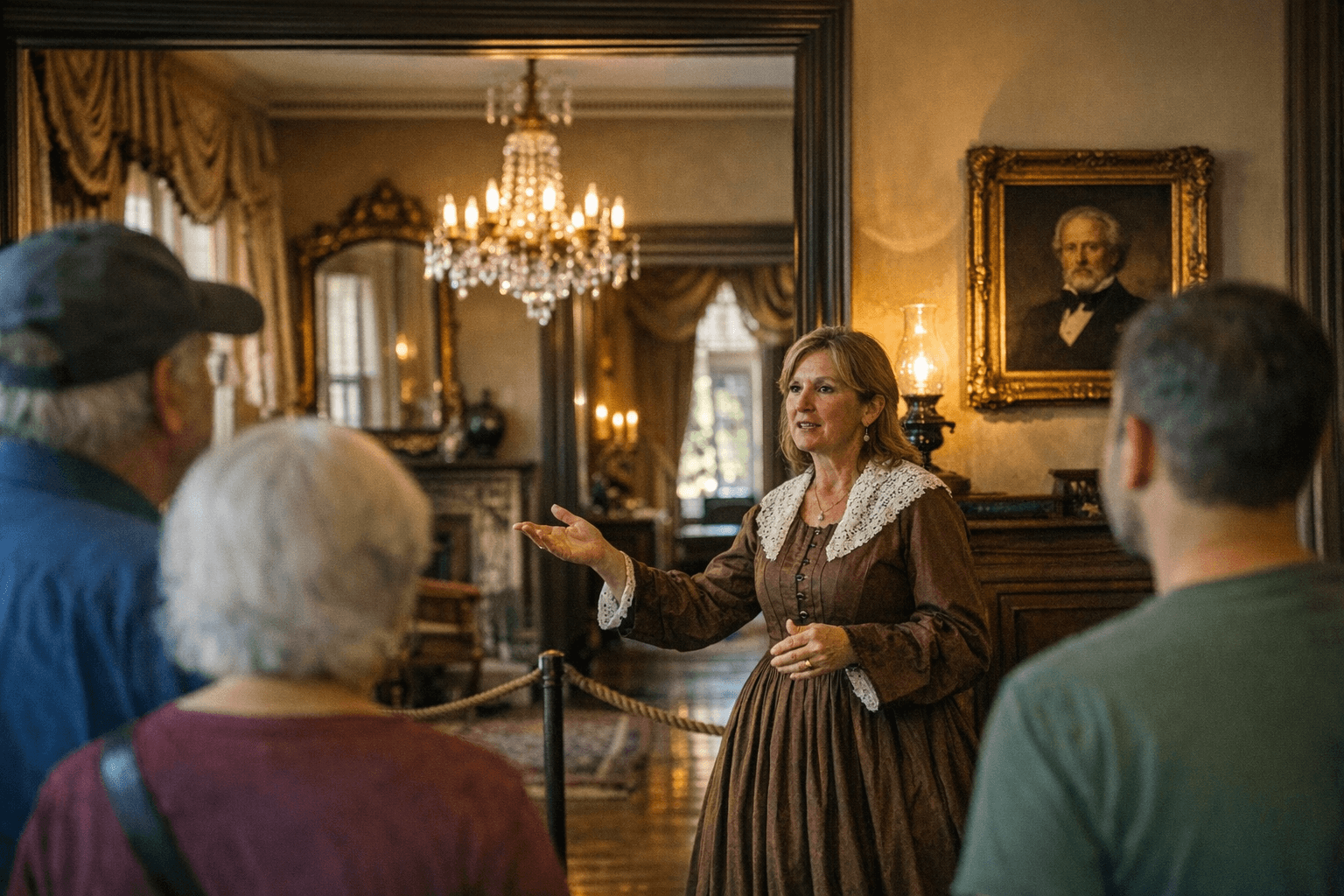
Blandwood operates as a house museum, and the guided tour is the central visitor experience. Rooms are furnished to reflect the period of Morehead's occupancy, offering a layered picture of how a prominent 19th-century household looked and functioned. Interpretive programming moves beyond aesthetics to address the historical context that shaped the house: Davis's architectural vision, Morehead's leadership role in promoting early railroad development and industrial expansion, and the social history embedded in every room.
The tour does not stop at the mansion's walls. The period gardens and carriage house are part of the experience, offering a sense of how the full estate was organized and used. The carriage house also serves as event space, giving the property a practical civic function alongside its educational mission. Seasonal garden events expand the calendar throughout the year, drawing visitors who may return multiple times as programming shifts with the seasons.
Governor Morehead and North Carolina's Economic Story
Understanding Blandwood fully means understanding John Motley Morehead. As a two-term governor, Morehead was a central figure in the push to industrialize North Carolina during a period when the state lagged behind its neighbors economically. His advocacy for railroad construction and industrial investment shaped the infrastructure that would carry the state into the late 19th century. Blandwood, then, is not simply a beautiful house; it is the home of someone whose decisions reverberated across the state's economy for generations.
That context is woven into Blandwood's interpretive programs. Visitors come away with more than an appreciation for Italianate cornices and period furniture; they leave with a grounded understanding of how private wealth, political leadership, and architectural aspiration intersected in antebellum North Carolina. For students and educators, that layered narrative makes Blandwood a rare teaching resource, one that grounds design history, social history, and landscape architecture in a single site.
Preservation as a Community Achievement
Blandwood's survival is itself a story worth telling. Preservation Greensboro, the nonprofit that maintains and interprets the property, has sustained the mansion through community support, volunteer engagement, and donor investment. The mansion stands as evidence that local organizations, given sufficient commitment and resources, can rescue and steward heritage that might otherwise be lost. Public events at Blandwood, ranging from architectural lectures to garden tours, extend that preservation mission into active community programming rather than static conservation.
That programming makes Blandwood an anchor rather than a relic. The mansion functions as a gathering point for civic conversations about history, design, and identity. Its event spaces host small cultural programs that keep the property woven into the fabric of Greensboro's cultural calendar rather than treating it as a site visited once and forgotten.
Planning Your Visit
Blandwood is centrally situated in downtown Greensboro, which makes it easy to incorporate into a broader day of cultural exploration. The Greensboro Historical Museum is a natural companion stop, and the surrounding dining districts provide options for before or after the tour. The mansion's location means it regularly appears on local cultural itineraries precisely because it pairs so well with the rest of what downtown Greensboro offers.
Tours are offered on a scheduled basis, and reservations are advisable during busy seasons. Preservation Greensboro maintains an updated calendar of hours, ticketing details, and upcoming public programs, including special exhibits and seasonal garden events that vary throughout the year. A few practical notes for planning:
- Check Preservation Greensboro's event calendar before visiting, as programming and hours shift seasonally.
- Reservations are recommended, especially during peak periods.
- The carriage house and period gardens are included in the tour experience, so plan enough time to move through the full property.
- Pair the visit with the Greensboro Historical Museum nearby for a fuller picture of Guilford County's history.
Why Blandwood Endures
What distinguishes Blandwood from a typical historic house museum is the density of its significance. It is simultaneously an architectural landmark, a gubernatorial home, a record of antebellum taste, and a monument to the industrial vision that shaped North Carolina's economic trajectory. Alexander Jackson Davis's 1844 Italian Villa transformation gave the state one of its most architecturally distinctive buildings. John Motley Morehead's legacy gives that building its historical gravity. And Preservation Greensboro's ongoing stewardship ensures that both stories remain accessible to anyone who walks through the door at 447 West Washington Street.
For a county rich in historical sites, Blandwood occupies a particular position: it is the kind of place that rewards a return visit, because the layers of meaning in its rooms, gardens, and programming do not exhaust themselves in a single afternoon.
This article was produced by Prism’s automated news system from verified source data, official records, and press releases, then run through automated quality and moderation checks before publishing. The system is built and supervised by the people who set the standards it runs under. Read our full AI policy.
Did this article answer your question?