Guilford County family warns heirs' property can force land sales
A Guilford County inheritance dispute shows how heirs' property can turn family land into a forced sale. Clear titles, wills and faster estate planning are the best defenses.
Land held by one Guilford County family for more than a century can still be lost in partition court. In North Carolina, heirs' property can end up in partition court, and if a judge finds the land cannot be practically divided, the property can be ordered sold.
How heirs' property traps family land
Heirs' property is land passed down from generation to generation, often without a will or other clear estate plan, so multiple descendants own it together as tenants in common. That setup gives each heir a stake in the land, but it also leaves the title clouded, which makes selling, mortgaging or improving the property far harder than most families realize. It can also block access to federal help, complicate repairs and fracture family relationships when money and control are divided among many owners.
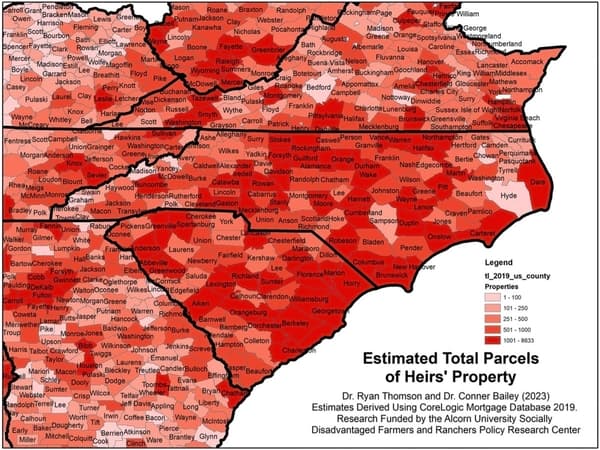
Heirs' property is disproportionately common among racial and ethnic minority groups, low-wealth and low-income households, and other vulnerable populations that are less likely to have sophisticated estate planning. In Guilford County, that makes any family land still tied to deceased parents, grandparents or great-grandparents especially vulnerable if no one has cleaned up the deed.
What North Carolina law allows now
North Carolina’s partition law gives co-owners a path into court, and the state’s recodified Chapter 46A became effective for partition proceedings started on or after October 1, 2020. Under that law, the court can order a sale when it finds by a preponderance of the evidence that an actual partition would cause substantial injury and cannot be made without that injury. The law also requires petition notices to tell respondents they may seek legal advice and that free legal services may be available through Legal Aid of North Carolina or other organizations.
Once a case is filed, mediation can be ordered before a sale is considered, but mediation does not eliminate the possibility of losing the land if the court concludes a sale is the only workable outcome. The statute also allows reasonable attorneys’ fees to be allocated among cotenants, which can add cost pressure to already strained family disputes.
Why the policy fight is still open
State lawmakers have tried to build more safeguards. Senate Bill 548 in the 2023-2024 session proposed the Uniform Partition of Heirs Property Act, and House Bill 976 in 2025 again sought to enact it. The 2025 bill would define heirs property more narrowly and specifically refers to a court-ordered sale as a partition by sale, part of a broader effort to slow involuntary land loss.
Advocates argue the Uniform Partition of Heirs Property Act would require stronger protections before a forced sale goes forward. The measure would give heirs more time and more leverage by requiring courts to look closely at value and by adding steps before a property can be sold off against the wishes of family members who want to keep it.
What Guilford County families can do now
Start with the paper trail. The first move is often to locate the original deed and the current active deed, then use county GIS maps and the Register of Deeds to see exactly whose names are on the record. Guilford County’s Register of Deeds records and preserves real estate records, and the Guilford County Center for N.C. Cooperative Extension operates in Greensboro at 3309 Burlington Rd., giving local owners a place to begin sorting out the title.
- Write a will or prepare a transfer-on-death deed.
- Pay property taxes on time and keep the billing address current.
- Build a family tree that shows how ownership passed from one generation to the next.
- Gather birth certificates, marriage records, obituaries and reunion records to support the ownership history.
- Talk with an attorney about an affidavit of heirship, a family LLC, a land trust or other co-ownership structure.
- Keep receipts for taxes, repairs and improvements, because those records can matter if a partition case starts.
The practical fixes are direct and family-specific:
Where local help comes from
North Carolina A&T State University and NC State University are jointly leading a statewide heirs' property education effort, and N.C. Cooperative Extension staffs local offices in all 100 counties, including Guilford County. In Guilford, that network can connect families with extension agents who understand land records, farm transition and estate-planning basics.
Why this also touches Guilford’s heritage
Guilford County’s Historic Preservation Commission exists to safeguard the county’s heritage by preserving properties that embody cultural, social, economic, political and architectural history.
This article was produced by Prism’s automated news system from verified source data, official records, and press releases, then run through automated quality and moderation checks before publishing. The system is built and supervised by the people who set the standards it runs under. Read our full AI policy.
Did this article answer your question?