Guilford County Forms Task Force to Tackle High Infant Mortality Rates
Guilford County's infant mortality rate hits 9.2 per 1,000 births — among NC's highest — with Black infants making up 70% of deaths in 2023, up from 52% in 2021.

Fifty-three babies in Guilford County did not live to see their first birthday in 2023. Thirty-seven of them were African American. Those numbers, drawn from an Every Baby Guilford report, drove county health leaders and community partners to form a new task force aimed at closing a racial gap in infant survival that has only widened in recent years.
Guilford's infant mortality rate stands at approximately 9.2 deaths per 1,000 births, well above North Carolina's average of 6.9 and the national rate of 5.6. Black infant deaths now account for 70% of all infant deaths in the county, up from 52% in 2021. Every Baby Guilford, the collective action partnership between Guilford County government and community organizations that leads this work, has set a target of cutting that disparity by 50% by 2026 and eliminating it entirely by 2031.
"Infant mortality is a reflection of community health," said Courtney McFadden, Guilford County Public Health Director. "When we uplift mothers — through nutrition, mental health support, and accessible prenatal care — we uplift entire neighborhoods here in Guilford County."
Among those now working inside the county's new task force is Ty Harris, vice president of Every Baby Guilford and a family advocate with the Children's Home Society of North Carolina. Harris knows the weight of these statistics from personal experience. She and her family lost their daughter Tahira, who died after being delivered at 21 weeks.
"That was all new in trying to navigate what it means to not only lose your child, what to do after that," Harris said.
She channeled that grief into advocacy. Today she helps connect mothers across Guilford County with prenatal resources. "Our community is being affected by the maternal death rates. Not only maternal deaths, but infant deaths as well," Harris said. "We have had, as far as 2023 data, because our data is kind of always two years behind, we've seen 53 deaths of babies who did not make it to their first birthday. Thirty-seven of those deaths were African American children."
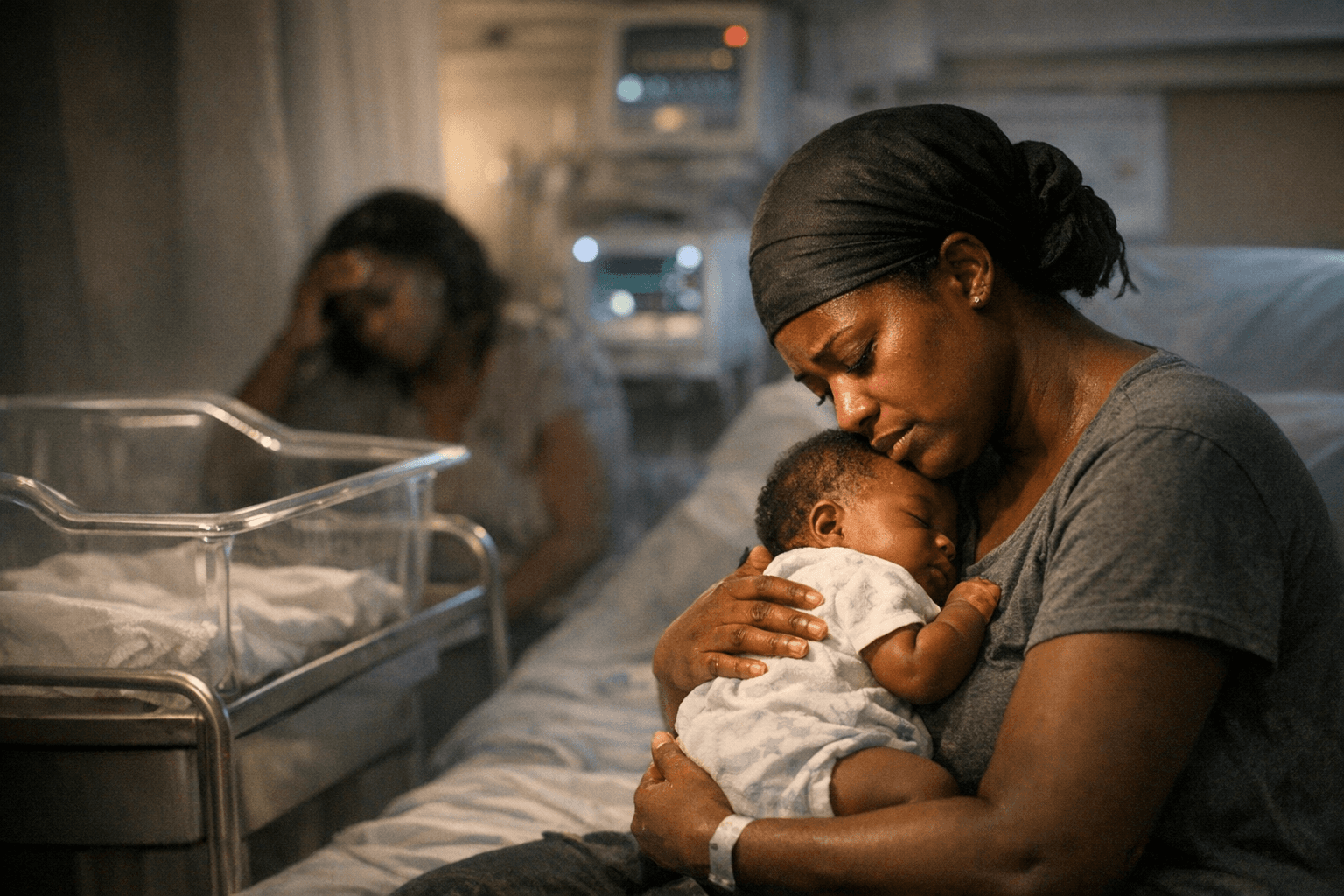
Every Baby Guilford traces its roots to the Guilford County Coalition on Infant Mortality, established in 1991, which spent three decades connecting uninsured women to prenatal care through its Adopt-A-Mom program. That program has linked more than 6,800 women to quality prenatal care. The coalition relaunched as Every Baby Guilford in 2021 with a new five-year strategic plan calling for a community-driven, systems-change approach and an explicit focus on racial equity.
In July 2021, Guilford became the first county in North Carolina to conduct a Fetal Infant Mortality Review, in which a team of community members and medical professionals examined individual death certificates to understand the causes of infant deaths. The team has reviewed 14 cases and produced 39 recommendations now before a community action group. The approach has not come without friction: "There's been a lot of limitations," said Vernon, who is involved in the review process. "Being the first ones that are doing this in North Carolina has been a challenge."
The North Carolina Child Fatality Task Force recommended in March that lawmakers consider legislation to formally authorize mortality review programs, grant reviewers access to necessary medical records, and provide immunity protections to both reviewers and review materials — changes that would give programs like Guilford's stronger legal footing.
Guilford County committed $500,000 of its $104 million in federal ARPA recovery funds to Every Baby Guilford. Jean Workman, who leads the organization, framed the investment in terms that extend beyond one community: "If we improve the birth outcomes for our Black infants in our community, we're going to improve health outcomes for all babies and all families.
Sources:
Know something we missed? Have a correction or additional information?
Submit a Tip