Guilford County Proposes Flexible Parking Rules Tied to Apartment Bedroom Counts
Under a Guilford County proposal heard Thursday, studios would require just 1.25 parking spaces while three-bedroom apartments need 2.0, scrapping a flat countywide standard.
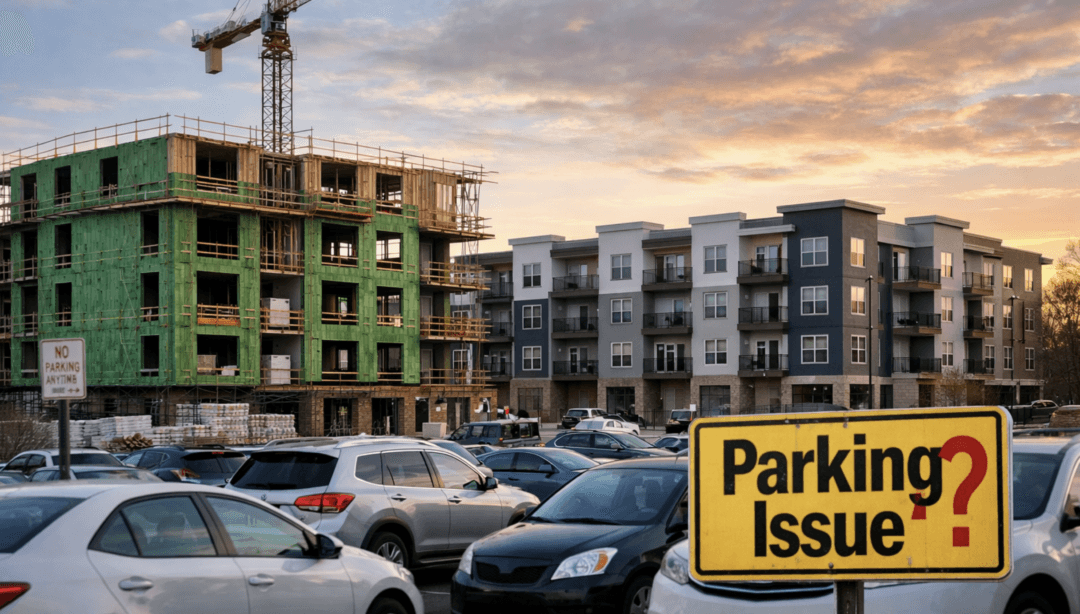
Guilford County commissioners heard public testimony Thursday on a proposed amendment that would abandon the county's uniform 1.8-spaces-per-unit parking standard for multi-family housing, replacing it with a sliding scale that assigns different minimums based on how many bedrooms an apartment contains.
The proposed change to the county's Unified Development Ordinance sets minimum off-street parking at 1.25 spaces for studio and one-bedroom units, 1.5 spaces for two-bedroom units, and 2.0 spaces for units with three or more bedrooms. County staff contends the existing single-number requirement fails to account for the measurable difference in vehicle ownership between a single-occupant studio and a four-person three-bedroom household.
If adopted, the amendment would govern new multi-family construction and townhome development across Greensboro, High Point, and Guilford County's unincorporated areas.
County planners frame the shift as both a housing economics tool and an environmental measure. Every parking space added to a site increases impervious surface, generating more stormwater runoff. By scaling back mandatory minimums, the county argues, developers can build more units on the same footprint, lower per-unit construction costs, and devote reclaimed land to green infrastructure rather than asphalt. Accelerating housing production is a stated county goal, and staff materials tie the parking revision directly to that objective.

The proposal surfaces against a backdrop of rapid apartment construction in parts of Greensboro and rising parking stress in established neighborhoods nearby. The central tension is straightforward: fewer required spaces on a new development do not automatically mean fewer cars among its residents. Critics worry that the shortfall ends up on surrounding streets and neighboring blocks that predate any transit alternative capable of absorbing the difference.
Whether the bedroom-based formula accurately predicts real-world parking demand will depend on the specific projects it governs. The county's enforcement capacity and the pace of transit investment in affected corridors will determine whether the policy delivers on its housing and environmental promises or shifts its costs onto the neighborhoods surrounding them.
This article was produced by Prism’s automated news system from verified source data, official records, and press releases, then run through automated quality and moderation checks before publishing. The system is built and supervised by the people who set the standards it runs under. Read our full AI policy.
Did this article answer your question?