High Point nonprofit fights hunger with mobile markets and food partnerships
High Point families are getting fresh food through mobile markets, but Guilford County's 2023 hunger numbers show the gap is still much larger than one nonprofit.

High Point families are stretching grocery dollars across rising prices, long drives and too few stores that sell fresh food. Out of the Garden Project is trying to narrow that gap with mobile markets and food partnerships, but Guilford County’s hunger numbers show the need is far larger than one nonprofit can absorb.
From a kitchen table to a countywide network
Out of the Garden Project began in August 2009 after Kristy and Don Milholin noticed classmates at Morehead Elementary School dealing with food insecurity while their children attended there during the 2008-2009 school year. The work started in their home, around the kitchen and dining room table, with the Milholins personally supplying six to 10 families with small bags of food each Friday so children would have something to eat over the weekend.
That origin still shapes the group’s approach. Instead of treating hunger as a one-time crisis, the organization built a model around regular access to groceries, especially fresh produce and other items families can actually cook into meals. The nonprofit says it is now the largest organization of its kind in the Piedmont Triad, a claim that speaks to how much the operation has grown since those first weekly food bags.
The list of food it moves matters because it reflects the difference between a shelf-stable pantry stop and a real grocery trip. Out of the Garden Project says it distributes fresh produce, dairy, bread, beans, deli items and other grocery-store staples, which can change what is possible in a household kitchen from one week to the next.
How the food moves through High Point and Greensboro
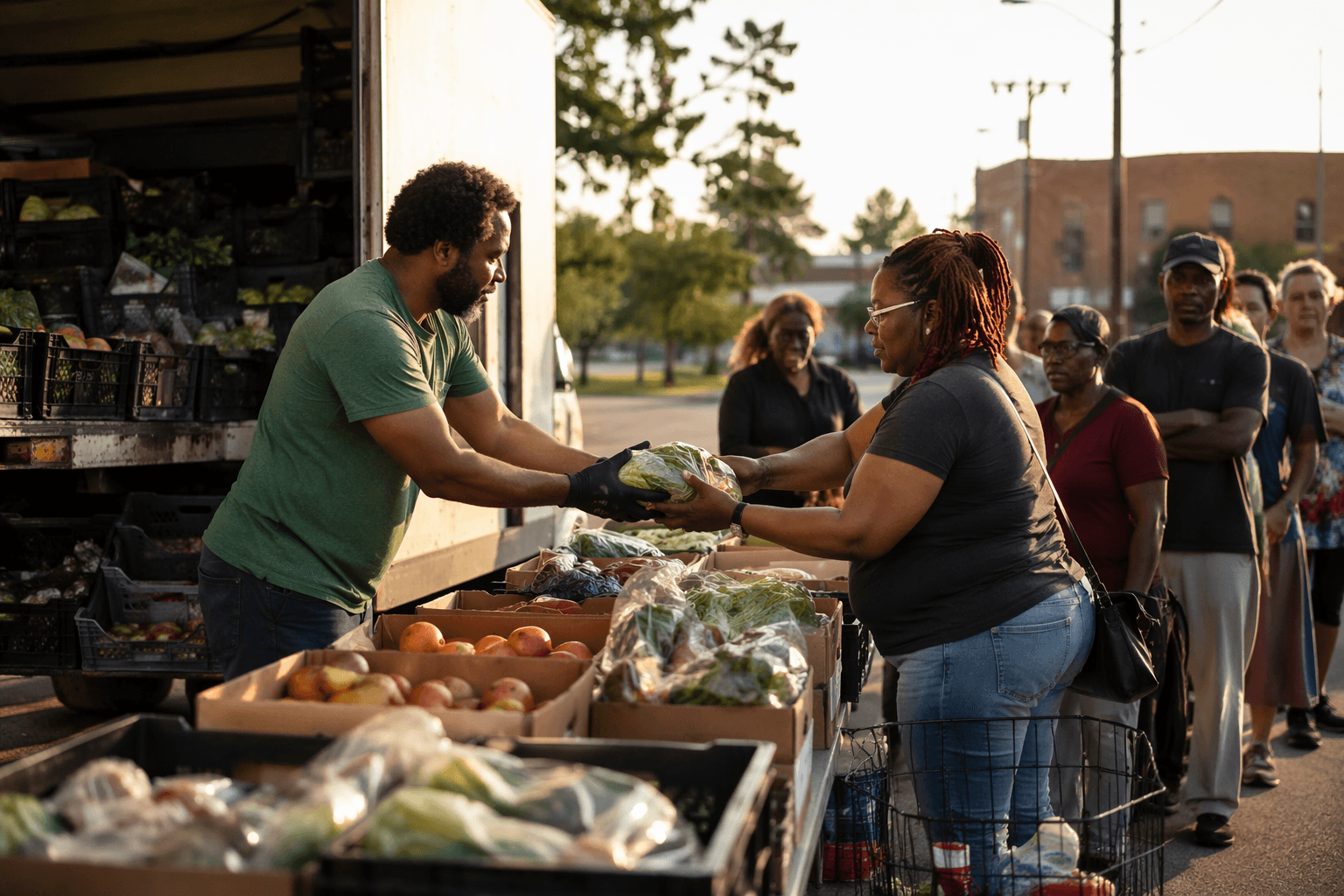
The organization’s mobile market model is built to push food closer to where people live, rather than forcing families to spend time and money reaching a store that may not be nearby. Donations of fruits and vegetables are picked up from Foster in Greensboro, sorted at a warehouse and then sent directly to families or to partner nonprofits that already have steady community relationships.
That partnership structure is one of the clearest signs that the anti-hunger response in Guilford County works like a supply chain. Helping Hands High Point receives food on the third Wednesday of every month, while West End Ministries gets deliveries on the first Wednesday, creating a schedule that is routine rather than symbolic. When food can be redirected before it spoils, the same box of produce can answer two problems at once: waste and hunger.
The steady cadence also matters for households trying to budget week by week. A family cannot plan meals around an occasional donation drive, but it can make decisions around a known monthly or weekly food source, especially when fresh items are involved. That is where mobile markets and partner deliveries have an edge over one-off handouts, even if they cannot meet every need in the county.
What the markets change for families trying to make meals last
The most immediate value of Out of the Garden Project’s model is practical. For families in food deserts, or for people without reliable transportation, the obstacle is not only price but access. High Point’s seven food deserts in 2025 show how geography can turn grocery shopping into a harder, more expensive errand than it should be.
The group’s markets are reaching real households in numbers that suggest meaningful local impact. The fresh mobile markets normally serve about 125 families per market, and some recent markets have served more than 200 households while providing food for more than 1,000 children, adults and seniors. That is not countywide coverage, but it is enough to change the weekly food supply for the families who get through the line.
The limit is scale. Guilford County had 82,510 food-insecure people in 2023, including 27,110 food-insecure children, and the county’s food insecurity rate stood at 15.2 percent. Feeding America’s Map the Meal Gap estimate puts the county’s annual food budget shortfall at $57.7 million, which makes clear that a mobile market can relieve pressure, but not erase it.
Why Guilford County still needs a bigger system
Guilford County’s food-data page points residents to the Greater High Point Food Alliance for detailed local food-system information, a sign that the county now treats food access as a planning issue, not just a charitable one. County and Cooperative Extension resources also describe the Greater Guilford Food Finder app as a free tool for locating emergency food resources across Guilford County, an important step for people who need help quickly and do not know where to start.
The broader policy picture shows that local leaders are trying to connect emergency food, data and long-term planning. Guilford County also has a Food Security Hub, and the Greater High Point Food Alliance’s 2026 grant cycle awarded more than $59,000 to 23 local projects focused on food access, nutrition education and food-system sustainability. Those dollars are modest compared with the countywide food shortfall, but they show an effort to build infrastructure around the problem instead of relying on a single pantry or volunteer drive.
Out of the Garden Project fits into that larger network as one of the more established pieces. Its regular market schedules, warehouse sorting, restaurant and grocery-style food mix, and monthly nonprofit deliveries make it more stable than a temporary campaign. Even so, the numbers in Guilford County suggest the same conclusion from multiple angles: the model matters, but the scale of hunger is still bigger than the current response.
This article was produced by Prism’s automated news system from verified source data, official records, and press releases, then run through automated quality and moderation checks before publishing. The system is built and supervised by the people who set the standards it runs under. Read our full AI policy.
Did this article answer your question?