NC A&T tests smart intersection technology at Greensboro crossing
NC A&T turned East Market and Dudley into a live test bed, aiming to cut crashes, delays and signal confusion at one of Greensboro’s busiest crossings.

A busy corner just off North Carolina A&T State University’s campus is now doing double duty as a transportation lab, with sensors watching how drivers, buses, scooters, pedestrians and emergency vehicles move through East Market Street and Dudley Street. The goal is not just to collect data, but to find out whether smarter signals and faster detection can make one of Greensboro’s most active crossings safer and less frustrating to use.
NC A&T formally unveiled the Smart Intersection Test Facility on March 11, 2026, at the Harold L. Martin Engineering Research and Innovation Complex, then announced it the next day. The site uses LiDAR, radar and dedicated short-range communication devices, and FOX8 reported that cameras were also installed. The system was built with Commsignia, Ouster, Smartmicro and BlueCity, and the university says it can track vehicles, cyclists and pedestrians in real time while also detecting approaching emergency vehicles to support signal preemption.
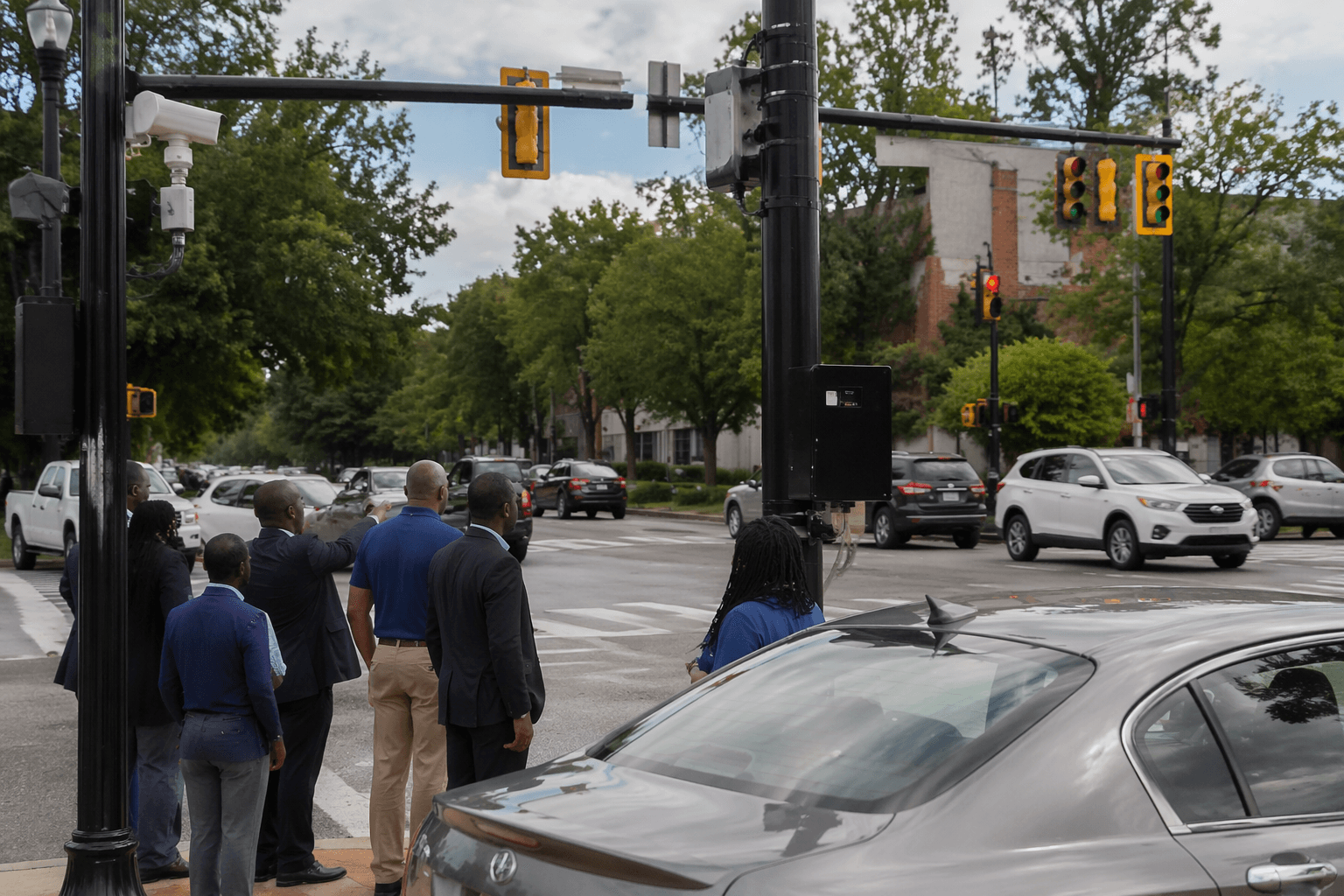
Ali Karimoddini, who directs the university’s Center for Regional and Rural Connected Communities, has described the setup as a living lab because the traffic is real and the data comes in live, not from a controlled indoor setting. That matters at East Market and Dudley, where movement is constant and complicated, and where a better read on traffic patterns could help with automated-vehicle integration, traffic-signal timing for first responders and even more time for a pedestrian with a disability to cross when needed.
The project also fits into a wider push at A&T to turn Greensboro into a proving ground for connected mobility. The Center for Regional and Rural Connected Communities serves as the Region 4 University Transportation Center, covering North Carolina, Alabama, Florida, Georgia, Kentucky, Mississippi, Puerto Rico, South Carolina and Tennessee, and it launched with a $3 million federal grant that could grow to $15 million over five years. University researchers say the smart-intersection work adds to that mission by training students in smart mobility systems, cybersecurity, artificial intelligence, data science and connected vehicle technology.
Greensboro has already hosted earlier A&T transportation pilots, including a September 2023 autonomous shuttle route that ran about a mile from campus to the Miriam P. Brenner Children’s Museum. A later North Carolina Department of Transportation report on a Greensboro microtransit pilot named Karimoddini as lead author and set a final report date of Jan. 31, 2025. Together, those projects show how the campus has been steadily building toward this moment, using city streets as a test site for ideas that could one day help reduce crashes, ease congestion and improve travel delays far beyond the A&T district.
The location is no accident. Greensboro adopted the East Market Street Redevelopment Plan in June 1998, and the city says the corridor has drawn more than $150 million in investment since then. With new sensors now watching the street in real time, the university and its partners are betting that a single intersection can help shape safer street design, better emergency response and smarter mobility decisions across Guilford County.
This article was produced by Prism’s automated news system from verified source data, official records, and press releases, then run through automated quality and moderation checks before publishing. The system is built and supervised by the people who set the standards it runs under. Read our full AI policy.
Did this article answer your question?

