Triad air quality worsens, earns C for ozone, D for particles
The Triad slipped to a C for ozone and a D for short-term particle pollution, a warning for Guilford County families headed into another ozone season.

The Triad’s air quality slipped again, with the Greensboro-Winston-Salem-High Point metro area earning a C for ozone and a D for short-term particle pollution. For Guilford County families in Greensboro, High Point and Jamestown, that grade is more than a report card. It points to the kind of air that can hit hardest on children, older adults and people living with asthma or COPD.
The American Lung Association’s 2026 State of the Air report used official U.S. Environmental Protection Agency data from 2022 through 2024 to rank metro areas on unhealthy levels of ground-level ozone and particle pollution. In those rankings, the Triad placed 100th worst nationally for ozone, 76th worst for short-term particle pollution and 62nd worst for year-round particle pollution. The metro still received a passing grade for year-round particle pollution, but the D for short-term particles shows that bad-air spikes remain a problem.
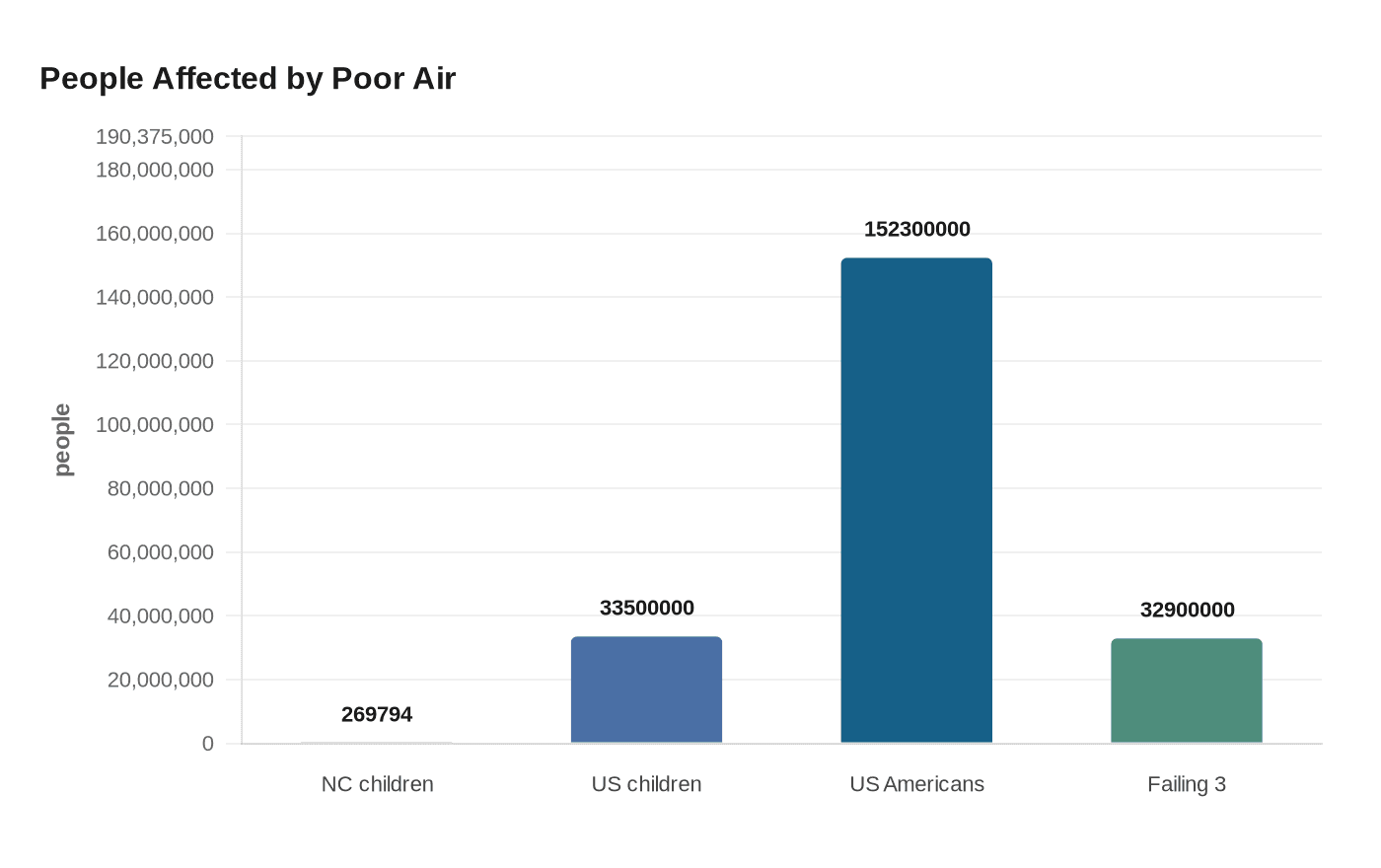
The numbers carry real health consequences in North Carolina. The Lung Association says 269,794 children in the state are breathing unhealthy levels of air pollution, and 33.5 million children nationwide live in areas that failed at least one air-pollution measure. Across the country, 44% of Americans, or 152.3 million people, live in places that received failing grades for ozone or particle pollution. The report also says 32.9 million people live in counties with failing grades for all three measures.
The burden falls heaviest on people most likely to feel the air first: children playing outside, older adults, people with asthma or COPD, and workers who spend long hours outdoors. The report also says people of color and people with lower incomes are disproportionately affected. In practical terms for Guilford County, that means summer sports, yard work, construction shifts and evening recreation all become part of the health equation when ozone climbs.
North Carolina’s ozone season generally runs from early March through October, when heat and sunlight help form ground-level ozone from emissions tied to vehicles, factories, paint, aerosol products and manufacturing facilities. That is the backdrop for a state where only 34 of 100 counties could be graded for at least one air-quality measure. Guilford County received a B for ozone in the county table, while neighboring Forsyth County received a C. Across the state, the greater Charlotte area earned an F for ozone, Raleigh-Durham and Fayetteville received Bs, and Asheville received a C.
EPA air-trends materials show national ozone levels have declined since 2002, but the Triad’s grade shows those gains have not reached every North Carolina community evenly. For Greensboro, High Point and the rest of Guilford County, the message heading into summer is clear: the air is getting harder to ignore.
This article was produced by Prism’s automated news system from verified source data, official records, and press releases, then run through automated quality and moderation checks before publishing. The system is built and supervised by the people who set the standards it runs under. Read our full AI policy.
Did this article answer your question?