Blind and Print-Disabled Voters Sue Harris County Over Inaccessible Mail Ballots
A federal class-action filed Feb 3, 2026 says Harris County and Clerk Teneshia Hudspeth deny blind and print-disabled voters remote accessible mail ballots, citing a 2024 county denial.
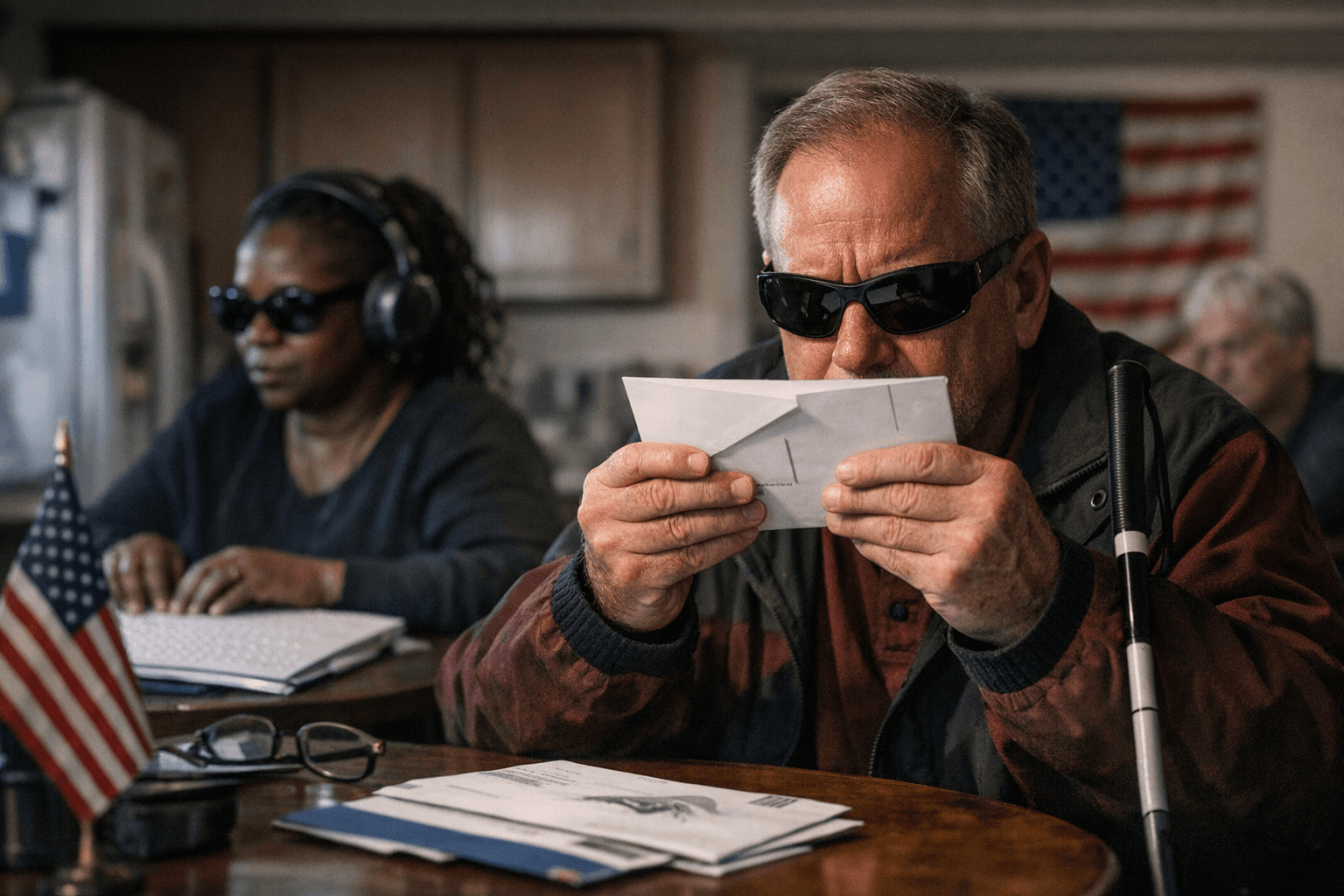
A federal complaint filed February 3, 2026 in the U.S. District Court for the Southern District of Texas accuses Harris County and County Clerk Teneshia Hudspeth of denying blind and other print-disabled voters an accessible way to vote by mail. The lawsuit, captioned National Federation of the Blind of Texas et al v. Hudspeth et al, seeks class certification to represent “all registered Harris County voters with print disabilities.”
Plaintiffs include the National Federation of the Blind of Texas and four named Harris County voters - Cedric Bryant, Ted Galanos, Louis Maher, and Michael McCulloch - who the complaint says are unable to independently hold, read, mark, or handle paper ballots. The complaint asserts violations of Title II of the Americans with Disabilities Act and Section 504 of the Rehabilitation Act of 1973 and asks the court to require Harris County to provide remote accessible vote-by-mail ballots so those voters can “privately and independently” read and mark their ballots. Plaintiffs are represented by Disability Rights Texas and Brown, Goldstein & Levy LLP, with Brown Gold attorneys Eve Hill, Lauren Kelleher, and Marisa Leib-Neri listed on the filing.
The complaint alleges Harris County issues only paper vote-by-mail ballots, forcing voters with print disabilities to rely on third parties to complete mail ballots and stripping them of a private ballot. Disability Rights Texas says advocates pressed the county for over a year to voluntarily implement an accessible vote-by-mail program. The filing highlights an October 2024 incident in which individual plaintiff Michael McCulloch requested an accessible ballot and the County Clerk’s Office responded that “no such ballot existed” and that Texas law prohibited electronic ballots for disabled voters.
Plaintiffs point to existing county practices to argue there is no practical barrier to providing remote accessible ballots. The complaint notes Harris County already offers accessible in-person voting machines and curbside voting and provides electronic ballots to military and overseas voters. Norma Crosby, president of the National Federation of the Blind of Texas, said, “Voting is a fundamental right essential to full and equal participation in American society, and that right necessarily includes the ability to cast a ballot privately and independently, without fear of disclosing our vote to others or having our ballot tampered with.” Crosby added, “Harris County already provides electronic ballots to military and overseas voters and even astronauts in outer space. There is no lawful or practical reason to deny the same access to blind and print‑disabled voters here at home. We are merely demanding the secret ballot that other voters already have and are guaranteed by law.”
Disability Rights Texas supervising attorney Sashi Nisankarao framed the argument similarly: “If astronauts can vote from space, surely people with vision and other print disabilities can vote down here on Earth.” McCulloch, a legally blind Houston resident and individual plaintiff, said, “If a person that has sight can do it privately, then why can’t I, as a blind person, be able to do the same thing that the rest of the sighted world can do?”
Democracy Docket notes the complaint places Harris County’s practices in a broader national history of barriers to voting for individuals with disabilities and references a 2019 Department of Justice settlement that resolved earlier ADA violations at Harris County polling places. The new complaint alleges those prior settlements did not address mail‑in ballot barriers and cites lower turnout among visually impaired voters as a consequence.
The plaintiffs ask the federal court to order Harris County to implement remote accessible vote-by-mail and to certify a class of all registered Harris County voters with print disabilities. The case is now pending in the U.S. District Court for the Southern District of Texas; the complaint was filed February 3, 2026 and lists Brown, Goldstein & Levy LLP and Disability Rights Texas as counsel for the plaintiffs.
This article was produced by Prism’s automated news system from verified source data, official records, and press releases, then run through automated quality and moderation checks before publishing. The system is built and supervised by the people who set the standards it runs under. Read our full AI policy.
Did this article answer your question?