Ernesto Neto's Massive Crochet Labyrinth Returns to MFAH This Spring
A 6,000-pound crocheted labyrinth suspended 12 feet in the air is back at MFAH through September 7.

A 6,000-pound structure of hand-crocheted paracord is once again filling Cullinan Hall at the Museum of Fine Arts, Houston, and visitors are not just allowed to touch it — they are required to climb inside.
Ernesto Neto: SunForceOceanLife reopened March 8 in the Caroline Wiess Law Building, where it will hang through September 7, 2026. Originally commissioned by MFAH in 2019, the installation is among the largest crochet works the Brazilian artist has ever produced. A team of more than a dozen people spent several weeks reconstructing its labyrinth of interior pathways for this reinstallation.
The structure suspends visitors roughly 12 feet above the ground along walkable pathways filled with hollow plastic balls — the kind found in a children's ball pit — contained in crocheted tubes. The paracord itself, woven in nature-inspired yellows, oranges, reds, and greens, was hand-crocheted by Neto and a small team that included three of his relatives, many of whom worked from their homes during the pandemic. Neto's technique uses fingers rather than needles, a process he developed to allow for larger apertures than standard crocheting permits. Segments were completed in his Rio de Janeiro studio, sewn together, shipped to Texas, and ultimately hung by museum workers on scaffolds and hydraulic lifts from crocheted cables affixed to a metal ceiling frame.
The design was no accident of scale. Neto used Rhinoceros and Adobe Illustrator to plan the installation, shaping its dimensions around the specific architecture of Cullinan Hall, which Ludwig Mies van der Rohe designed in 1958. The result, at nearly 80 feet in length according to Interior Design, occupies the full footprint of the hall.
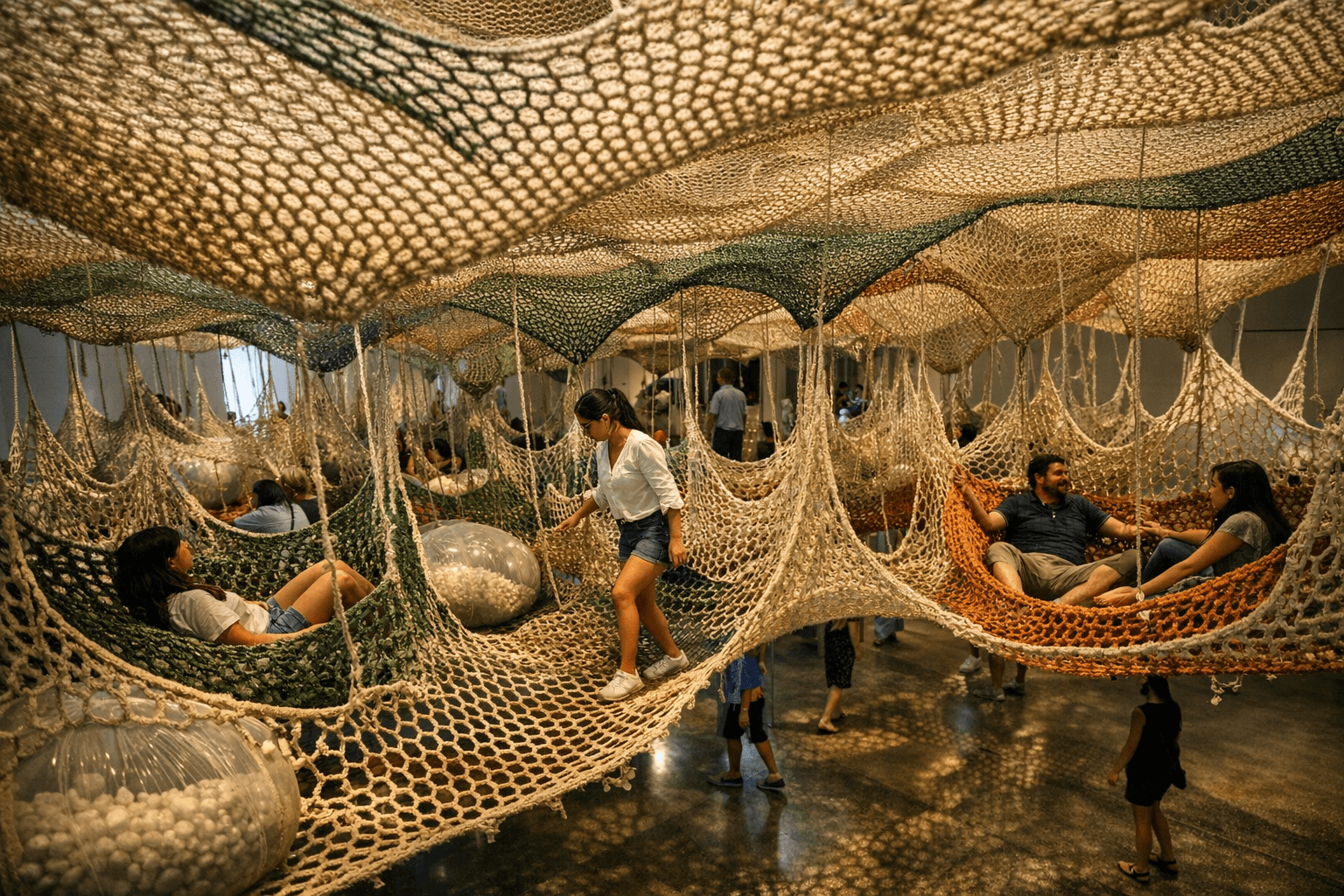
Mari Carmen Ramírez, the Wortham Curator of Latin American Art and Founding Director of the International Center for the Arts of the Americas at MFAH, framed the work as rooted in personal and cultural history. "Inspired by crochet, which he learned from his grandmother, the piece transforms this traditional Brazilian craft into a massive, enveloping structure that engages the body and the mind," Ramírez said. She has also described the piece as Neto's tribute to "the life-giving forces of the sun and the ocean."
MFAH Director Gary Tinterow called the commission a statement of institutional purpose. "Ernesto Neto has captivated audiences around the world with his multi-sensory, structural environments — each one unique in nature and its visitor experience," Tinterow said. "We are delighted to bring this monumental, one-of-a-kind piece to our Museum and into our collection."
Before entering, visitors must sign a waiver, stow their shoes in a locker, and put on museum-issued socks. The installation is on view in Cullinan Hall through September 7.
Know something we missed? Have a correction or additional information?
Submit a Tip