Federal probe opens into HISD special education changes
Federal civil-rights officials are probing HISD’s special-ed overhaul as families brace for campus moves that could affect about 5,000 students.
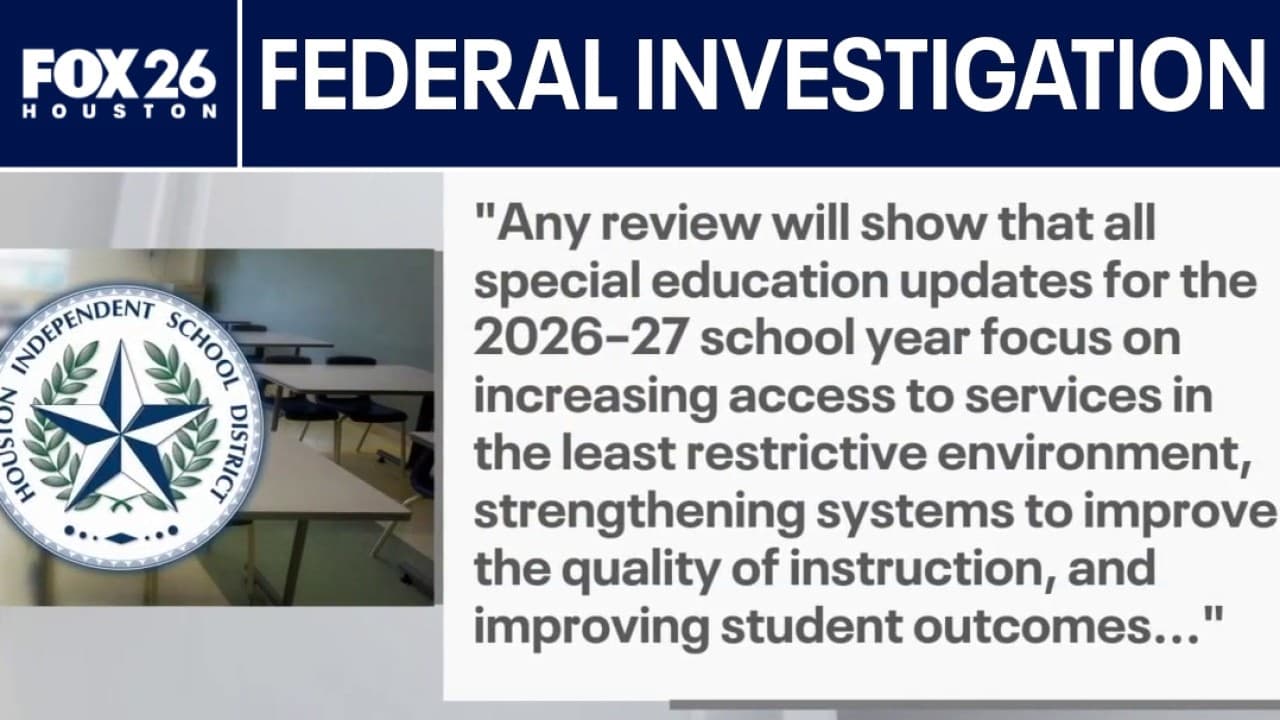
The U.S. Department of Education’s Office for Civil Rights opened a disability-discrimination investigation into Houston ISD on May 8, putting the district’s special education overhaul under a federal microscope just as families prepare for 2026-27 placements. OCR said it is examining whether HISD’s plan violates Section 504 of the Rehabilitation Act and Title II of the Americans with Disabilities Act by centralizing services and pushing students with disabilities farther from general education classrooms.
HISD says it is planning updates to special education delivery starting in the 2026-2027 school year, and that all students currently served in an inclusion setting will stay there unless their IEP changes. The district also says special education success programs will be available at 142 of its 259 campuses, with social skills support offered at every campus, and self-contained classrooms capped at a 1:5 adult-to-student ratio. Houston Chronicle reported that roughly 5,000 students were assigned to new schools under the overhaul.

The fight spilled into Midtown Houston on May 9, where families and advocates gathered at Houston City College’s Central Campus for a special education resource fair hosted with Partners Resource Network. Elizabeth Ortega, a former HISD parent whose son is on the autism spectrum, said the district’s plan looked to her like “segregation instead of inclusion,” while Jane Friou said special education “has to be individualized for each student” and warned against broad changes sent home in notes. Mark Stadnyk, whose first grader has cerebral palsy and epilepsy, said his daughter already relies on a detailed, teacher-built IEP and was struggling with the idea of changing schools.
For parents, the law still gives them leverage while the probe is pending. Federal rules require written notice a reasonable time before a district proposes or refuses to change a child’s identification, evaluation, placement or free appropriate public education, and parents are entitled to the procedural-safeguards notice on request. Those safeguards include the ability to challenge placement or services through a due-process complaint, and OCR can also investigate a discrimination complaint filed within its deadline.
If OCR finds HISD ran afoul of federal disability law, the remedies could be concrete and immediate: individualized placement reviews, reevaluations, compensatory or remedial services, written plans for delivery, revised IEPs, staff training, and ongoing reporting and monitoring until the district proves compliance. Federal resolution agreements in disability cases routinely require districts to convene IEP or Section 504 meetings, document decisions, and spell out who will provide services and on what timeline. At Thursday night’s board meeting, about 100 people signed up to speak, and Superintendent Mike Miles said the district was still working through longstanding compliance issues that predated the state takeover.
This article was produced by Prism’s automated news system from verified source data, official records, and press releases, then run through automated quality and moderation checks before publishing. The system is built and supervised by the people who set the standards it runs under. Read our full AI policy.
Did this article answer your question?