Harris County Leads All U.S. Counties in Population Growth, Census Data Shows
Harris County added 105,852 residents in a single year, topping every U.S. county in numeric growth — but a Rice University analyst warns the immigration policies of the Trump era could stall that streak.
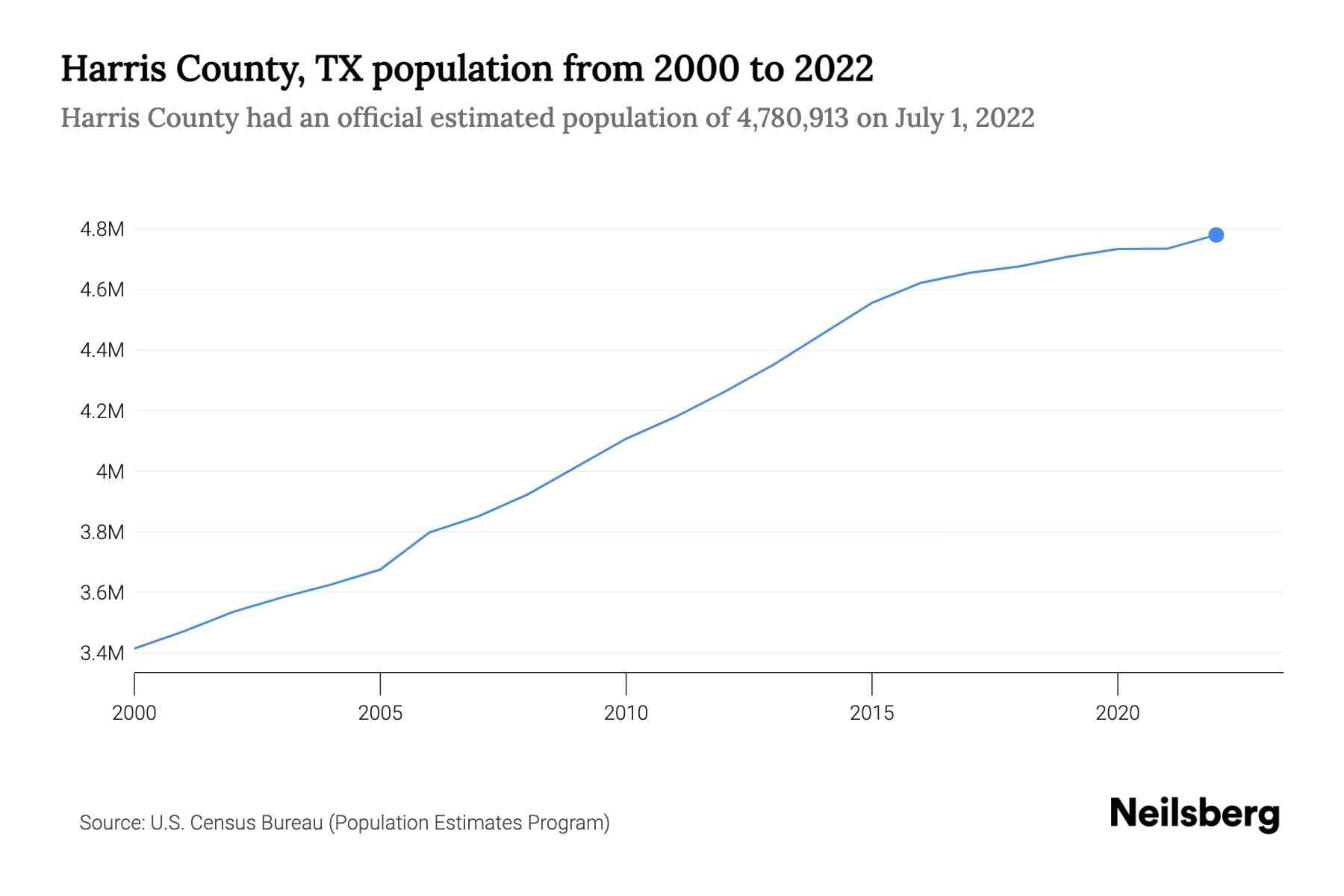
Harris County ranked first in the nation for numeric growth, adding 105,852 new residents from 2023 to 2024, according to U.S. Census Bureau estimates, a gain that nearly doubled the county's growth compared to the previous year, when it added 53,788 residents.
Harris County's 105,852 net new residents represented more than double Cook County's 40,095, making the gap between Houston's home county and its closest competitor stark. Harris County remains the third-largest county in the U.S., trailing only Los Angeles County and Cook County, but the nation's five most populous counties in 2024 were Los Angeles County at 9,757,179; Cook County at 5,182,617; and Harris County at 5,009,302. By July 2025, the county's population had crossed another threshold: Harris County surpassed 5.2 million residents in the Census Bureau's Vintage 2025 estimates.
Almost all of that growth came from international migration, according to an analysis of U.S. Census Bureau data by a fellow at Rice University's Baker Institute. Bill King, the Baker Institute's public finance fellow, calculated that 96% of the nearly 106,000 people who moved to Harris County in 2024 came from outside the United States. King pointed directly to the county's established immigrant communities as a draw: "You have a big immigrant community here. So if you're coming in and you know some people ... that got to the same place of worship or that sort of thing, it's kind of a natural place to settle," King said.

That same engine of growth now faces potential headwinds. "It would be very surprising to me if we don't see some significant impact on Harris County's growth, probably for the remainder of this administration," King said, referring to the immigration enforcement priorities of the Trump administration. King was blunt about the stakes: "Right now, if you stopped immigration, Harris County's growth would come to a screeching halt. We haven't seen that since the 1980s from Harris County."
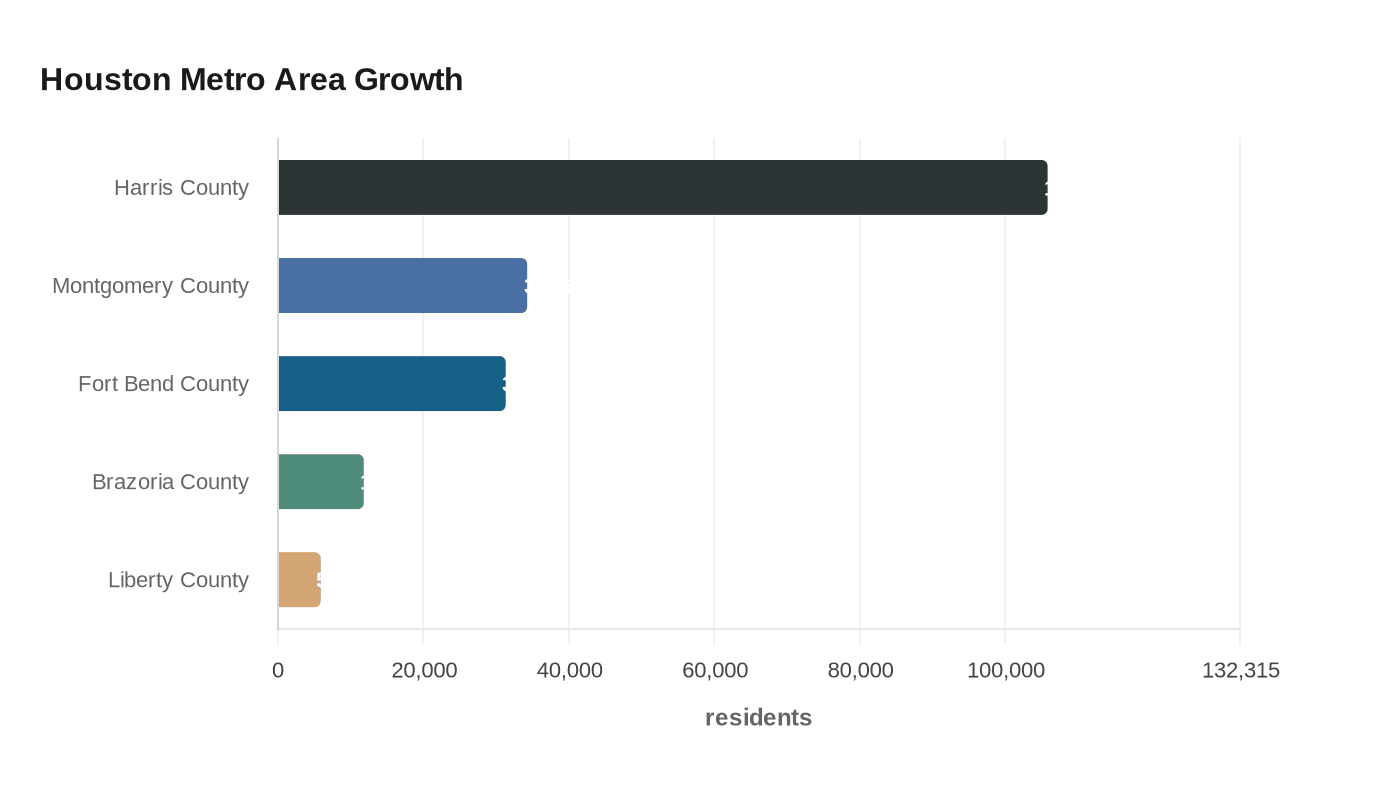
The growth extended well beyond Harris County's borders. Montgomery County grew by 4.8% after adding 34,268 new residents, placing it ninth in the nation for numeric growth and seventh for percentage growth. Montgomery County's population has now grown to 749,613 people. Liberty County saw a 5.4% increase, adding 5,870 residents, making it the sixth-fastest-growing county in the U.S. by percentage. Fort Bend County added 31,314 residents, a 3.4% increase, while Brazoria County followed with an increase of 11,802 residents. Notably, none of the nine counties that make up the Houston MSA experienced a population decline.
At the metro level, the Houston-Pasadena-The Woodlands metro area nearly led the nation as the second-fastest growing metro area in 2024, adding 198,171 residents from July 2023 to July 2024, for a total population of 7,796,182. New York-Newark-Jersey City was the only metro area to outpace Houston, adding 213,403 new residents to bring its total above 19.94 million.
Texas as a whole posted the fourth-fastest population growth rate among all states between July 2024 and July 2025, at 1.2%, and ranked second nationally for international migration over the same period, according to Census Bureau Vintage 2025 estimates. Of the state's 254 counties, 180 reported growth while 74 experienced population decline. Four Texas counties, Harris, Collin, Montgomery and Tarrant, landed in the top 10 nationally for both numeric and percentage growth, spanning the Houston and Dallas metro regions.
For the first time in decades, the U.S. immigrant population is declining, and Bill King has spoken publicly about how demographic trends and President Trump's sweeping immigration policies are shaping the nation's future labor force and economy. For Harris County, which built its record-breaking growth almost entirely on international arrivals, that shift carries consequences that extend far beyond the Census tables.
This article was produced by Prism’s automated news system from verified source data, official records, and press releases, then run through automated quality and moderation checks before publishing. The system is built and supervised by the people who set the standards it runs under. Read our full AI policy.
Did this article answer your question?