HISD reports broad STAAR gains, reading improves across all grades
HISD’s preliminary STAAR results showed gains in reading, math and high school tests, but U.S. history slipped and the scores remain under review.

Houston ISD’s latest STAAR numbers point to a districtwide rebound that reached into nearly every tested area, with reading improving across all grades and strong math gains turning up in both elementary and high school classrooms. For families across Houston and Harris County, the results offer a clearer look at whether the district’s state-led reforms are translating into student progress, campus by campus.
The strongest one-year jumps came in several key checkpoints. Eighth grade reading rose 6 percentage points, fourth grade math climbed 5 points, Biology increased 10 points, and Algebra I improved 8 points. English I and English II also moved upward, adding to a pattern the district says spans 3rd through 8th grade reading and multiple math grades.

At the high school level, HISD reported 2026 passing rates of 82% in Algebra I, 69% in English I, 94% in Biology and 71% in English II. U.S. history fell by 1 percentage point compared with last year, the clearest sign that the gains were not perfectly even across subjects. Those high school scores are still preliminary because districts can submit rescore requests, and grades 3 through 8 were scheduled to follow later in June.
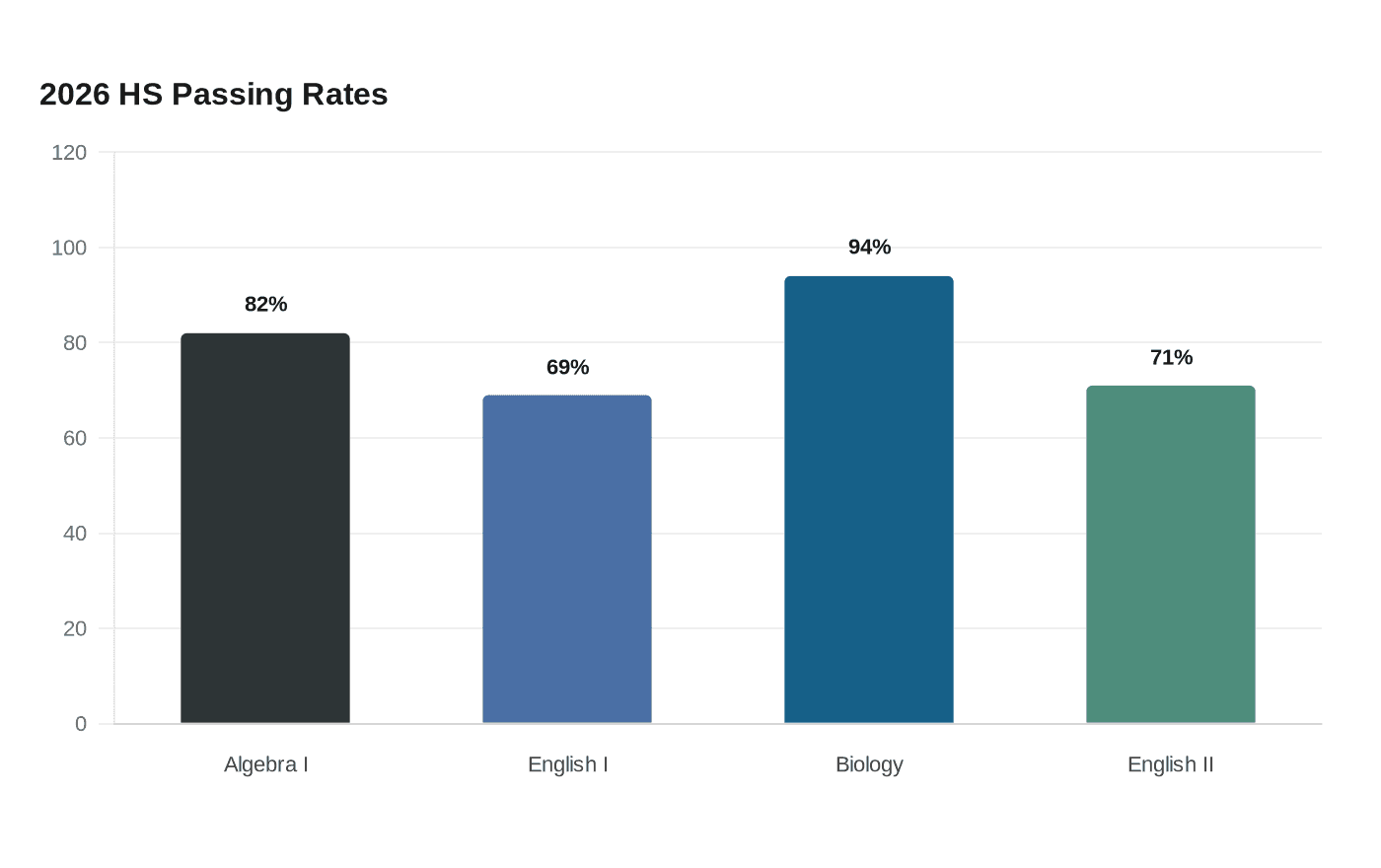
District leaders have cast the results as evidence that higher expectations and more consistent instruction are taking hold. Superintendent Mike Miles has framed the academic gains as part of a broader transformation in the 272-campus system, which serves 168,812 students, according to the Texas Tribune’s Schools Explorer, and has a student population that is 77.1% economically disadvantaged. That scale matters: even modest percentage-point changes affect thousands of children.
The state context remains hard to ignore. The Texas Education Agency placed HISD under intervention on June 1, 2023, when it appointed a superintendent and board of managers, and later extended that takeover through June 1, 2027. TEA said in 2025 that the district had made significant academic and operational progress, and HISD says 74% of campuses earned A or B ratings in the 2024-2025 accountability cycle with none receiving an F.
There is also a testing caveat that matters for the science gains. TEA said the 2026 Biology EOC was redesigned to fully assess revised science TEKS implemented in 2024, which makes direct year-to-year comparisons more complicated even as Biology posted one of the district’s biggest jumps.
Taken together, the numbers suggest improvement that is broad enough to be measurable and uneven enough to keep pressure on HISD to prove the gains are durable. For Houston parents watching a district still defined by takeover politics, staffing churn and closures, the test scores offer a concrete benchmark for whether the reforms are changing day-to-day learning.
This article was produced by Prism’s automated news system from verified source data, official records, and press releases, then run through automated quality and moderation checks before publishing. The system is built and supervised by the people who set the standards it runs under. Read our full AI policy.
Did this article answer your question?