Historic Third Ward Hospital Reborn as Community Health Hub by Juneteenth 2026
Rodney Ellis was born at Riverside General Hospital. Now he's leading a $200M effort to resurrect it as a Third Ward health hub by Juneteenth 2026.

A century after Black doctors petitioned Houston for a hospital that would treat their patients, the building those physicians fought to create is being transformed into the Riverside Health Hub, a sprawling community health complex anchored in the Third Ward and backed by more than $200 million in public and philanthropic investment.
Phase one of the two-phase restoration is on track to open to the public on Juneteenth 2026, a date that carries deliberate weight: the original hospital opened in 1926 and was dedicated on Juneteenth. That first structure was called the Houston Negro Hospital, later renamed Riverside General Hospital, and it served as both the first nonprofit hospital in Houston dedicated to Black patients and the site of the city's first school for Black nurses. It is listed on the National Register of Historic Places.
Harris County Precinct One Commissioner Rodney Ellis, who was born at Riverside General and whose sister was also born there, has made the project a signature initiative. "Like many people in this community, I have a personal tie to Riverside General Hospital," Ellis said. "I am grateful to know that its legacy will live on as we continue to expand access to healthcare for underserved communities." More than $40 million has already been spent on the restoration, and Ellis projects the total revitalization will exceed $200 million when complete.
The funding comes from multiple directions. Houston Endowment contributed $7 million. The Qatar Harvey Fund added $2.5 million, drawn from the $30 million it committed to the Houston region after Hurricane Harvey. The U.S. Department of Housing and Urban Development provided $750,000 secured by the late Congresswoman Sheila Jackson Lee. Harris County Commissioners Court, which approved the campus acquisition in 2018, authorized the broader county investment.
Phase one covers the restoration of Riverside's three historic structures: the hospital building, the nursing school, and the utility building. Architecture firms Kirksey and Harrison Kornberg led the design work. Nicola Springer, partner and managing director of Kirksey's PK-12 practice, described the condition crews found when work began. "When we got to these buildings, they were in great disrepair," Springer said. "This is a huge part of the Third Ward, the Houston community, and African American history in the entire United States." She called the project "a labor of love."
Skanska USA Building handled the renovation and announced its completion, with the facility now described as home to the Harris County Public Health Department. The renovation is targeting LEED certification and incorporates modern office space, research and development areas, and public-serving amenities. Dennis Yung, executive vice president and general manager of Skanska Texas, said the project carried meaning beyond construction. "Projects like Riverside Hospital remind us that buildings are more than structures; they carry the memories and meaning of the communities they serve," Yung said.
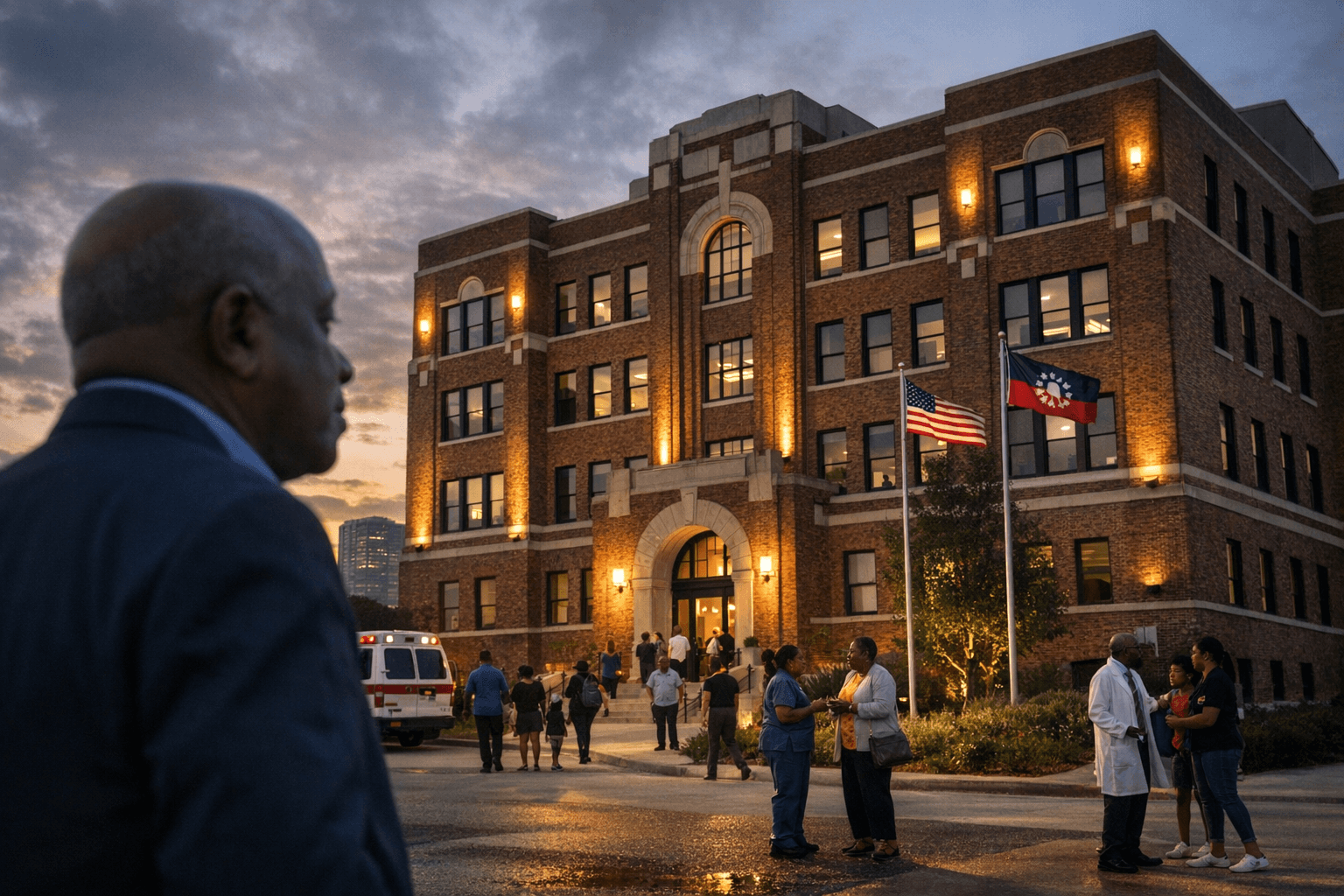
The Riverside Health Hub will not function as a traditional inpatient hospital. Instead, the complex will house multiple Harris County Precinct One programs, including ACCESS Harris County, which connects residents with transportation assistance, food and financial assistance, and housing and shelter resources. Phase two, projected at roughly $160 million, will add a new four-story headquarters for Harris County Public Health and is scheduled for completion in December 2028.
The building's road back was not straightforward. Riverside Hospital closed in 2015 after serving patients for nearly nine decades. Ellis described its final years plainly: "It had become a drug rehab center and there was some Medicaid fraud issues that led to the closure of this. It was boarded up, abandoned here for a long time." After the county's 2018 acquisition, several plans for the site were proposed but none advanced until the current health hub concept took hold.
For 92-year-old Dorothy Booker, who dedicated a decade of her life to the hospital, the revival is personal. "I'm proud to be a part of something that started in my life, advanced in my life, that I was able to help somebody," Booker said.
Ellis framed the project's ambition plainly: "This is a strategic investment to strengthen preventative care and reduce health disparities. We're restoring history while building lasting public infrastructure. A ribbon-cutting marks progress, not completion.
Know something we missed? Have a correction or additional information?
Submit a Tip