Houston Art Car Parade Returns Saturday, Drawing Thousands to Downtown
Up to 300,000 spectators packed Allen Parkway for Houston's 39th Art Car Parade Saturday as 250 decorated vehicles circled City Hall.
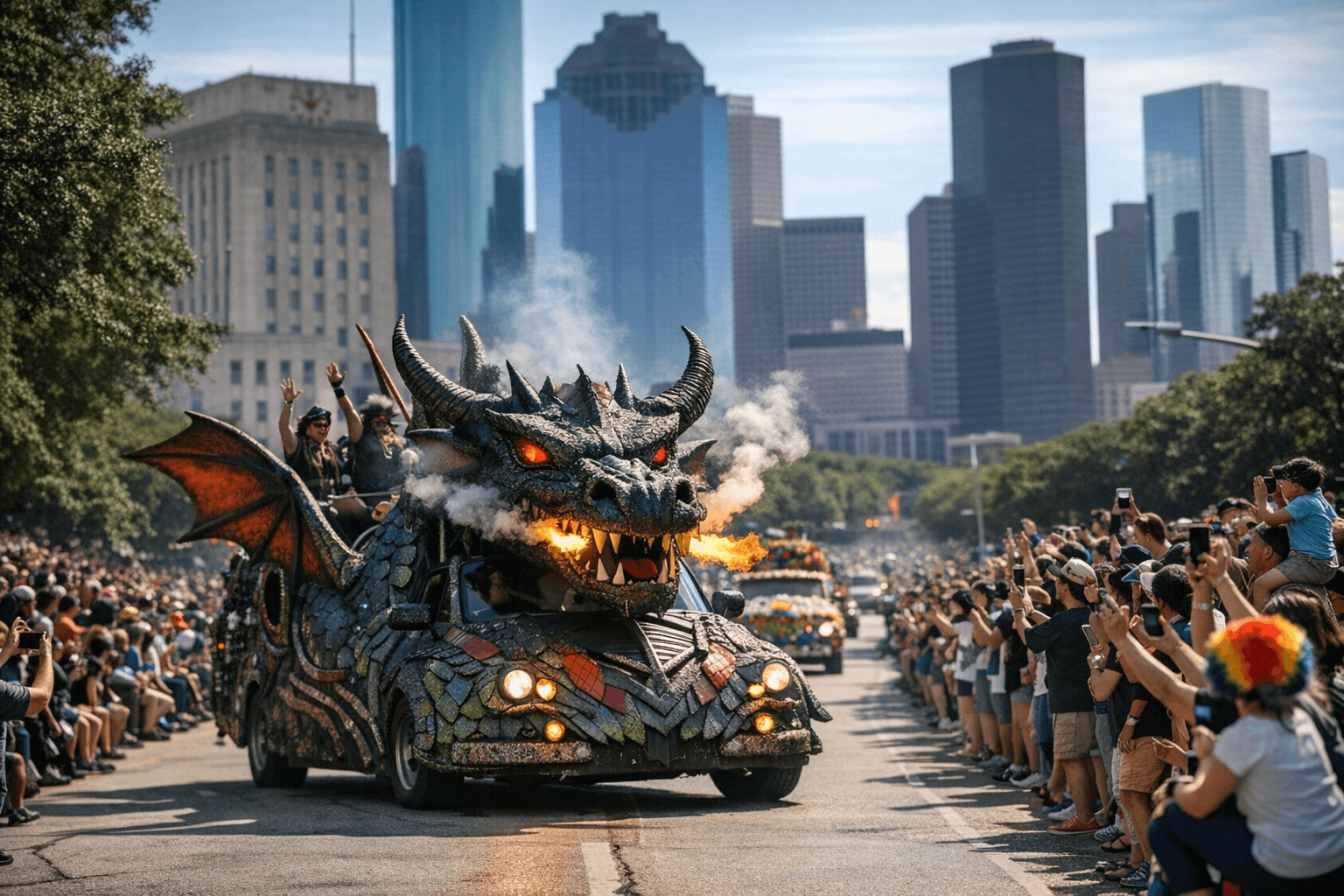
Up to 300,000 people lined Allen Parkway and downtown Houston's streets Saturday as 250 rolling masterpieces, from welded sculptures to fire-breathing contraptions, wound their way from Bagby Street through the city's core, circling City Hall before dispersing at Waugh Drive in the Orange Show Center for Visionary Art's 39th annual Art Car Parade, presented by Team Gillman.
The parade rolled at 2 p.m., but the best viewing window opened three hours earlier. The Lineup Party ran from 11 a.m. along Allen Parkway between Taft and Bagby streets, where all 250 entries sat stationary and accessible before the procession moved, giving early arrivals direct access to artists and their builds. Simultaneously, the Kids Creative Zone in Sam Houston Park opened free to families, with performances and hands-on activities along the route. Reserved grandstand seats at Heritage Society and VIPit Party tickets at Hermann Square, directly in front of City Hall, offered elevated views; VIPit pricing ranged from $250 to $6,000. Street closures swept across the area starting at 7 a.m. and locked down downtown by 1 p.m., with free and paid parking available along the route and, for northbound I-45 drivers, off exit 48A onto Milam Street between Pease and Walker.
Phillip Pyle II, a Houston visual artist, graphic designer, and photographer, served as the parade's 2026 Featured Artist, one of the most visible roles in an event that distributed more than $16,000 in prize awards to competing builders, judged on creativity, artistic technique, and the story behind each build.
The four-day festival began Thursday morning when roughly 100 art cars fanned across the city on the Main Street Drag, rolling through hospitals, nursing homes, and schools for residents who couldn't make it downtown. On Friday evening, the Art Car Sneak Peek brought nearly 100 cars to Discovery Green and Avenida Houston from 6 to 10 p.m. for close-up viewing and artist conversations before the ticketed Art Car Ball turned downtown into an after-dark spectacle of illuminated and fire-breathing vehicles.
The parade traces to 1984, when Houston artist Jackie Harris transformed a 1967 Ford station wagon, donated by Kit and Carl Detering to the Orange Show Foundation, into the first art car: the Fruitmobile. That car was auctioned at the foundation's gala, purchased, and donated back, quickly inspiring other builders to follow. What grew from that single decorated wagon now draws entries from schools, civic groups, and independent artists across the globe, cementing Houston's claim to what organizers call the world's largest gathering of art cars.
The Orange Show Center for Visionary Art keeps the parade free through its ticketed fundraisers. The VIPit benefit and reserved seating revenue underwrites the community programming, including the Main Street Drag's outreach to facilities whose residents cannot travel downtown, a model the foundation has sustained across nearly four decades and one that continues to define how a street festival can scale without pricing out the neighborhood that built it.
SUMMARY: Up to 300,000 spectators packed Allen Parkway for Houston's 39th Art Car Parade Saturday as 250 decorated vehicles circled City Hall.
CONTENT:
Up to 300,000 people lined Allen Parkway and downtown Houston's streets Saturday as 250 rolling masterpieces, from welded sculptures to fire-breathing contraptions, wound their way from Bagby Street through the city's core, circling City Hall before dispersing at Waugh Drive in the Orange Show Center for Visionary Art's 39th annual Art Car Parade, presented by Team Gillman.
The parade rolled at 2 p.m., but the best viewing window opened three hours earlier. The Lineup Party ran from 11 a.m. along Allen Parkway between Taft and Bagby streets, where all 250 entries sat stationary and accessible before the procession moved, giving early arrivals direct access to artists and their builds. Simultaneously, the Kids Creative Zone in Sam Houston Park opened free to families, with performances and hands-on activities along the route. Reserved grandstand seats at Heritage Society and VIPit Party tickets at Hermann Square, directly in front of City Hall, offered elevated views; VIPit pricing ranged from $250 to $6,000. Street closures swept across the area starting at 7 a.m. and locked down downtown by 1 p.m., with free and paid parking available along the route and, for northbound I-45 drivers, off exit 48A onto Milam Street between Pease and Walker.
Phillip Pyle II, a Houston visual artist, graphic designer, and photographer, served as the parade's 2026 Featured Artist, one of the most visible roles in an event that distributed more than $16,000 in prize awards to competing builders, judged on creativity, artistic technique, and the story behind each build.
The four-day festival began Thursday morning when roughly 100 art cars fanned across the city on the Main Street Drag, rolling through hospitals, nursing homes, and schools for residents who couldn't make it downtown. On Friday evening, the Art Car Sneak Peek brought nearly 100 cars to Discovery Green and Avenida Houston from 6 to 10 p.m. for close-up viewing and artist conversations before the ticketed Art Car Ball turned downtown into an after-dark spectacle of illuminated and fire-breathing vehicles.
The parade traces to 1984, when Houston artist Jackie Harris transformed a 1967 Ford station wagon, donated by Kit and Carl Detering to the Orange Show Foundation, into the first art car: the Fruitmobile. That car was auctioned at the foundation's gala, purchased, and donated back, quickly inspiring other builders to follow. What grew from that single decorated wagon now draws entries from schools, civic groups, and independent artists across the globe, cementing Houston's claim to what organizers call the world's largest gathering of art cars.
The Orange Show Center for Visionary Art keeps the parade free through its ticketed fundraisers. The VIPit benefit and reserved seating revenue underwrites the community programming, including the Main Street Drag's outreach to facilities whose residents cannot travel downtown, a model the foundation has sustained across nearly four decades and one that continues to define how a street festival can scale without pricing out the neighborhood that built it.
This article was produced by Prism’s automated news system from verified source data, official records, and press releases, then run through automated quality and moderation checks before publishing. The system is built and supervised by the people who set the standards it runs under. Read our full AI policy.
Did this article answer your question?