Texas Supreme Court blocks Harris County immigrant legal fund temporarily
County payments to five immigrant legal aid groups are on hold, leaving detention and deportation defense in limbo as the court weighs Texas’ challenge.
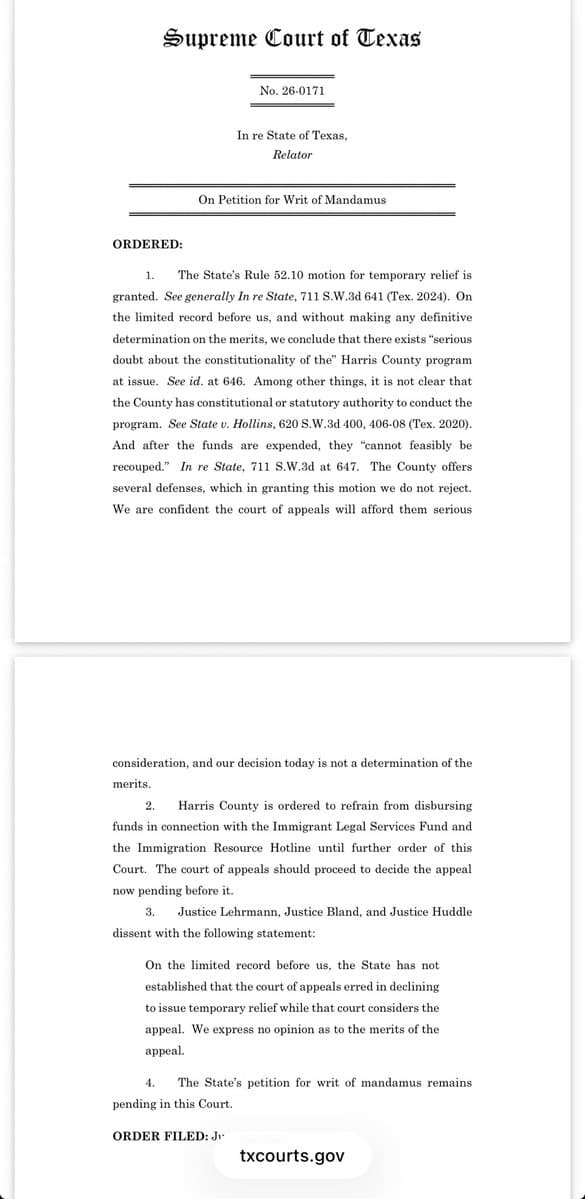
The Texas Supreme Court temporarily stopped Harris County from using taxpayer money to pay for legal fights on behalf of undocumented immigrants facing deportation, freezing county payments to five legal-aid groups while the state’s challenge moves forward.
The order puts on hold the Immigrant Legal Services Fund, a county program created in 2020 and later expanded by another $1.3 million in October 2025. That money is directed to BakerRipley, the Galveston-Houston Immigrant Representation Project, Justice for All Immigrants, KIND, Inc. and the Refugee and Immigrant Center for Education and Legal Service, all of which have handled legal aid tied to detention and deportation defense.

The fund was meant to strengthen due process and help keep families together. At the time the program began, Harris County was the largest county in the country without a program aimed at helping undocumented immigrants get legal counsel. The county created the fund under a 2020 plan pushed by Harris County Judge Lina Hidalgo, and county leaders later defended the arrangement as a public service in a county that includes Houston and is the nation’s largest by population.

Attorney General Ken Paxton has argued the program serves no public purpose and amounts to an unconstitutional grant of public funds. County Attorney Christian Menefee called Paxton’s lawsuit a “cheap political stunt designed to score headlines.” Gov. Greg Abbott filed an amicus brief backing Paxton’s legal position, but also criticized the pace of the case, saying Harris County had operated the fund for five years before Paxton sued.

The Fifteenth Court of Appeals rejected Paxton’s bid to shut the program down, saying he had not shown that it caused actual harm to Harris County residents or to the state. A similar challenge had already failed in a Harris County district court. The appeals court also found the program had operated for nearly five years without apparent objection or controversy.
This article was produced by Prism’s automated news system from verified source data, official records, and press releases, then run through automated quality and moderation checks before publishing. The system is built and supervised by the people who set the standards it runs under. Read our full AI policy.
Know something we missed? Have a correction or additional information?
Submit a Tip