Brooksville courthouse hill still defines downtown Hernando County
Courthouse hill is still Brooksville’s civic center, where county government, downtown commerce and public ritual meet under the oaks.
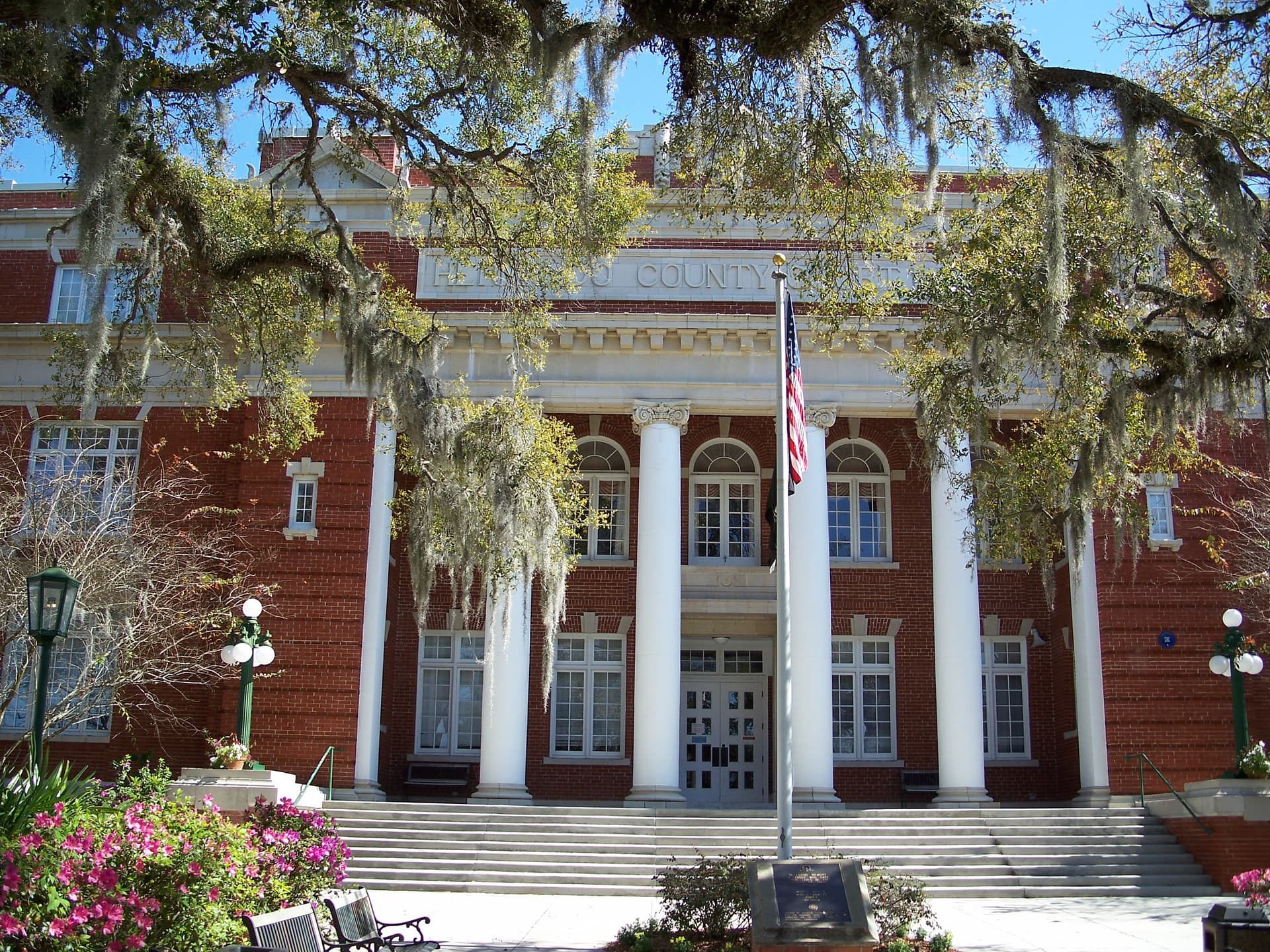
At 20 North Main Street, Brooksville still gathers around the same hill that has anchored Hernando County life for more than a century. The 1913 courthouse sits under live oaks at the crest of downtown, and the streets around it still channel county business, visitor traffic and civic identity into one compact block.
Courthouse hill as downtown’s compass
Downtown Brooksville is not arranged like a wide, spread-out commercial district. It is concentrated around the courthouse hill, where the county’s main public building sits above Main Street and gives the center of town a clear focal point. The city’s redevelopment plan describes downtown as the geographic center of Hernando County and a historic civic and commercial hub, which is exactly how the hill functions today: as both a meeting point and a reference point.
That role is visible in daily movement. People come to the hill for county business, court activity, meetings and errands, then spill into the surrounding blocks that still hold shops, offices and services. The courthouse does not just sit in downtown Brooksville, it organizes it, shaping where people park, where they walk and where they linger before or after handling business.
The Florida Department of State’s Main Street materials also place the courthouse at the center of Brooksville’s public image. Brooksville Main Street was recognized as Florida Main Street Community of the Month in 2018 for downtown preservation work, a sign that the city’s historic core is not treated as a museum piece but as an active place where preservation and everyday use still overlap.
From a moving county seat to a fixed civic center
Hernando County was created in 1843 and was known as Benton County for a period, but its government did not settle quickly. The county seat moved through Newnansville, DeSoto, Bayport and Pierceville before finally landing in Brooksville, which helps explain why courthouse hill carries so much symbolic weight. Brooksville was not chosen as a decorative backdrop; it became the place where county authority finally took root.
The earliest courthouse in Brooksville was not a formal civic building at all. It operated out of Major Isaac Garrison’s home, then Joseph Hale donated land for a wooden courthouse in 1855. That building burned in 1877, a reminder that the county’s public life was still vulnerable and unsettled, and a second wooden courthouse followed in 1878 before the current building opened in 1913.
The courthouse that stands now was designed by William Augustus Edwards in the Beaux-Arts style, giving the hill the architectural presence that earlier wooden structures lacked. Edwards also designed many of the University of Florida’s original buildings, which places Brooksville’s county seat within a broader Florida architectural legacy. The building’s date, style and location combine to make it more than a landmark. It is the point at which Hernando County’s long movement toward permanence became visible.
The building still works as a seat of government
The courthouse is not an unused monument. It stands at 20 North Main Street, and county commissioners still meet in the Government Center there, specifically in the John Law Ayers room on the first floor. That matters because it keeps public authority on the same hill that helped define the town’s commercial core, rather than pushing county government out to an edge of town.

Recent renovation work has reinforced that role. In 2022, Hernando County announced upgrades to the judicial center in Brooksville that included expanding courtrooms, enhancing security, creating a new entrance and lobby, and adding seven ADA parking spaces. Those changes show that the courthouse complex is still being adapted for modern use, with public access, safety and mobility all built into the continuing life of the site.
That ongoing activity shapes the neighborhood around it. Court users, commissioners, employees, lawyers and residents all arrive at the same block, which keeps downtown Brooksville in a constant rhythm of arrivals, departures and short stops on Main Street. The courthouse hill still pulls government, traffic and commerce into one shared space.
Why the courthouse survived the 1970s
The strongest argument for courthouse hill is not just history, but the decision to keep it intact. In the 1970s, county leaders considered razing and replacing the 1913 courthouse, but residents pushed back hard enough that a referendum saved the building and an annex was built instead. That choice preserved the physical center of downtown and prevented Hernando County from losing the building that many people had already come to see as the symbol of Brooksville itself.
One resident described the courthouse as “the Brooksville crown” and warned that without it the city would be “a headless torso.” The language is vivid because it captures what the building meant in practical terms. Remove the courthouse and the town would not simply lose a handsome structure, it would lose the civic anchor that makes the rest of downtown legible.
The preservation structure around the building is still active. Brooksville’s Historic Preservation program includes design guidelines and structure surveys, which means the courthouse sits inside a broader local effort to manage change without erasing the city’s historic shape. In that context, the 1913 courthouse is not frozen in time. It is the standard against which downtown change is still measured.
A public square that still gathers people
Brooksville Main Street has continued to use the courthouse hill as a gathering place, including holiday programming built around a 30-foot tree placed at the courthouse. That kind of event matters because it shows the building works not only for government, but for civic ritual and public memory. The same hill where commissioners meet also becomes the place where the community marks seasons, welcomes visitors and stages downtown life.
The courthouse hill also fits Brooksville’s larger identity as a destination within Central-West Florida. The city’s redevelopment materials say downtown has long drawn both residents and visitors, supported by Brooksville’s access to key transportation corridors. In practice, that means the courthouse is not isolated from daily life. It sits where government, business and neighborhood routines meet, and it gives downtown Brooksville a center that still feels unmistakably local.
That is why the 1913 courthouse remains more than a preserved building. It is the map point, meeting point and memory point for Hernando County, and downtown Brooksville still turns around it every day.
This article was produced by Prism’s automated news system from verified source data, official records, and press releases, then run through automated quality and moderation checks before publishing. The system is built and supervised by the people who set the standards it runs under. Read our full AI policy.
Did this article answer your question?