Hernando County Watches as Artemis II Prepares First Crewed Moon Mission
NASA rolled the Artemis II rocket to Launch Complex 39B as it prepares a Feb. 6 launch, a historic crewed Moon mission Hernando County residents may travel to see.
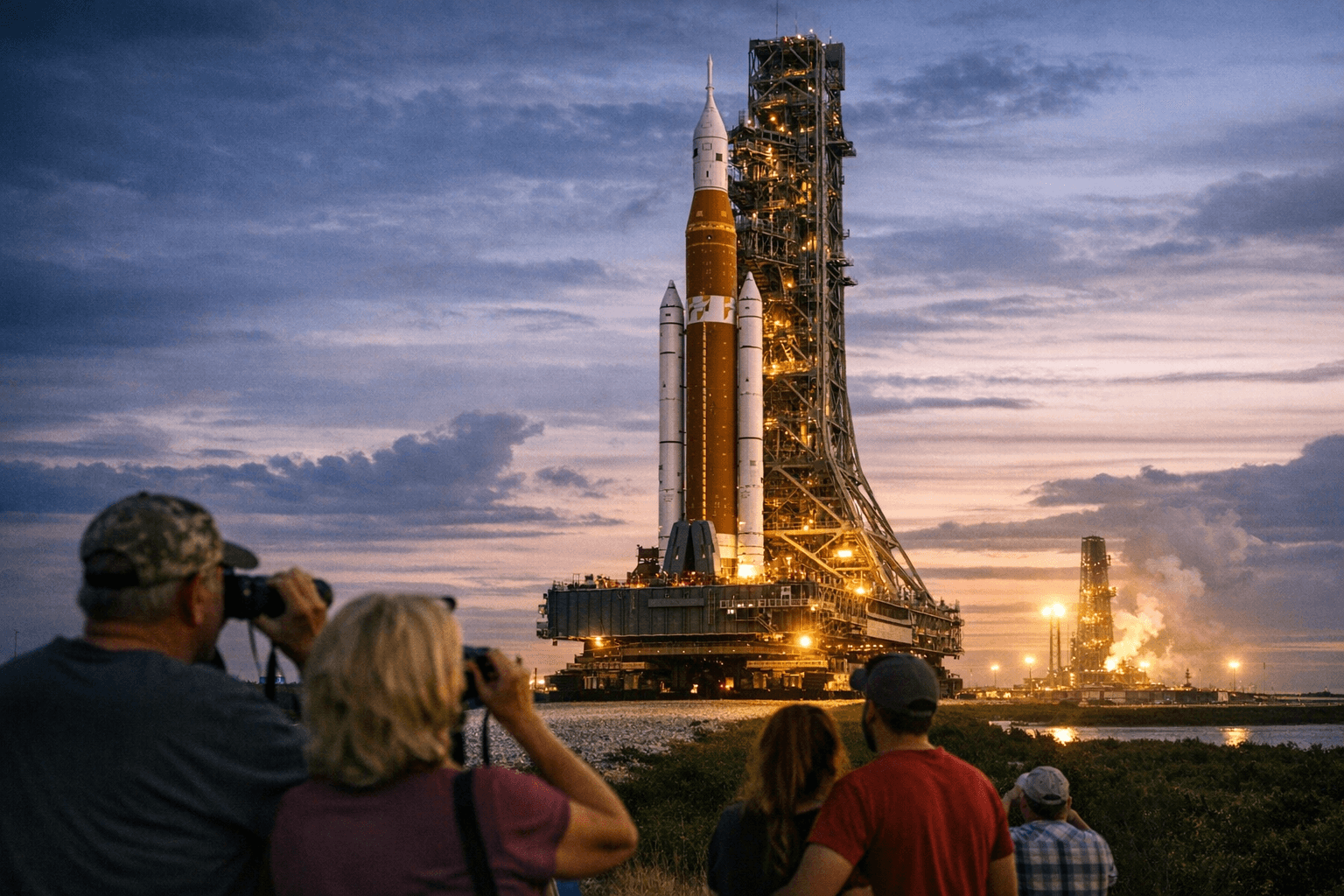
NASA completed a high-profile rollout of the Artemis II Orion spacecraft and its Space Launch System booster to Launch Complex 39B, stepping closer to the first crewed lunar flight in more than 50 years. The move underscored planning that will culminate in a mission targeted no earlier than Feb. 6, a milestone with both local and global significance.
On Jan. 17, the Orion stack emerged from the Vehicle Assembly Building and rode NASA’s crawler for a 12-hour, four-mile transfer to Pad 39B. The rollout put a 322-foot-tall SLS rocket - capable of more than 8.8 million pounds of thrust at liftoff - on public display and marked the first time astronauts will ride atop the SLS. The Artemis II crew of Commander Reid Wiseman, Pilot Victor Glover, Mission Specialist Christina Koch, and Canadian astronaut Jeremy Hansen will embark on a roughly 10-day flight that will loop the Moon and return to Earth.
Artemis II will test the systems required for sustained human operations beyond low Earth orbit. The Orion spacecraft and crew will pass roughly 4,700 miles beyond the far side of the Moon, farther from Earth than any humans have traveled since the Apollo era. The mission echoes Apollo 8 in concept but uses modern systems and decades of operational lessons to validate deep-space transport ahead of a planned crewed lunar landing in 2028 and eventual construction of a sustained outpost near the lunar south pole.
The crew brings a blend of experience and firsts. Reid Wiseman is a Navy test pilot and veteran who logged nearly 165 days in space and more than 5,000 flight hours. Victor Glover flew as pilot of SpaceX Crew-1 and spent 168 days in orbit, with more than 3,000 flight hours and 400 carrier landings. Christina Koch holds the record for the longest single spaceflight by a woman at 328 consecutive days and brings electrical engineering and extensive spacewalking experience. Jeremy Hansen will make his first spaceflight and become the first Canadian to travel to the Moon, reflecting international cooperation in the Artemis program.
For Hernando County residents, the rollout and pending launch are immediate reasons to plan. Kennedy Space Center is offering a limited number of tours that allow up-close viewing of Artemis II, though those opportunities come with a substantial admission price. A more economical viewing option is Playa Linda Beach at Cape Canaveral National Seashore. The National Park Service set Playa Linda District hours at 8 a.m.-5 p.m. through Feb. 1. From Feb. 2 through Feb. 8, or until the day of a successful launch, the entire Playa Linda District will be closed; regular hours of 6 a.m.-6 p.m. will resume the day after Artemis II launches successfully.
Beyond tourism, the mission casts attention on Florida’s role in spaceflight and on opportunities for local schools, museums, and businesses to connect with a renewed era of exploration. Artemis II is a test flight that will shape missions to come, including plans for habitats, rovers, power systems, and a nuclear power station targeted by 2030 to support longer lunar stays.
Hernando County residents who want to see the rocket in person should consider travel logistics and park closures, and follow Kennedy Space Center announcements for tour availability. As Artemis II prepares for launch, the local community can watch a global endeavor unfold that promises to reshape human presence in deep space.
This article was produced by Prism’s automated news system from verified source data, official records, and press releases, then run through automated quality and moderation checks before publishing. The system is built and supervised by the people who set the standards it runs under. Read our full AI policy.
Did this article answer your question?