BLM Modifies Bootheel Fences to Restore Pronghorn Migration Corridors
BLM crews are modifying fence segments north of Lordsburg, raising bottom wires to 16 inches to let pronghorn pass beneath barriers that have fragmented Bootheel migration routes.
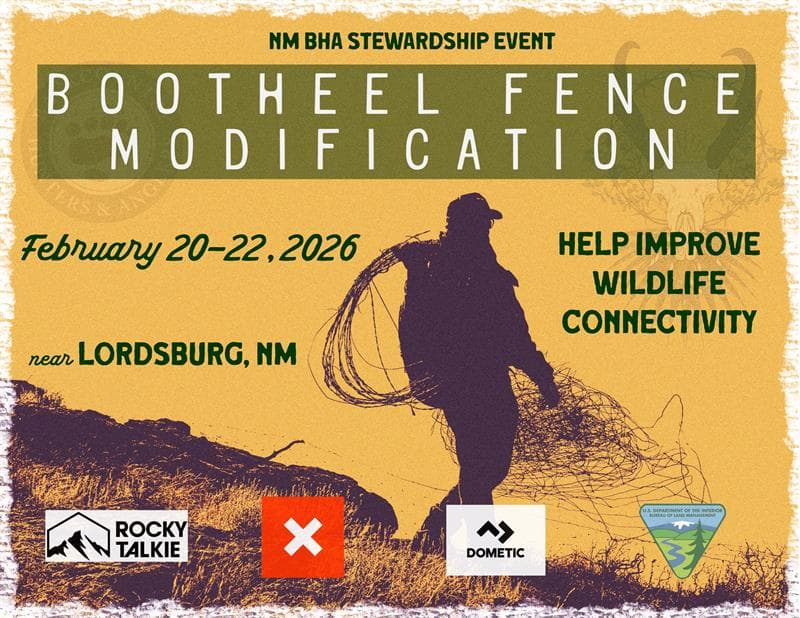
The Bureau of Land Management's Las Cruces field office is converting bottom fence wires to smooth wire positioned 16 inches above ground across targeted segments of Bootheel rangeland north of Lordsburg, opening migration corridors that GPS collar data identified as chokepoints for pronghorn herds.
The modification technique is deliberately low-cost: rather than removing fences entirely, crews raise or replace the lowest strand of existing wire to allow pronghorn, which pass under rather than over obstacles, to cross barriers that would otherwise be impassable. The approach preserves the stock-control function ranchers depend on while eliminating the fragmentation that has disrupted seasonal movement across the Bootheel's desert grasslands and sky-island uplands.
Priority segments are selected through a combination of GPS collar telemetry, documented movement bottlenecks, and community input, meaning modifications are concentrated where ecological return is highest. Conservation organizations and volunteer crews, including Backcountry Hunters & Anglers members who participated in a February 20 work event near Lordsburg, have been directly involved in physical implementation.
The Bootheel sits at the intersection of several distinct ecological zones, where Chihuahuan Desert grassland transitions toward the sky-island mountain ranges that define the region's western horizon. Pronghorn require broad, unobstructed ranges to complete seasonal migrations, and fences that impede that movement carry downstream consequences: disrupted herd dynamics, reduced access to forage and water, and heightened exposure to vehicle strikes on rural highways as animals are forced into unfamiliar routes.

Those corridor improvements carry practical implications for Hidalgo County roadways that bisect known movement zones. Restoring established pathways can reduce animal-vehicle collision frequency over time as herds return to routes they used before fragmentation cut them off.
The project also reflects a cross-jurisdictional coordination model that has become increasingly necessary in the Bootheel: BLM working alongside state wildlife agencies, conservation groups, and private landowners to address landscape-scale problems that no single entity controls. In Hidalgo County, where land ownership is divided among federal, state, and private parcels, that alignment is a prerequisite for any meaningful conservation outcome.
Public notices and BLM project announcements have been circulating since early 2026, and the Las Cruces field office continues to accept community input on future project phases. The Bootheel has long functioned as a natural corridor between the Chihuahuan Desert and the sky-island ranges to the west; these fence modifications are designed to keep it working as one.
This article was produced by Prism’s automated news system from verified source data, official records, and press releases, then run through automated quality and moderation checks before publishing. The system is built and supervised by the people who set the standards it runs under. Read our full AI policy.
Did this article answer your question?