Federal Partnership Funds Rancher Efforts to Deter Mexican Gray Wolves
A federal public private partnership will make millions available in 2026 to help ranchers in southwest New Mexico and Arizona adopt range riders and other deterrents to reduce wolf depredations on cattle. Hidalgo County is not included in the initial funding area, a concern for local ranchers as Mexican gray wolves move north from Mexico and into nearby Cochise County.
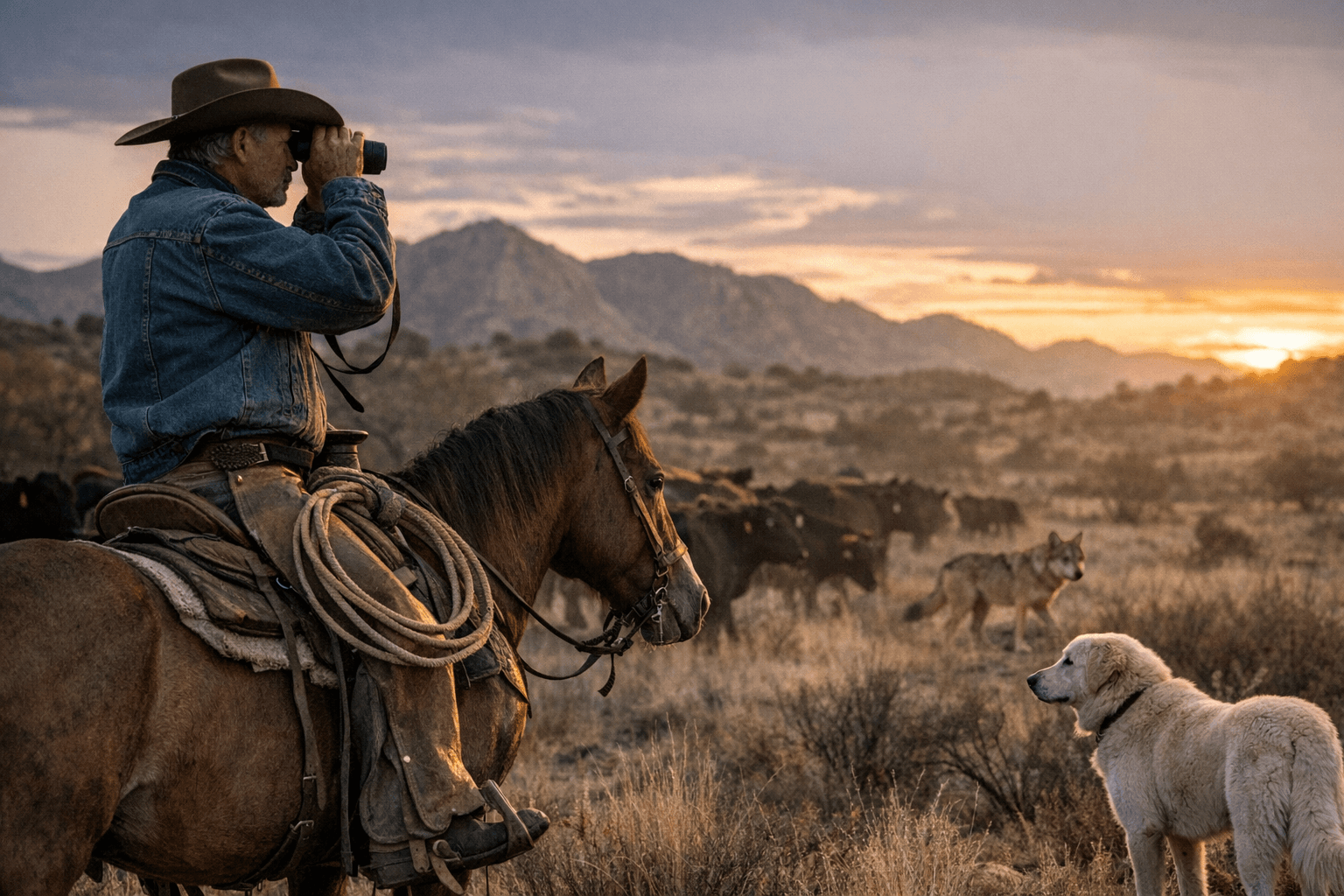
A three year predator mitigation project backed by a federal public private partnership will provide funding to help ranchers in parts of southwest New Mexico and Arizona pay for range riders and other deterrents aimed at reducing Mexican gray wolf depredations. The program was outlined to the Grant County Soil and Water Conservation District board on December 15 at the National Resources Conservation Service office in Silver City by Sisto Hernandez, southwest resource coordinator for the Western Landowners Alliance.
The Western Landowners Alliance, a Denver based nonprofit that works to sustain working lands, landscapes and native species, helped drive development of the mitigation program with its members in eastern Arizona and western New Mexico. Dusty Glidewell, regional RCPP director with the NRCS, participated by phone and said the agency seeks projects that address priority resource concerns and are innovative. “We look for things that are addressing our priority resource concerns and that are innovative,” she said.
The three year project will make five million dollars available to ranchers in Grant, Catron, Sierra, Cibola and McKinley counties in New Mexico, with an additional set of five counties in Arizona also covered. Funding by year will be one point five million dollars in each state in the first year, nine hundred fifty thousand dollars in each state in the second year, and fifty thousand dollars in each state in the third year. The deadline to apply is January 15, and the Western Landowners Alliance plans an informational webinar early in January. Hernandez said local NRCS offices may not yet have program materials but that information should be distributed soon.
The funding is designed to cover about seventy five percent of the cost of two deterrent approaches, turbo fladry and range riding. Turbo fladry is fencing that is electrified or has bright red flags, while range riding places people on the landscape to monitor and deter predators. Hernandez emphasized range riding as likely the most effective option for the Southwest given terrain and ranch size. “Range riding, of all the conflict prevention practices, seems to be the one that … has the better likelihood of having success, just given the topography and ecology of the Southwest,” he said.
Hernandez, who served as the rangeland management specialist for the White Mountain Apache and is vice president of the Grasshopper Livestock Association, said the alliance supports prevention, compensation, control including lethal methods when necessary, and collaboration. He described past success using range riders drawn from outdoorsmen and hunters who were trained to monitor cattle and document causes of losses, reducing depredations to a minimum when he ran the program. “When I was still working for the tribe and running that program, we got the depredations down to a minimum,” he said.
Hidalgo County ranchers will be watching closely, although the county was not included in the initial funding area despite recent increases in Mexican gray wolf activity moving north from Mexico. Hernandez noted that Socorro County was likewise left out even as it has become the second most confirmed area for wolf depredations in the state. “Unfortunately, Socorro County got left out of this, and in the time it took to get this going, now Socorro’s taken over as the second-most confirmed [wolf] depredations in the state,” he said.
The program is not presented as a universal fix. “It’s not meant to be a silver bullet,” Hernandez said. “If there’s anything out there that has a chance, this might. It might work for this rancher and then the neighbor, maybe it doesn’t work there. But at least you have the opportunity to find out, and the financial support to be able to do that.” Hidalgo County ranchers who face increasing wolf presence should contact their local NRCS office for updates and watch for the Western Landowners Alliance webinar in early January.
This article was produced by Prism’s automated news system from verified source data, official records, and press releases, then run through automated quality and moderation checks before publishing. The system is built and supervised by the people who set the standards it runs under. Read our full AI policy.
Did this article answer your question?