Hidalgo County courthouse stands as historic heart of Lordsburg
Lordsburg’s courthouse still handles county business daily, anchoring a county of 4,894 spread across 3,445.63 square miles. Its preservation matters because it still works.
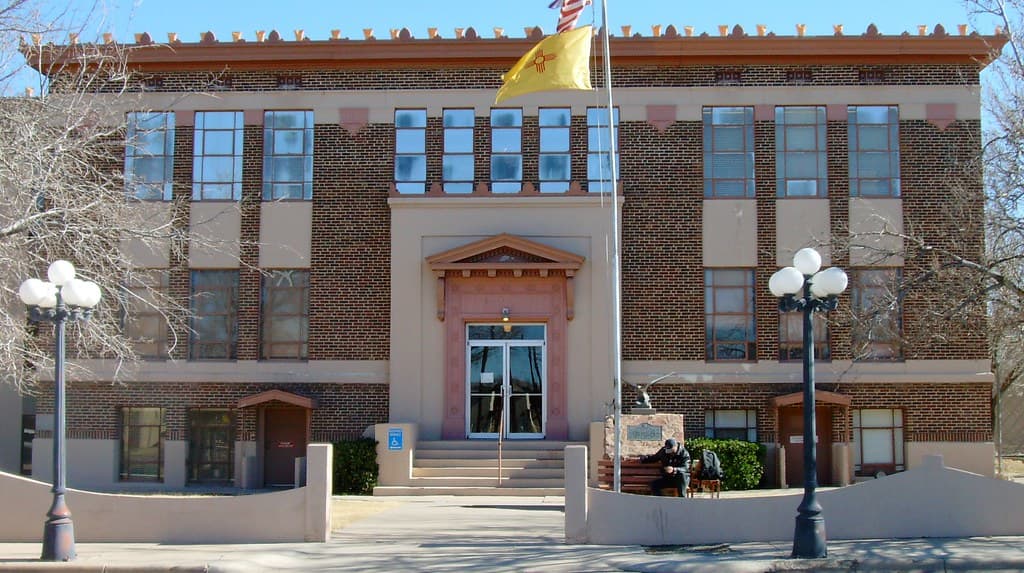
At 300 S. Shakespeare St., the Hidalgo County courthouse still organizes public life in a county so spread out that one building carries the weight of several offices, records, and daily errands. Residents come here for the clerk, treasurer, and assessor, while the building’s place in downtown Lordsburg keeps county government visible in the middle of town rather than tucked away on the edge.
A courthouse built for a new county
Hidalgo County was formed from Grant County in 1919, with Lordsburg chosen as the county seat, and the county was named in honor of Miguel Dolores Hidalgo. New Mexico law establishing the county made that civic arrangement explicit: the county seat was to be at Lordsburg, and the county commissioners were to choose sites for the courthouse, jail, and other public buildings. The courthouse that rose a few years later became the physical expression of that founding plan.
The building was constructed in 1926, when Hidalgo County was still defining itself as a separate jurisdiction. Its dark red brick Classical Revival form, set on Shakespeare Street between 3rd and 4th streets, gives the county seat a fixed address for records, meetings, and routine public business. Designed by Thurman and Fraser and later enlarged in 1978, it shows how a government building can keep adapting without losing the role it was built to serve.
What happens inside matters as much as what it looks like
The courthouse remains an active government building, not a preserved shell. County offices there include the clerk, treasurer, and assessor, and the county says those courthouse offices operate Monday through Thursday from 7:30 a.m. to 5:30 p.m. The clerk’s office is also open on the last Friday of the month, except holidays, which gives the building a rhythm of public use that reaches beyond a single weekday schedule.

That practical routine matters in a county with only 4,894 people across 3,445.63 square miles, or about 1.4 persons per square mile. In a place that sparse, one courthouse has to do the work of a much larger civic network, concentrating business that would be spread across multiple sites in a denser county. The building is where residents turn for the kind of administrative tasks that keep land ownership, taxation, and local government moving.
The county clerk’s office also links the courthouse to election integrity and public access to services, which makes the building part of the democratic machinery of the county as well as its paperwork center. That dual function is what gives the courthouse its present-day importance: it is both a landmark and a working desk for local government.
Why the location still shapes Lordsburg
The courthouse stands in Lordsburg, a town whose story stretches back to 1880, when the Southern Pacific Railroad came through from the west. Lordsburg later became an important freight and highway stop, and that transportation history explains why the county seat feels tied to movement, commerce, and public administration all at once. The courthouse sits in the path of that older town pattern, where rail, road, and government have long overlapped.
That setting gives the building a broader civic reach than its footprint suggests. A courthouse in a county seat with a small population and wide geography becomes more than an office block: it becomes the place where the county presents itself to the public, where decisions are recorded, and where the community’s official life stays anchored in one recognizable corner of town. In Lordsburg, that anchor has remained on Shakespeare Street for decades.
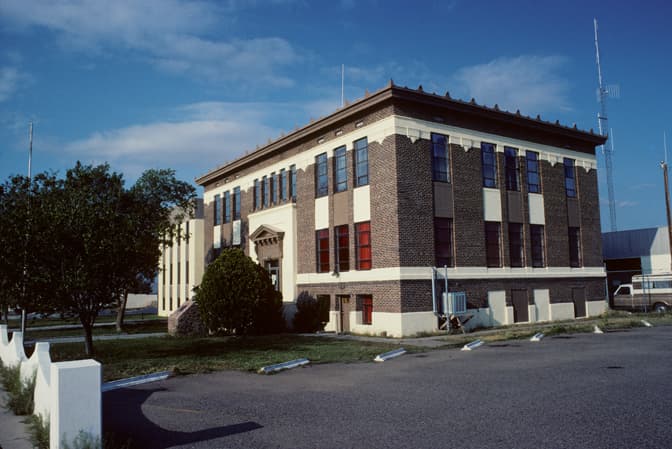
The courthouse grounds add to that sense of continuity. Veteran memorials on the site and the later addition of a county administration building show that the area has grown into a civic campus rather than a frozen historic district. The county’s public life has expanded around the courthouse, but the old building still sits at the center of it.
Historic status, but with a working purpose
The courthouse received state and federal recognition as a historic place while continuing to function as government property. It was added to the New Mexico State Register of Cultural Properties on May 9, 1986, and listed on the National Register of Historic Places on December 7, 1987. That kind of recognition matters because it confirms that the building’s value is not only local nostalgia but documented architectural and civic significance.
The National Register nomination describes the courthouse as a competent, if simple, Neo-Classical design and one of the best-designed historic public buildings in Lordsburg. That assessment helps explain why the structure matters to preservation efforts today: it is not simply old, but judged to be an accomplished public building within the town’s architectural record. Its red brick, classical lines, and long service life give Hidalgo County a courthouse that is both recognizable and substantial.
Preservation carries extra weight here because the building still carries real local use. A courthouse that continues to house core county offices cannot be treated like a museum piece; it has to remain functional, accessible, and ready for the daily work of local government. In Hidalgo County, that means the historic heart of Lordsburg is still beating in the same building where county business has been concentrated since the county’s early years.
This article was produced by Prism’s automated news system from verified source data, official records, and press releases, then run through automated quality and moderation checks before publishing. The system is built and supervised by the people who set the standards it runs under. Read our full AI policy.
Did this article answer your question?