Playas, Hidalgo County town reborn as training center for responders
Playas turned a closed smelter town into a 640-acre training ground, giving Hidalgo County a place for responder drills, testing and large exercises.
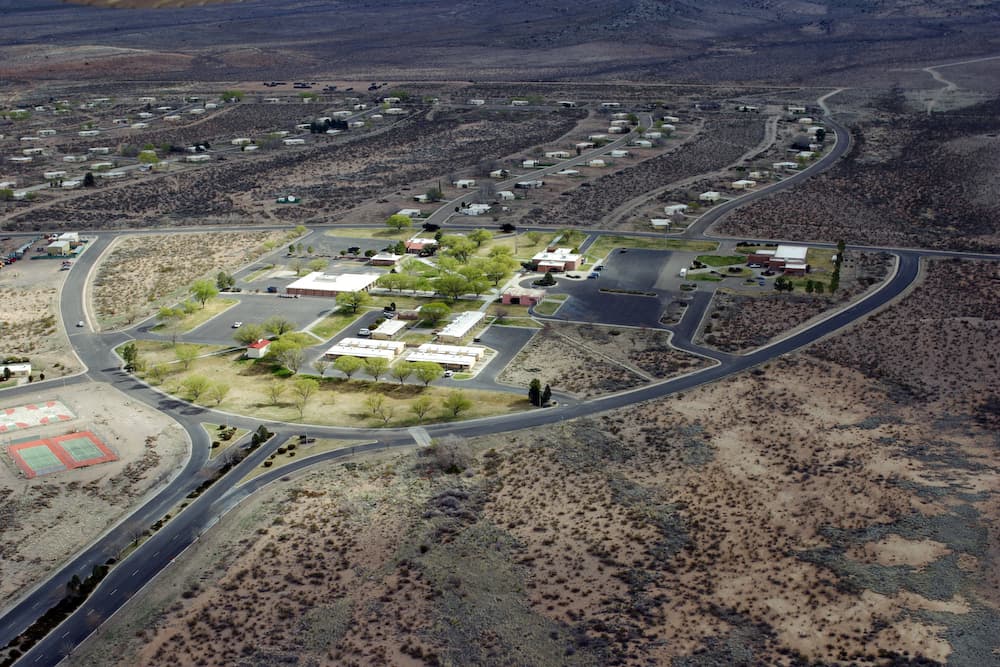
Playas is not a forgotten company town in Hidalgo County. It is a working training site that still draws value from the same wide-open landscape that once supported a mining workforce, and that shift has turned a shuttered smelter community into one of the county’s most unusual public-safety and research resources.
From smelter town to training ground
Phelps Dodge developed Playas in the 1970s for workers at the Hidalgo Copper Smelter, after construction on the smelter began in 1974. At its peak, the town had about 1,500 residents built around the mining operation. When copper prices fell, Phelps Dodge closed the smelter and the town in 1999, leaving behind a place that had to be managed even after the industrial heart of the community was gone.
A skeleton crew stayed on in Playas to handle environmental maintenance, and the site did not simply disappear. Four years later, in 2003, New Mexico Tech signed a $5 million purchase agreement for the town. That purchase set the stage for the site’s second life, one defined less by extraction than by exercises, experiments and emergency preparation.
What Playas is used for now
Today, the Playas Research and Training Center operates as part of New Mexico Tech and describes itself as a place built for controlled, reality-based work. It says the center began as a training arena for first responders and counter-terrorism programs, then expanded to serve military, homeland security, law enforcement and research clients. That evolution matters in a county where open space and practical training infrastructure are not easy to come by.
The center’s own description emphasizes flexibility. New Mexico Tech says Playas can support a technical training session, a community-focused event or a large-scale exercise, which makes the townsite useful for agencies that need real structures, real roads and room to operate without disrupting an active neighborhood. The Air Force Research Laboratory has also pointed to Playas as a setting for high-tech testing, underscoring that the site’s value extends beyond local emergency drills.
For Hidalgo County, that means Playas functions as a place where agencies can practice before a crisis arrives. Instead of building a temporary mock-up from scratch, responders and researchers can work in a former town that already has the kind of infrastructure many simulations try to imitate.
How big the site really is
The scale of the place is part of what makes it so distinctive. The Playas Research and Training Center describes the townsite as 640 acres with more than 300 homes and buildings. It also says the surrounding operational area covers about 400,000 acres, giving trainers and researchers room for rural and desert scenarios that would be difficult to stage anywhere else in the region.
The built environment is still unusually complete for a former company town. The center says it includes a classroom complex, a small grocery store, a bowling alley, parks, day care and a community center. Its capabilities also include residential and commercial buildings, along with utilities and communications infrastructure, which helps explain why so many different kinds of users have gravitated to the site.
That mix of buildings and open land gives Playas an unusual double role. It can stand in for a neighborhood, a small town or a broad desert training ground, depending on what an agency needs to test. In practical terms, that versatility is the town’s biggest economic and public-safety value.
Why Hidalgo County still gains from it
Playas gives Hidalgo County something many rural counties do not have: a place where major agencies can train and test without having to build the environment themselves. That is especially relevant for emergency response, where realism matters and where the difference between a classroom exercise and a field exercise can shape how people act in the first minutes of a real event.
New Mexico Tech says the center serves government and industry clients that need controlled, reality-based testing and training venues. EMRTC, New Mexico Tech’s Energetic Materials Research and Testing Center, says it is one of the lead training organizations for the Department of Homeland Security and a member of the National Domestic Preparedness Council. Those connections show that Playas is not just a local curiosity. It sits inside a larger national network of preparedness work.
The county’s gain is not only symbolic. A site like Playas can support public-safety training, homeland security work and research that would otherwise have to happen elsewhere. That brings outside users into Hidalgo County, keeps a rare piece of infrastructure active and gives local officials and residents a resource tied to readiness rather than abandonment.
What is easy to miss about Playas
The tension in Playas is that its usefulness is also what can make it feel distant from everyday county life. The work there is specialized, and much of it happens out of public view. For people outside the training world, the town can still look like an old industrial remnant, even though its current purpose is very much alive.
That is the central question Playas raises for Hidalgo County: is it simply an unusual place with a past, or a tool that expands what the county can offer to emergency managers, researchers and trainers? The answer appears to be both. Playas is still carrying the footprint of the old smelter town, but it is doing so in service of a modern function that has real consequences for preparedness, land reuse and the county’s long-term options.
In a region where large, controllable training environments are rare, Playas stands out because it converts industrial history into practical capacity. Its value now lies not in what it used to extract, but in what it lets people practice before the next emergency arrives.
This article was produced by Prism’s automated news system from verified source data, official records, and press releases, then run through automated quality and moderation checks before publishing. The system is built and supervised by the people who set the standards it runs under. Read our full AI policy.
Know something we missed? Have a correction or additional information?
Submit a Tip