Aerial view highlights Potter Valley dam debate over Eel River future
PG&E’s move to decommission Potter Valley has turned a century-old water fight into a deadline for Humboldt, fish, farms and power.

A view from above makes the stakes harder to ignore
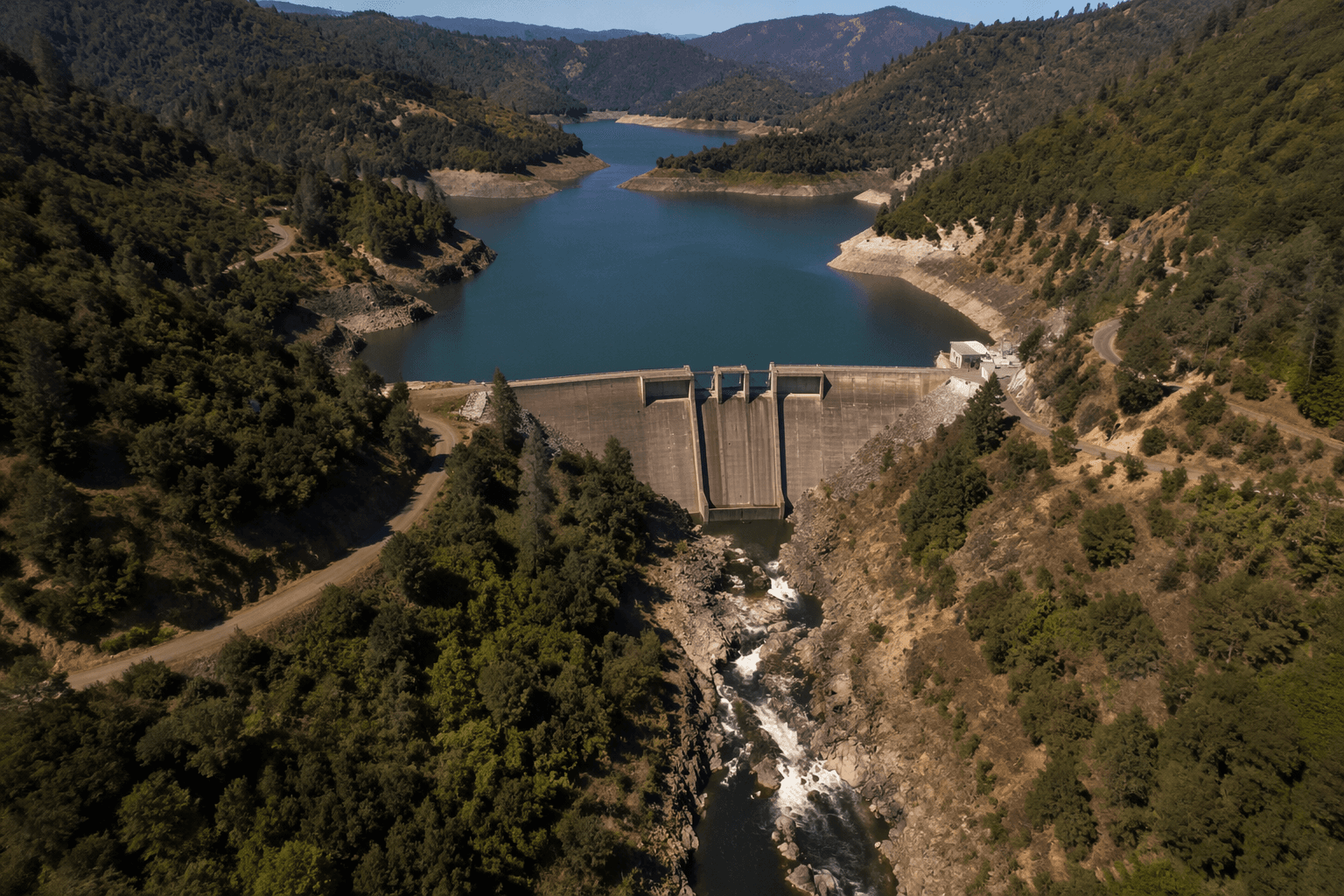
A small plane over the Eel River turns an old North Coast dispute into something tangible: Scott Dam sits as a complete barrier to fish passage, PG&E has now asked to surrender the Potter Valley Hydroelectric Project, and federal scoping meetings are set for Ukiah on June 24, 2026. From the air, the capture area looks small against the much larger watershed downstream that depends on the river system.
That scale matters because the Potter Valley project is not just a dam story. It is a water supply system, a fish passage barrier, a power project that has not produced electricity since 2021, and a century-old interbasin diversion that still shapes who gets water and who bears the risk when flows run low.
What the Potter Valley project is, and why it still matters
The Potter Valley Hydroelectric Project is owned by Pacific Gas and Electric Company and includes Scott Dam, Cape Horn Dam, a diversion tunnel and a powerhouse. Water diversions began at Cape Horn Dam in 1908, Scott Dam became operational in 1922, and since then the system has redirected Eel River water into the Russian River basin.
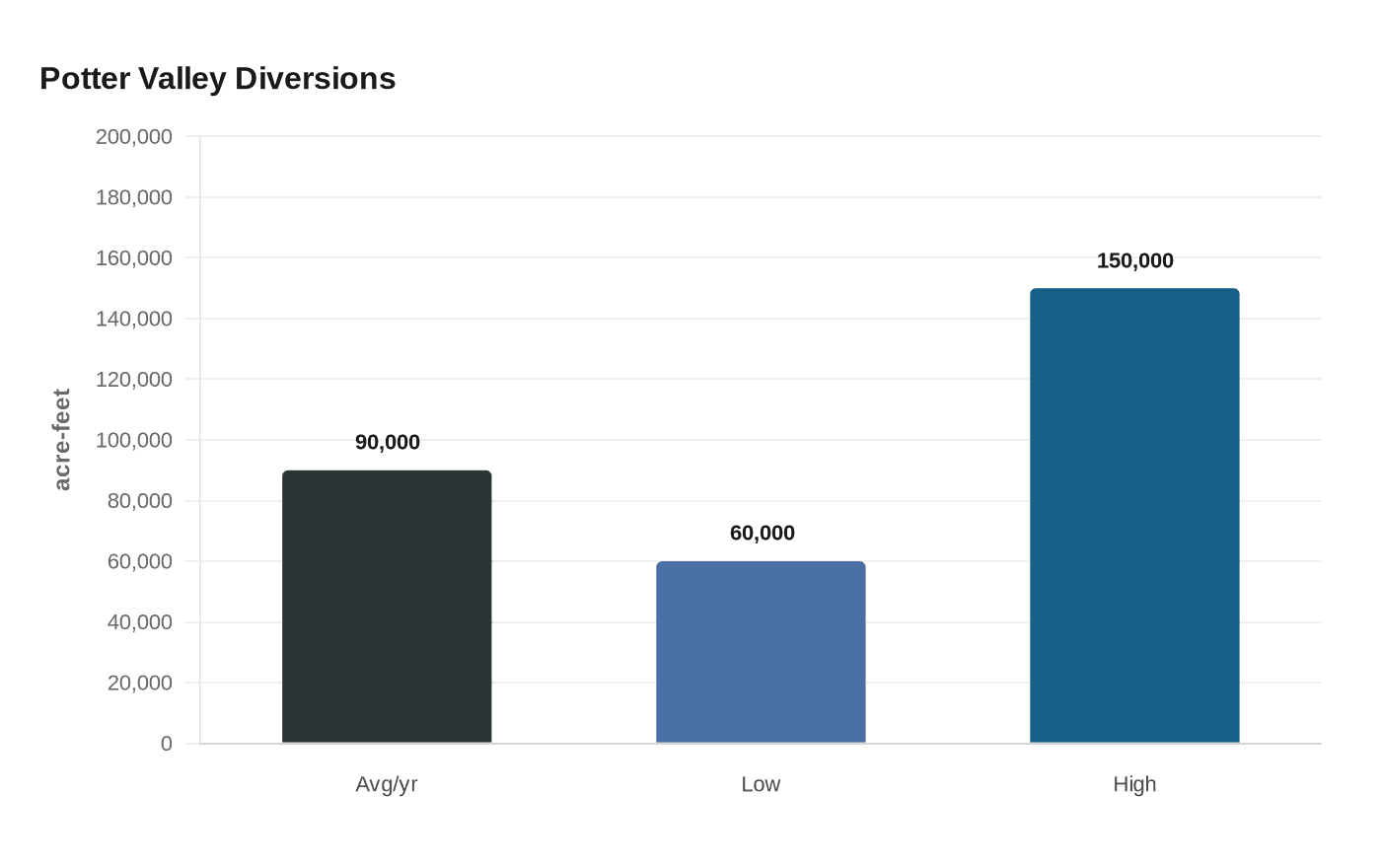
On average, the project diverts about 90,000 acre-feet of Eel River water a year, with historical diversions ranging from roughly 60,000 to more than 150,000 acre-feet annually. Humboldt County notes that the Eel River runs 81 miles through Humboldt County and another 75 miles through Trinity and Mendocino counties between the ocean and Cape Horn Dam, which is one reason the diversion has always had consequences far beyond Potter Valley itself.
The county also says diversions can affect fish passage, habitat availability, geomorphic processes and alluvial aquifer recharge. In other words, this is not only about how much water stays in the channel. It is about the shape of the river, the health of floodplain systems and the long-term condition of the groundwater that helps sustain communities and agriculture.
Why environmental groups say removal would change the river
Environmental groups, including the Environmental Protection Information Center, Friends of the Eel River and California Trout, see the aerial view as evidence of just how much river has been held back by a relatively small piece of infrastructure. California Trout says Scott Dam and Cape Horn Dam form PG&E’s Potter Valley Project, that Scott Dam is a total barrier to fish migration, and that Cape Horn Dam has a poorly functioning fish ladder and diverts Eel River water through a mile-long tunnel.
Their central argument is ecological recovery. CalTrout and NOAA say removing the dams could restore access to about 300 miles of salmon and steelhead habitat in the upper Eel River, and California Trout says dam removal would make the Eel River the longest free-flowing river in California. That prospect matters not just for fish but for the North Coast fishing economy and the broader recovery of salmon runs that have long been part of the region’s identity.
The project’s supporters also frame the issue in historical terms. Friends of the Eel River says the dams and diversion have caused significant harm to fisheries since the early 20th century, and the current debate reflects how long those impacts have been accumulating.
Why farmers and water users are worried
The other side of the argument is just as concrete. Farmers and water users in Potter Valley and beyond worry that dam removal or a reduced diversion could mean less water for irrigation and day-to-day use, especially in drought years. For rural communities, the risk is not abstract. Water reliability can decide crop acreage, household planning and whether local systems can absorb another dry season.
Supporters of maintaining or replacing the diversion point say the project serves a much larger human footprint than its mountain setting suggests. Local water advocates have described it as supplying water for more than 750,000 residents across four counties from Potter Valley to Marin County. A USDA-backed community letter also says Lake Pillsbury water helped extinguish two of California’s three largest fires, a claim that shows how supporters connect the project to wildfire resilience as well as to drinking water and agriculture.
That broader framing helps explain why the project has become such a political fight. For opponents of removal, this is not simply a fish passage issue. It is a question of water supply, safety and economic stability for farms, ranches and communities throughout the region.
A deal is emerging, but not everyone is convinced
The most important shift in 2025 was not just PG&E’s decommissioning filing. It was the appearance of a new agreement that tried to bridge the gap between river restoration and water supply. A July 2025 Water Diversion Agreement brought together the California Department of Fish and Wildlife, California Trout, Humboldt County, Mendocino Inland Water and Power Commission, Round Valley Indian Tribes, Sonoma Water and Trout Unlimited around a proposed new Eel-Russian diversion facility that would be built alongside dam removal.
Humboldt County says the agreement includes key protections such as tribal ownership of PG&E’s Eel River water rights, limited diversions tied to fishery needs and a facility design that allows a free-flowing river. That is a significant change from the old binary of either keeping the dams as they are or losing the diversion entirely.
Still, opposition remains strong. Regional farm bureaus asked the federal government in 2025 to halt or delay dam removal, arguing that the proposal threatens water supply, safety and economic stability. USDA later intervened in December 2025 in the Federal Energy Regulatory Commission proceeding to protect the interests of the U.S. Forest Service, local farmers, ranchers, agricultural producers and communities.
The regulatory clock is now running
The legal timeline is what makes the aerial debate feel urgent now. PG&E announced in 2019 that it would not renew the project’s federal license. The license expired on April 14, 2022, and the Federal Energy Regulatory Commission authorized continued operation under an annual license on April 21, 2022. PG&E then filed its application to surrender and decommission the project on July 25, 2025.
PG&E’s draft surrender and decommissioning plan calls for removing Scott Dam and Cape Horn Dam. California Trout says the draft removal plan would remove most in-river facilities, and it notes that economics are the most common reason dams are removed in the United States. The practical question now is how that transition will be managed, and whether a replacement diversion can satisfy both fish recovery and water supply concerns.
For Humboldt County, the answer will affect more than one river corridor. It will shape salmon habitat, groundwater recharge, ranch and farm water access, tribal rights, and the future of a watershed that has been tied in knots by one project for more than a century.
What comes next in Ukiah
The next public checkpoint is the Federal Energy Regulatory Commission’s daytime and evening scoping meetings in Ukiah on June 24, 2026. Those meetings are where the scope of environmental review will be set, and where the debate over fish recovery, water reliability and decommissioning design will move from broad principle to specific planning.
From the air, the system already looks like a small set of structures on a vast landscape. On the ground, the consequences are much larger. The decision over Scott Dam and Cape Horn Dam will determine whether the Eel River stays constrained by a century-old diversion or begins the long process of recovering as a freer river with its upstream habitat reopened.
This article was produced by Prism’s automated news system from verified source data, official records, and press releases, then run through automated quality and moderation checks before publishing. The system is built and supervised by the people who set the standards it runs under. Read our full AI policy.
Know something we missed? Have a correction or additional information?
Submit a Tip