Blue Lake Rancheria prepares for disaster before it strikes
Blue Lake Rancheria's microgrid kept lights, heat, charging, and internet on during outages. Humboldt County can copy its power, sheltering, and training model before the next emergency.
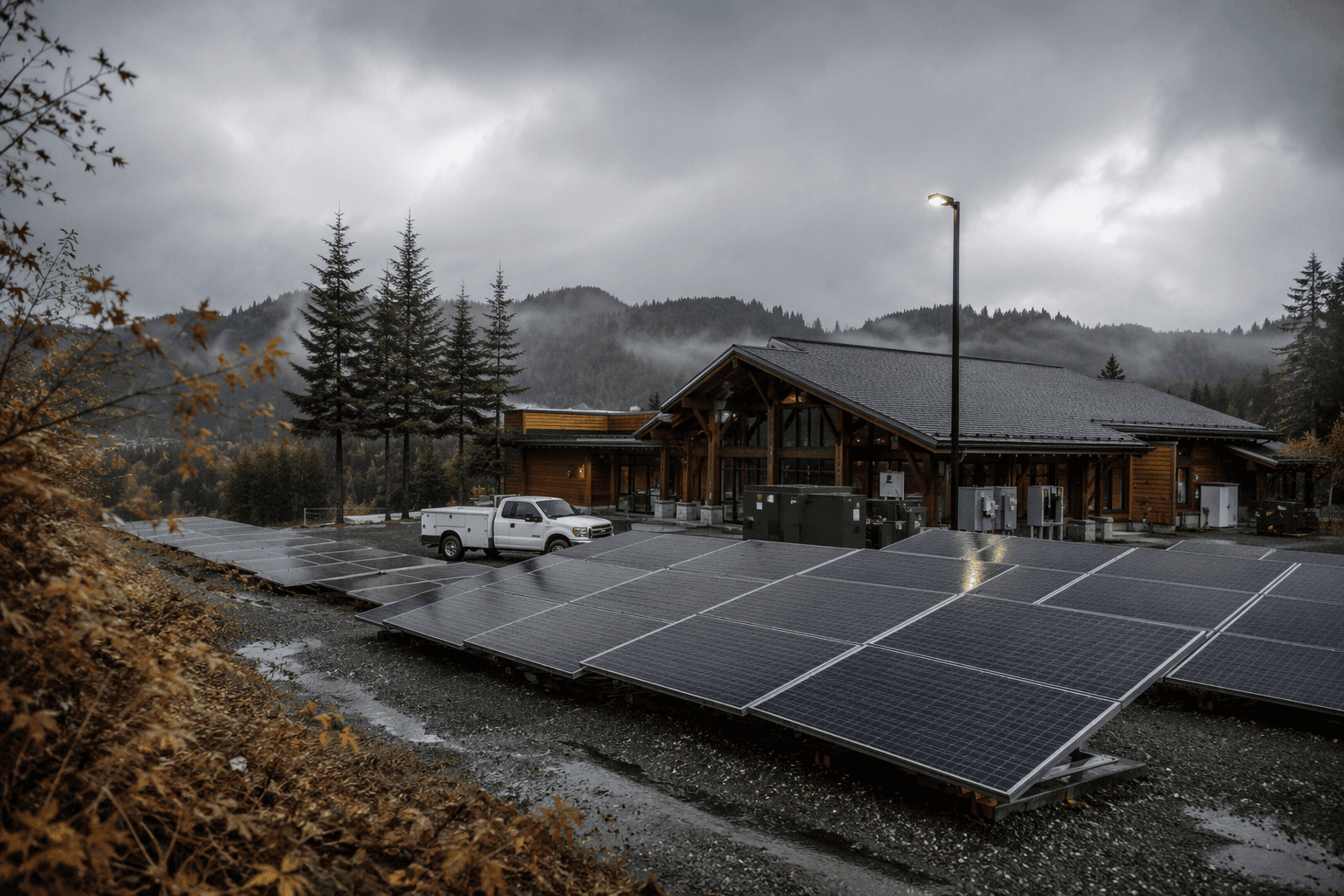
Blue Lake Rancheria has built a disaster system that is meant to work when Humboldt County's larger grids do not. Its microgrid pairs a 420 kW solar array with a 500 kW / 950 kWh Tesla Powerpack battery, a Siemens controller, and a backup generator, creating a setup designed to keep the campus functioning as a Red Cross emergency center when wildfire, quake, storm, or outage hits.
Power that stays on when the region goes dark
The core of the Rancheria's readiness is not a policy memo or a tabletop exercise. It is hardware. A Schatz Energy Research Center project update described the Blue Lake Rancheria microgrid as 1.92 MW of generation capacity, combining the photovoltaic array, a 500 kW, 950 kWh lithium-ion Tesla battery, and a legacy 1.0 MW backup generator.
That system was completed in March 2018, according to a California Energy Commission report, and it was built for a region the tribe describes as naturally disaster-prone and constrained by transmission from the larger electric grid. In Humboldt County, where outages can arrive with wildfire smoke, storm damage, or public safety shutoffs, the value of that design is immediate: the campus can keep operating when outside power is unstable.
A 2019 Schatz Energy summary showed what that looks like in practice. During a Public Safety Power Shutoff, the microgrid provided a safe, warm environment where local families could study and play, charge cell phones, and access the internet. That is the practical difference between having backup power and having resilience.
The system also changes the tribe's operating budget. Yale Climate Connections reported in March 2019 that the microgrid saves Blue Lake Rancheria $200,000 a year. For a small tribal community, that is not an abstract efficiency gain. It is money that can stay inside a local system built to absorb the next shock.
Resilience is built into the institution
Blue Lake Rancheria has also made preparedness part of its day-to-day governance. Its Office of Emergency Services includes a Resiliency Training & Innovation Center, and the tribe identifies Brittaney Lewis as the OES Director on that page. That matters because it shows the Rancheria is not treating emergency management as a one-time project. It is running it as an ongoing institutional function.
The tribe's resilience work also ties to broader community planning. Blue Lake Rancheria describes its Ta'm Resilience Campus as a strategic investment for economic development, which connects disaster readiness to business continuity, workforce stability, and long-term community survival. In a county where an outage can close businesses, disrupt school routines, and isolate rural neighborhoods, that broader frame is part of the emergency plan.
The campus itself is meant to do more than power lights. The microgrid was explicitly designed to let the Rancheria function as a Red Cross emergency center, which means the site can serve sheltering and response needs, not just its own operations. That kind of dual use, serving both the tribe and the wider public during a crisis, is exactly what many Humboldt communities need but do not yet have in one place.
Training before the next event
Blue Lake Rancheria's preparedness does not stop with equipment. The tribe's Disaster Preparedness Academy shows a continuing effort to train people for specific hazards that Humboldt knows too well. The academy lists AWR-345: Uncrewed Aircraft Systems in Disaster Management for August 14, 2026, AWR-362: Flooding Hazards: Science and Preparedness for September 4, 2026, and Flood Fight Training.
That kind of training matters because the county's hazards do not arrive one at a time. A winter storm can trigger flooding and road failures. A quake can knock out communications and power together. Wildfire can close evacuation routes while smoke and outages make sheltering harder. The academy's menu reflects that reality by focusing on aircraft use, flood science, and hands-on flood response rather than generic emergency language.
Blue Lake also sits at the center of Humboldt's broader preparedness culture. Humboldt County's DisasterCon is an annual two-day emergency preparedness gathering held in Blue Lake during National Preparedness Month, where emergency management professionals meet to share lessons learned and sharpen response plans. That does not replace infrastructure, but it does show that the county has a standing forum for coordination.
What Humboldt can copy now
The simplest measure of readiness is whether a community can name the systems that keep it functioning. Blue Lake Rancheria can point to electricity, battery storage, emergency shelter capability, internet access, charging, staff training, and an emergency-services office with a dedicated resilience center. That is a much harder standard than passing a resolution or holding a press event.
For nearby cities and the county, the comparison is instructive. The public evidence here shows a strong culture of planning, especially through Humboldt County's DisasterCon and the Rancheria's training programs, but the Rancheria stands out because its readiness is physical as well as procedural. It already has the microgrid, the shelter role, and the training backbone in place.
In Humboldt, where wildfire, earthquakes, tsunamis, flooding, and communication failures are not theoretical, that is the model to copy before the next emergency forces the issue.
This article was produced by Prism’s automated news system from verified source data, official records, and press releases, then run through automated quality and moderation checks before publishing. The system is built and supervised by the people who set the standards it runs under. Read our full AI policy.
Did this article answer your question?