Cal Poly Humboldt Hosts Cannabis Equity and Environment Symposium March 28
With 149 Humboldt cannabis permits on the verge of suspension and a $10M county deficit, a Cal Poly symposium put survival and cleanup costs on the agenda.
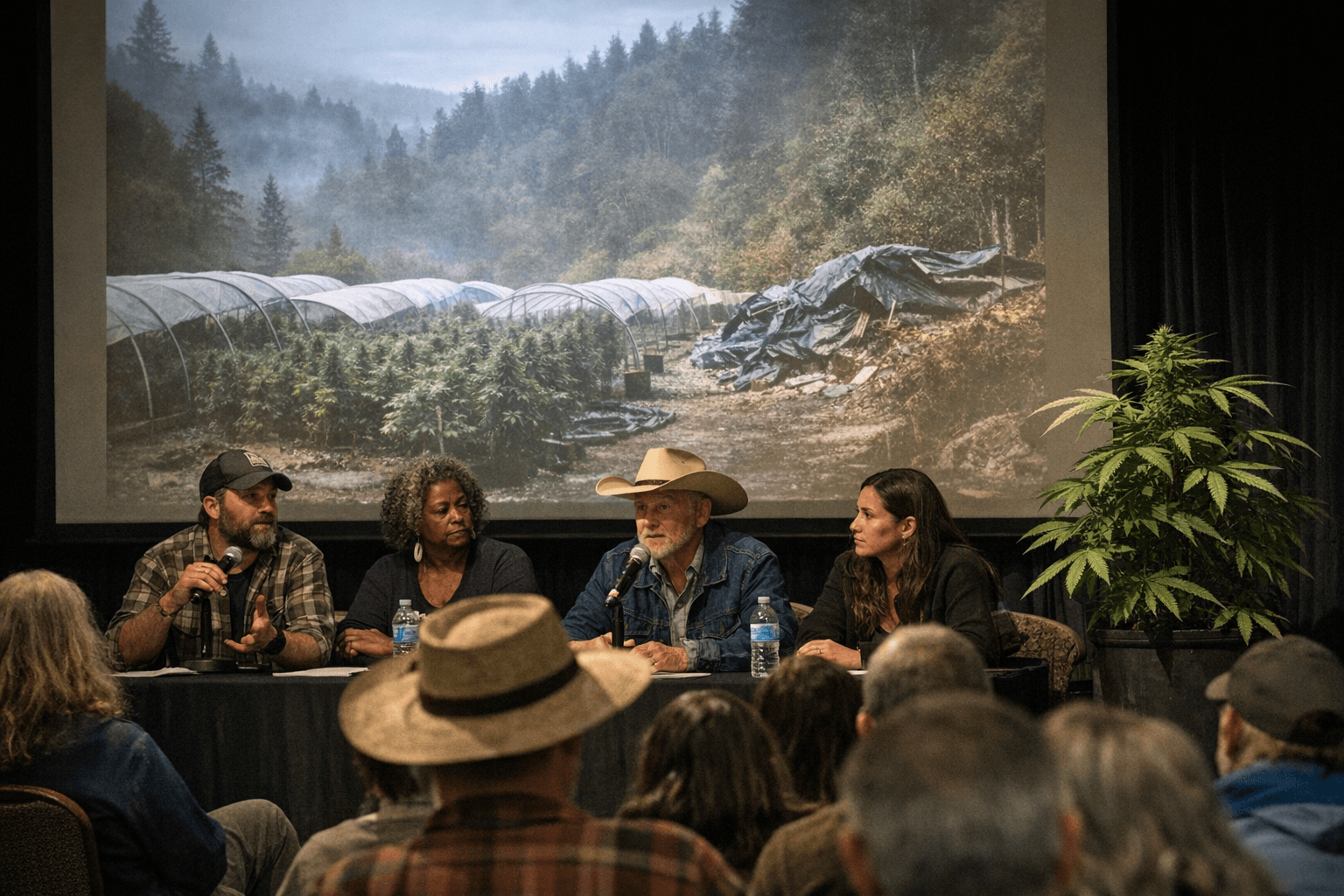
One hundred forty-nine Humboldt County cannabis farmers with approved permits were staring down possible suspension when Cal Poly Humboldt convened its second annual Cannabis and Environmental Stewardship Symposium on March 28 at the campus Native Forum. With 538 total permits under review and a $10 million county budget shortfall driven partly by collapsing cannabis tax revenue, the daylong event was less an academic exercise than a reckoning.
The symposium, organized by students in Cal Poly Humboldt's Cannabis Studies Program, ran from 9 a.m. to 5 p.m. and was free and open to the public, with breakfast and lunch provided. The program is housed in the university's Department of Sociology and offers the world's first Cannabis Studies Bachelor's Degree, launched in Fall 2023 with concentrations in Equity & Social Justice and Environmental Stewardship, the exact fault lines the symposium was designed to probe.
The panel brought together voices rarely in the same room: Kason Grady, racial equity liaison with the North Coast Regional Water Quality Control Board; Alan Archuleta, vice chairman of Mooretown Rancheria; Ryan Bourque, senior environmental scientist with the Cannabis Restoration Grant Program at the California Department of Fish and Wildlife; and Taylor Stein, a farmer at Briceland Forest Farm. Cal Poly Humboldt President Richard Carvajal and Assemblyman Chris Rogers also addressed the audience. Presentations ranged from Tribal youth programs to the ergonomics of cannabis farming, with contributions from Cal Poly Humboldt students, alumni, and faculty.
Dan Mar, an instructor in the Cannabis Studies program and symposium panelist, framed what was at stake: "This symposium creates a space where policy, research, and lived experience can inform one another in real time."
The environmental dimension of the industry's collapse was sharpened by a case that drew statewide attention. Humboldt cultivator Joshua Sweet and his companies, Shadow Light Ranch LLC and The Hills LLC, were ordered to pay $1.75 million in fines for violations that included illegal water diversions from onstream reservoirs, destruction of wetland habitat and stream channels, and conversion of oak woodland for cannabis cultivation, conduct that persisted over roughly four years. The $500,000 water rights portion of the penalty was described as a California record.
For farmers who lose permits over unpaid taxes, those enforcement actions point to a structural trap. Humboldt's strict environmental protections make reactivating a shuttered license close to impossible, and one local farmer described the prospect as "a permanent extinction event."
The financial backdrop explains the urgency. Measure S, the county's cannabis cultivation tax, was slashed by 85 percent in February 2022, then suspended entirely for 2023 and 2024. The revenue gap contributed to a $10 million budget deficit, cutting into county services as the sector that was supposed to anchor the post-legalization economy continued to contract.
The symposium drew contributors from the California Department of Fish and Wildlife, Chico State, and Cal Poly Humboldt's Rou Dalagourr Food Sovereignty Lab and Traditional Ecological Knowledges Institute. A pre-symposium social gathering was held the evening before, March 27, at Septentrio Winery in Arcata. The event was funded through the Land-Sea Connection Program of Resources Legacy Fund, supported by the Keith Campbell Foundation for the Environment.
This article was produced by Prism’s automated news system from verified source data, official records, and press releases, then run through automated quality and moderation checks before publishing. The system is built and supervised by the people who set the standards it runs under. Read our full AI policy.
Did this article answer your question?