Humboldt County Residents Should Know These Tsunami Drill Preparedness Steps
A tsunami off Humboldt's coast could arrive in as little as 10 minutes. Here's exactly what to do before, during, and after a drill — or the real thing.
The December 5, 2024 earthquake off Cape Mendocino didn't just rattle north coast nerves; it reset the urgency around tsunami preparedness across Del Norte, Humboldt, and Mendocino counties. Emergency managers responded by expanding public education, running county-wide drills, and pushing out reverse-calling messages with a stark reminder: a tsunami following a large offshore earthquake could arrive in as little as 10 minutes. That is not enough time to figure out your plan on the fly.
Tsunami Preparedness Week runs March 21–29, 2026, and it coincides with a coordinated calendar of drills and community events across the north coast. Whether you're using this week as a prompt or reading this guide outside of any scheduled event, the steps below apply equally to a drill and to the real thing.
Step One: Find Out If You're in a Tsunami Zone
Before anything else, determine whether your home, workplace, school, or regular recreation areas sit inside a designated tsunami hazard area. The Redwood Coast Tsunami Work Group has created community-specific tsunami hazard maps covering Del Norte, Humboldt, and Mendocino counties that you can download and use to build your own evacuation plan. A companion resource, the Know Your Zone Guide, explains how to read those maps.
For a fast, address-level check, the California Geological Survey offers an interactive map that lets you type in any address and see exactly how it sits relative to the tsunami zone. If you're not sure whether your neighborhood in Eureka, the Manila peninsula, or anywhere along Humboldt Bay falls within the hazard boundary, this tool gives you a definitive answer in seconds.
The Redwood Coast Tsunami Work Group website and TsunamiZone.org are the two primary portals for accessing maps, registering for Preparedness Week events, and finding community-specific drill information across the three-county region.
Step Two: Get Connected to the Warning System
Knowing your zone means nothing if you don't receive the warning when it counts. Register for the Humboldt ALERT system, which is the county's local emergency notification platform. During Tsunami Preparedness Week, the National Weather Service and the County Office of Emergency Services will be conducting tests of their notification systems — which makes this an ideal week to confirm that your registration is active and that alerts are reaching your phone.
The HumCo OES website includes a Get Prepared page and a Know Your Hazards page, both of which are worth bookmarking. For real-time status during an actual event, official local government updates will be posted at humboldtgov.org/emergency, and personnel — from agency staff to individual households — should stay out of tsunami hazard areas until that site explicitly indicates it is safe to return.
Step Three: Build Your Household Plan
The Humboldt County Office of Emergency Services, through its Northwestern Coastal California Earthquake & Tsunami Response Fact Sheet (Ver.1, October 2025), is direct on this point: every household should sit down and decide what each family member will do if a large earthquake strikes while they are at home, at work, at school, or anywhere else they regularly spend time in tsunami hazard areas. That conversation needs to happen before an event, not during one.
A complete household plan covers three essentials:
- Evacuation routes from every location where family members spend regular time, including specific meeting points outside the hazard zone
- Communication protocols, since cell networks often fail after a major earthquake
- Emergency supplies, including water, food, medications, and documents that can sustain your household for at least 72 hours
Resources to support this planning include *Living on Shaky Ground* magazine, the California Geological Survey's Earthquakes and Tsunamis webpages, Ready.gov, and the Cal OES Earthquake Readiness Guide available at earthquake.ca.gov.
Step Four: Practice — and Make It Count
The Redwood Coast Tsunami Work Group frames tsunami evacuation drills not as grim exercises but as something genuinely useful and accessible: "Practicing your tsunami evacuation drill can be fun!" The format is flexible. You can walk your evacuation route alone, with family, with neighbors, or with coworkers. The Tsunami Walk concept requires no registration, no special equipment, and no set time — pick a route from your home or office out of the hazard zone and walk it.
Manila, California serves as one example the Work Group explicitly highlights for evacuation practice, with Cal Poly Humboldt also involved in coordinating community participation there. The low-lying Manila peninsula, sitting between Humboldt Bay and the Pacific, illustrates exactly why rehearsal matters: the route out is narrow, and 10 minutes leaves almost no margin.
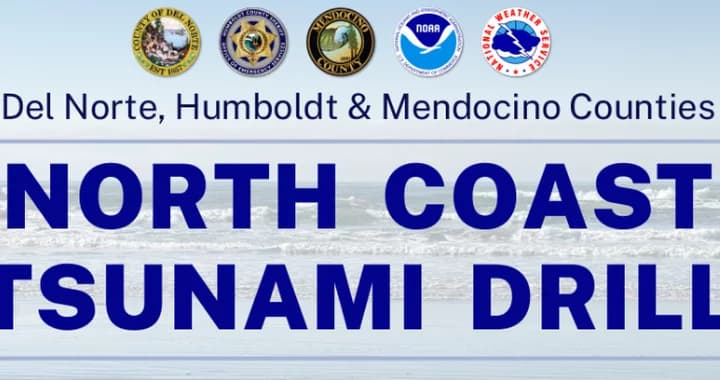
For those who want a structured event, the Klamath Community Tsunami Drill takes place March 6 and 7, 2026. During the 2025 Preparedness Week, Del Norte, Humboldt, and Mendocino Counties hosted county-wide drills, and Humboldt Bay Fire and the Community Emergency Response Team (CERT) set up an earthquake and tsunami information booth in Eureka during the North Coast Drill. Those kinds of community touchpoints — where you can talk to trained personnel, pick up printed maps, and ask questions about your specific neighborhood — are worth attending when they're available.
On March 23, 2026, tsunami expert Lori Dengler will deliver an OLLI lecture on the July 29, 2025 magnitude 8.8 Kamchatka earthquake, the resulting tsunami, and how the warning system performed. The lecture runs from 12:00 to 1:30 pm, with registration available through the Redwood Coast Tsunami Work Group.
For Agencies and Organizations: Policy, ICS, and the One-Hour Rule
Local businesses, nonprofits, schools, and government agencies operating anywhere along the Humboldt coast face an added layer of responsibility. The October 2025 Fact Sheet from Humboldt County calls on agency and entity leadership to develop written policy that defines their organization's intended approach to earthquake and tsunami response. That policy should be built around the Incident Command System (ICS), which allows multiple agencies to coordinate under a unified structure. When a tsunami warning coincides with road damage and scattered groups of people in different parts of the county, ICS Area Commands offer a framework for managing scarce resources across what can become "isolated islands" of personnel separated from one another.
Two specific concepts in the Fact Sheet deserve attention from any organization with staff in hazard areas. The first is the "One-Hour Rule": for a regional or distant-source tsunami, agency leadership should consider withdrawing all personnel from hazard areas at least one hour before the estimated time of arrival. The second is the "T-Minus" approach, described in the Fact Sheet as similar to a rocket launch countdown. Leadership uses timed verbal updates to remind and move personnel toward the threshold of "T-Minus One Hour" before impact. Once staff are out of the hazard area, they stay out until humboldtgov.org/emergency explicitly confirms it is safe to return. Policy should also address what on-duty and off-duty members should each do during an event, since a major earthquake will likely catch some staff at work and others at home.
The Bigger Picture
The December 2024 Cape Mendocino event was a warning shot, and north coast emergency managers took it seriously. The years since have produced more maps, more drills, better notification infrastructure, and a clearer framework for both individual households and organized agencies to follow. Tsunami Preparedness Week, now running through March 29, 2026, is the concentrated version of that ongoing effort — a window to register for alerts, walk your evacuation route, test your household plan, and connect with the community resources that will matter most when the shaking starts and the clock begins.
This article was produced by Prism’s automated news system from verified source data, official records, and press releases, then run through automated quality and moderation checks before publishing. The system is built and supervised by the people who set the standards it runs under. Read our full AI policy.
Did this article answer your question?