Lost Coast Outpost Publishes Eureka Police Log Listing Roughly 180 Calls
The Eureka Police Department log for Jan. 19 lists roughly 180 calls, showing where officers spent time that day and offering residents a detailed look at public-safety activity.
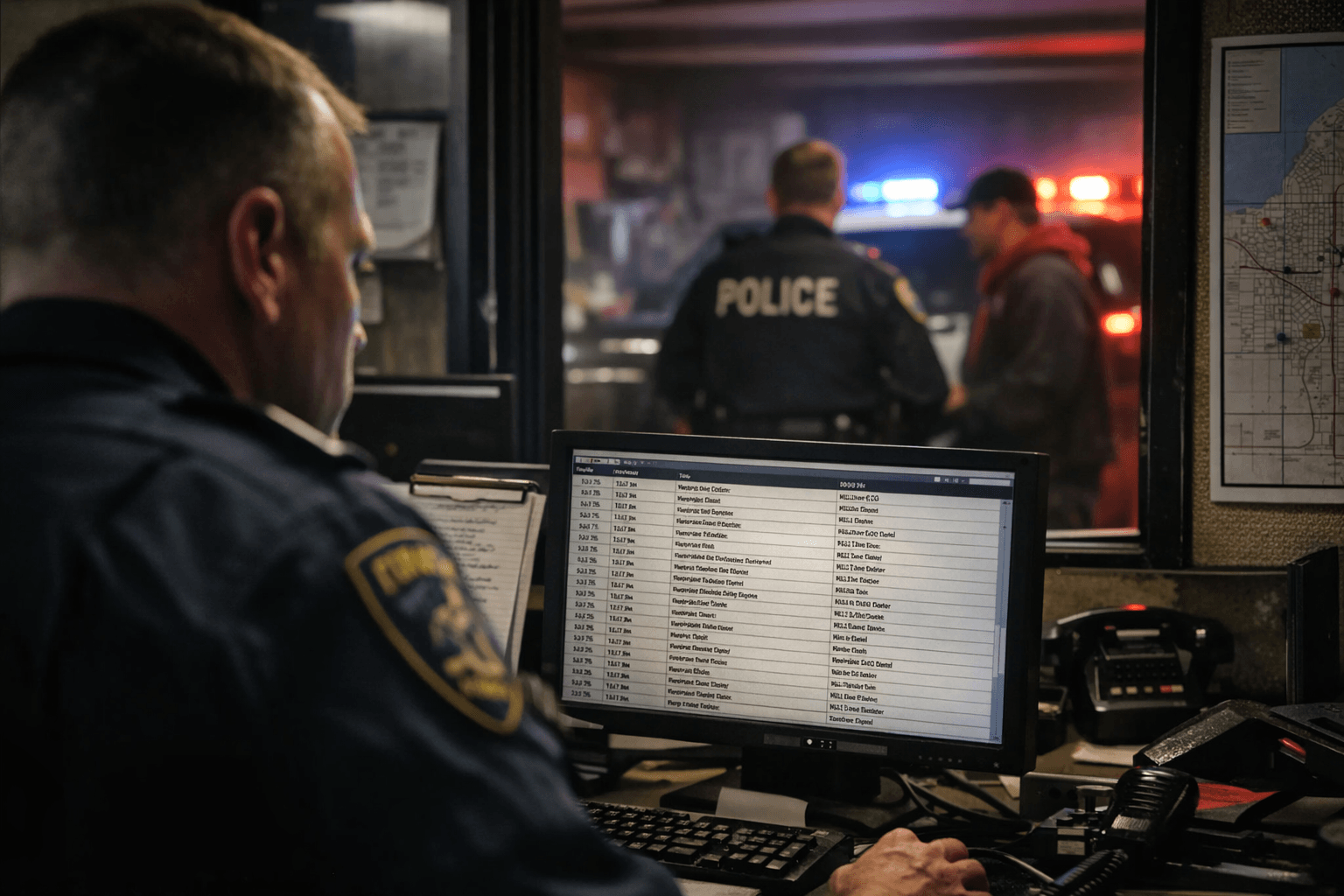
Roughly 180 calls for service on Jan. 19 filled the Eureka Police Department's daily log, providing an hour-by-hour record of policing activity across the city. The day’s entries include vehicle investigations, field interviews, disturbances, repeated patrol checks, foot patrols, municipal code violations, traffic stops, welfare checks, an animal call, found property and a hit-and-run report.
Vehicle investigations were recorded in the 3000 block of Broadway Street, and a disturbance was logged in the 1500 block of Third Street. Officers performed repeated patrol checks along the waterfront and Del Norte Street while conducting numerous traffic stops and foot patrols in multiple neighborhoods. The full, hour-by-hour list is available at lostcoastoutpost.com/patrolled/eureka/2026/jan/19/.
The volume and variety of the calls show how basic public-safety duties are distributed over a single 24-hour period. About 180 calls equals an average of roughly 7.5 calls per hour, but the log’s timestamps show clustering of activity in waterfront and downtown corridors during peak daytime and evening hours. That pattern underscores routine demands on patrol resources in Old Town and along Eureka’s waterfront, where municipal code enforcement and welfare checks appear alongside criminal-investigation work.
For residents, the log is a tool to monitor neighborhood conditions and police presence. Detailed calls-for-service records enable neighborhood associations, business owners and city council members to identify recurring issues - such as repeated patrol checks in the same locations - and to press for targeted responses or different deployment strategies. Community groups seeking more predictable patrol coverage or stronger municipal code enforcement can use the record to inform public comment at Humboldt County or city meetings.
Institutionally, posting calls-for-service information supports transparency and civic oversight, but it also raises operational questions about staffing and prioritization. Police chiefs and city policymakers must balance reactive responses - traffic stops and hit-and-run investigations - with proactive work such as foot patrols and community outreach. Patterns evident in daily logs can inform budgeting, overtime decisions and whether specialized units or partnerships with social services are warranted in hotspots like the waterfront and Del Norte Street corridor.
What comes next for readers is practical: track subsequent daily logs to see whether these patterns persist, raise specific incidents with the Eureka Police Department for clarification, and bring aggregate concerns to City Council or neighborhood meetings. Sustained civic attention to public records like the calls-for-service log is the concrete mechanism residents have to shape how policing resources are allocated in Eureka.
This article was produced by Prism’s automated news system from verified source data, official records, and press releases, then run through automated quality and moderation checks before publishing. The system is built and supervised by the people who set the standards it runs under. Read our full AI policy.
Did this article answer your question?