Research Tests Using Buried Fiber Optic Cables for Earthquake Warning
Researchers conducted tests on December 16 to evaluate whether existing buried fiber optic broadband cables can detect very small seismic motions, with the aim of adding dense early warning capability along the North Coast. The work matters to Humboldt County because a validated network could provide a few seconds of warning before stronger shaking, improving safety for hospitals, schools, emergency services and remote communities.
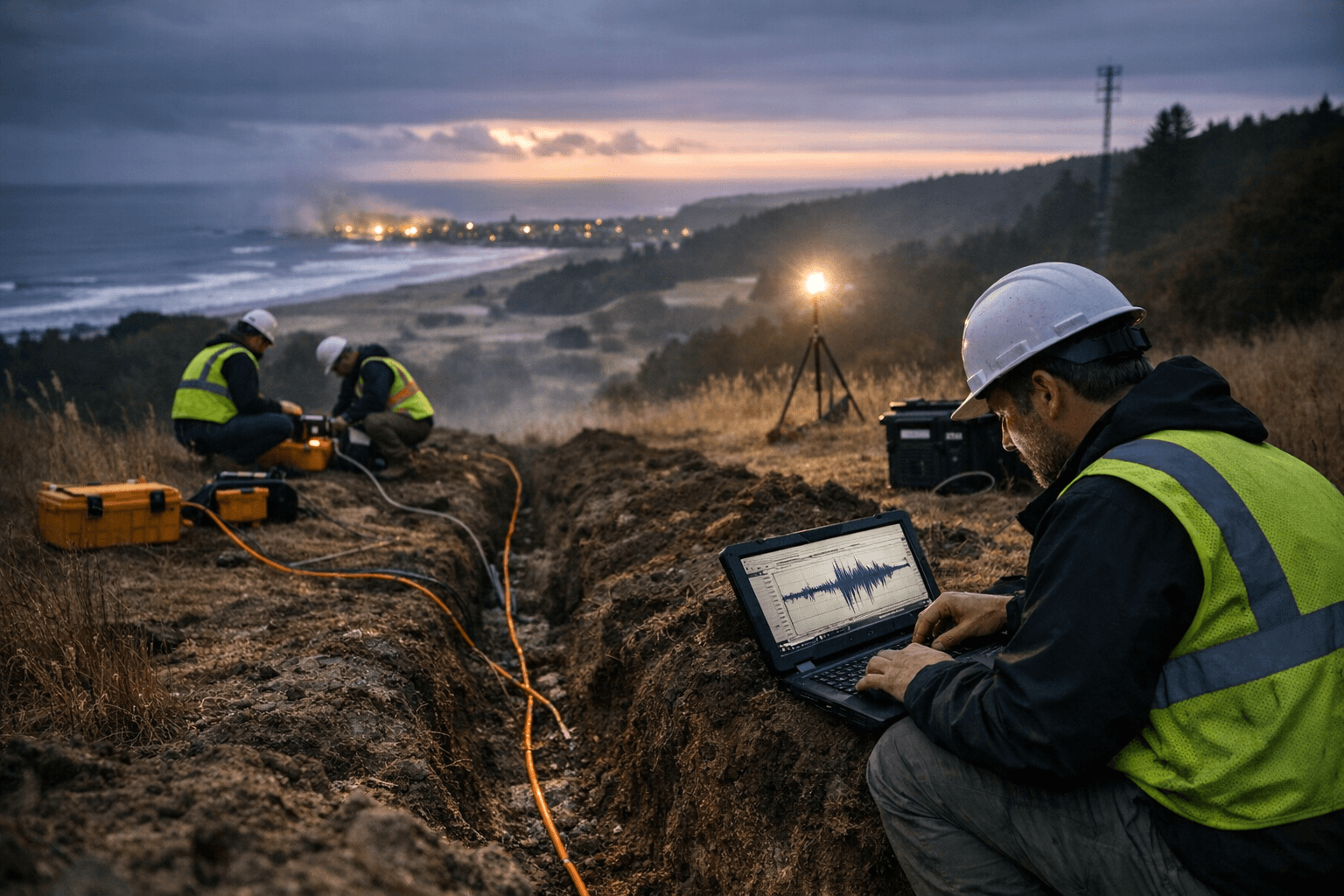
Researchers ran tests along a section of state middle mile infrastructure near Arcata on December 16 as part of a multi year evaluation of fiber derived seismic sensing. Cal Poly Humboldt led data collection to compare signals recorded on conventional seismographs with measurements derived from the buried fiber optic cables. The goal was to determine whether the telecommunications lines can pick up very small ground motions, roughly magnitude one, and whether a networked approach can, when analyzed in real time, provide a few seconds of early warning ahead of stronger shaking.
If fiber derived sensing proves accurate and operationally viable it could greatly increase the density of seismic monitoring across the North Coast. Existing telecom routes already run through many rural and remote areas that are otherwise underserved by traditional seismic stations. Using this passive infrastructure for sensing could lower costs and expand coverage, offering more localized alerts for communities that now rely on sparser networks.
For Humboldt County the potential benefits are practical and immediate. Even a few seconds of advance notice can give hospitals time to secure equipment, allow transit systems to slow or stop, and give residents a moment to take protective action. Early warning seconds also matter for emergency dispatch and for protecting critical infrastructure in isolated areas where first responders face longer travel times.
The research team emphasized the need for multi year testing to validate accuracy under different seasonal and environmental conditions and to test operational integration with existing early warning systems. Key obstacles include data management, reliability of telecom access for continuous sensing, and agreements between universities, telecom operators and state agencies to share infrastructure and coordinate alerts.
The Humboldt County tests are an early step in assessing whether buried fiber optic cables can be part of a distributed earthquake sensing network. Residents should expect continued data collection and evaluation over coming years before any system is deployed widely, and policymakers will need to weigh investment, privacy and equity considerations as the work proceeds.
This article was produced by Prism’s automated news system from verified source data, official records, and press releases, then run through automated quality and moderation checks before publishing. The system is built and supervised by the people who set the standards it runs under. Read our full AI policy.
Did this article answer your question?