Copper Peak in Ironwood MI Set for Major Ski Jumping Revival
Blasting has reshaped Copper Peak's landing hill, clearing the way for a December 2026 completion and a projected $570 million boost to the western U.P. economy.
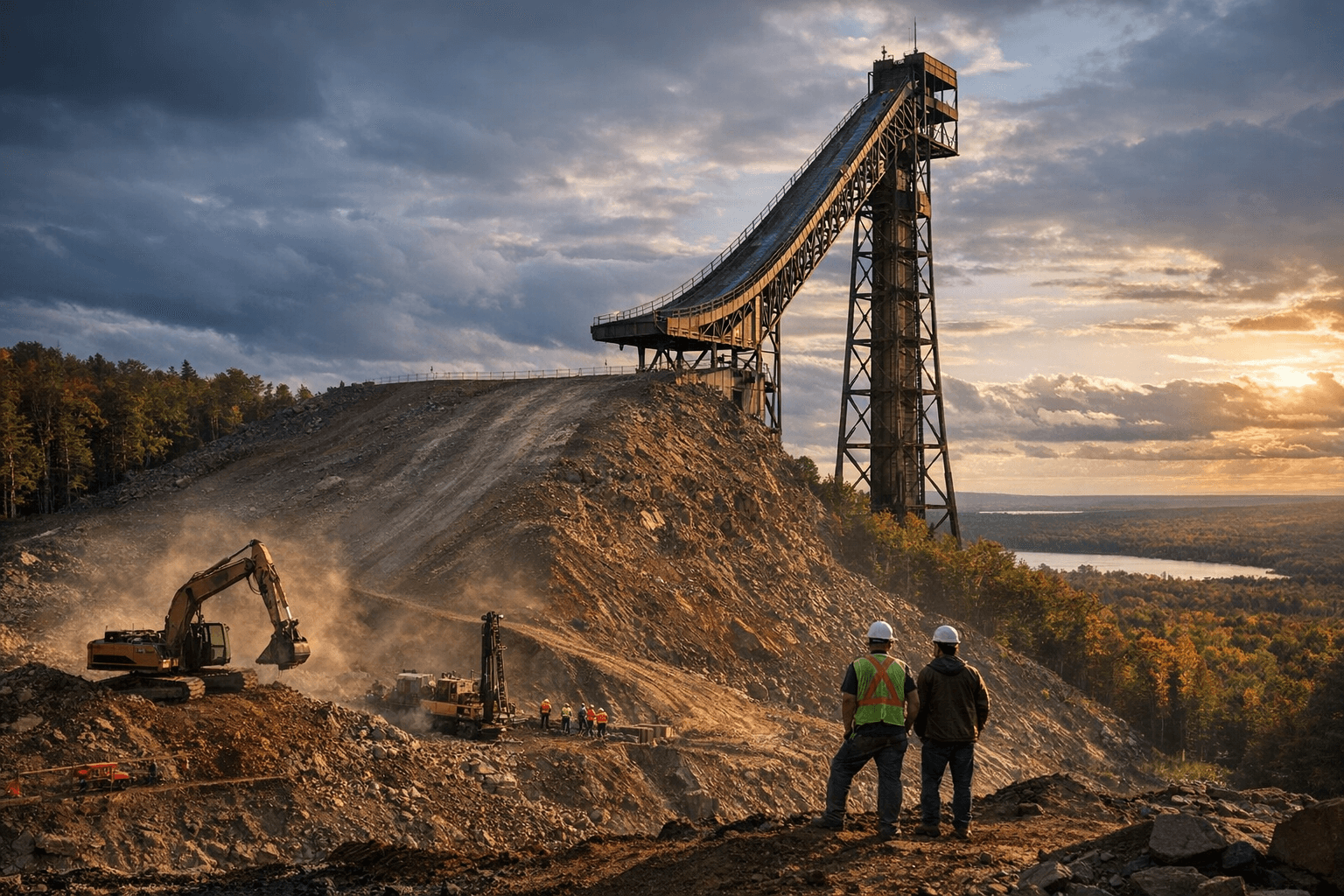
Controlled explosives went to work on Copper Peak's landing hill last May, and what Dykon Blasting Corp excavated from the volcanic rock of Chippewa Hill could ultimately reshape the economy of Michigan's western Upper Peninsula. The concrete ski jump landing hill and outrun are now scheduled for completion by December 2026, setting the stage for the return of international competition to a facility that has sat dormant for more than 30 years.
The 26-story steel structure near Ironwood has not hosted a competitive jumper since 1994, when Austrians Werner Schuster and Matthias Wallner set the official hill record at 158 meters (518 feet). Schuster had unofficially flown even farther in 1989, covering 522 feet, a mark that still stands. After Michigan approved a $20 million grant through the American Rescue Plan Act in March 2022, contractor ECI is now raising the bottom of the landing hill by 18 feet to meet current International Ski Federation specifications, with Barr Engineering overseeing the design.
That FIS certification is the economic linchpin. The governing body has committed to eight competitive events once renovations are complete: three World Cup events and one Continental Cup event each in both winter and summer, with Copper Peak also positioned as a potential finale venue for the Summer Grand Prix.
Bob Jacquart, president of Copper Peak Inc. and founder of Ironwood's Jacquart Fabric Products, the company behind the Stormy Kromer hat, has been the project's primary champion. He estimates the Ironwood area will see a $190 million economic boost within five years of reopening, while officials project $570 million in total regional revenue once the facility is fully operational. "Our group saw the economic potential for Ironwood on a miniature but significantly impactful scale what hosting the 2002 Olympics has done for Park City, Utah," Jacquart said.
For Iron County, which shares its western border with Gogebic County along roughly 98 miles of US-2 corridor from Ironwood to Crystal Falls, those projections carry direct implications. Tom Nemacheck, executive director of Upper Peninsula Travel and Recreation, notes that international visitors average 18-day stays, a duration that spreads lodging and dining demand well beyond a single destination. Ironwood's nine-property hotel inventory was already identified as a pressure point by regional tourism leaders, meaning overflow from world-class ski flying events would likely push east along the US-2 corridor into neighboring Iron County. Tom Bergman, Ironwood's community development director, described the project as one that "puts us on the world stage" and "puts Michigan on the world stage."
The hill that carries those ambitions was built in 1969 by engineer Lauren Larsen using 300 tons of COR-TEN steel for the Gogebic Range Ski Club. At HS180, it holds FIS designation as a ski flying hill, the federation's largest category, exceeding the 90-meter and 120-meter hills used in Olympic competition. Ten international events ran at Copper Peak from 1970 to 1994 before the hill went quiet.
While Phase One construction advances, the Adventure Ride remains open seasonally. Daily hours from mid-July through mid-October run 9:30 a.m. to 4:30 p.m., with admission at $28 for adults and $15 for students 14 and under. A chairlift carries visitors to the hilltop, an elevator climbs to the 18-story observation deck, and on clear days the view extends roughly 60 kilometers across the U.P. and into Wisconsin. A 5.5-mile mountain bike trail system operates alongside. Phase Two, contingent on raising additional funds beyond the initial $20 million, would complete the full modernization and unlock the full slate of FIS events.
This article was produced by Prism’s automated news system from verified source data, official records, and press releases, then run through automated quality and moderation checks before publishing. The system is built and supervised by the people who set the standards it runs under. Read our full AI policy.
Did this article answer your question?