Fortune Pond shows how Iron County mine sites can become nature spots
Fortune Pond turns a former mine pit into a place to fish, paddle, and see Iron County’s industrial past in plain view.
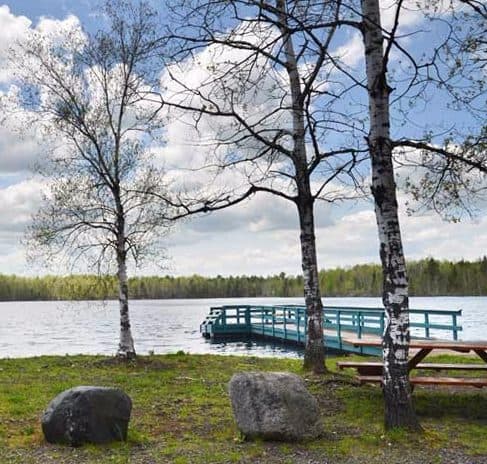
Fortune Pond is the kind of place that makes Iron County’s mining history easy to see at a glance. What was once an open-pit iron operation west of Crystal Falls is now a flooded landscape with undeveloped shores, no homes or cabins, and a public role in the county’s heritage trail.
A mine pit that became water
The pond is the flooded remnant of the former Fortune Lake iron mine, a site that worked for a short but productive stretch from 1953 to 1958. The Michigan Department of Environment, Great Lakes, and Energy says the pit measured about 1,800 feet long, 800 feet wide, and 300 feet deep, while the Iron County Lodging Association places it at about 1,930 feet long and 750 feet wide. Those figures are approximate rather than exact engineering measurements, but they point to the same scale: a large excavation that now reads as a lake.
The ore totals tell the same story. Iron County heritage materials put production at 1,316,905 tons from 1953 to 1958, while EGLE describes the output as about 1,300,000 tons. The mine’s infrastructure also left a mark. Local history materials say it had one shaft with two drifts used to drain the 210-foot-deep pit, a reminder that the water visitors see now filled a space once built for extraction, not recreation.
What changed after the mining stopped
Fortune Pond’s value today comes from what was left behind and what was not built over it. The Michigan Department of Natural Resources says there are no homes or cabins on the pond and that it remains mostly undeveloped. That makes it different from many lakes that have been heavily built up around the shoreline, and it gives the site a quieter, more open feel for fishing and small-boat use.
The DNR also notes that zebra mussels have been found there. That matters for anyone putting a boat in the water or moving gear between lakes, because invasive species spread easily on trailers, anchors, and live wells. The pond’s conservation angle is not abstract; it is part of the everyday experience of using the site responsibly.
A 1994 Michigan fisheries land-use order adds another layer to that practical picture. It prohibits launching motorized vessels from state-owned lands at Fortune Pond, though electric motors are allowed. It also restricts use or occupation of the site between 10:00 p.m. and 4:00 a.m. without written permission. For visitors, that means the pond is open for quiet, low-impact use, but not for the kind of heavy launch activity associated with larger boating lakes.
Where Fortune Pond fits in Iron County’s mining story
Fortune Pond is not an isolated remnant. It is one stop in a county-wide story that began when rail access made ore extraction and transport practical, and eventually grew to about 70 producing mines across Iron County. That larger arc is what gives the pond its local meaning: it is a visible after-image of an industry that shaped the county’s economy, settlement pattern, and identity.

The site’s history goes back even further than the 1950s mine. MichiganRailroads says the Fortune Lake Mining Co. began exploring the Fortune Lake Mine in 1915, and that the property was explored through 1920 before later open-pit work by Pickands-Mather Company. That earlier phase helps explain why the site matters beyond a single postwar mining campaign. The place was part of a much longer search for ore, then a later industrial push, and finally a reclamation by water and vegetation.
The county’s heritage trail materials put Fortune Pond in that broader interpretive frame by listing it as stop number 8 on Iron County’s 36-mile loop. The brochure places it about three-quarters of a mile north of US 2 on New Bristol Road, two miles west of Crystal Falls. That location makes it easy to tie into other Crystal Falls stories without repeating the courthouse-and-downtown narrative that often dominates local history coverage.
How to see it as part of the county’s public landscape
Fortune Pond works best as a stop when you approach it as both a place to visit and a place to read. The shoreline tells you what is not there anymore. The water tells you what filled the pit. The undeveloped setting tells you why the site feels different from a typical roadside lake.
The Iron County Lodging Association captures that transformation plainly, calling it “a wonderful example of the many mines that have been reclaimed by nature.” That is the point visitors can take in immediately: this is not a scenic pond that happened to be near a mine. It is a mine site whose afterlife has become public and visible.
If you are planning a stop, the practical details matter as much as the history. Fortune Pond is best understood as a low-impact destination with limited development, a known zebra mussel issue, and boating rules that favor small, quiet use over powered launch traffic. The site’s appeal comes from that mix of access and restraint.
A useful comparison nearby
The heritage trail brochure pairs Fortune Pond with other county sites that show different layers of Iron County history. One of the clearest nearby comparisons is Be-Wa-Bic State Park, described there as a 315-acre park with public log buildings built by the Civilian Conservation Corps in the 1930s. Put together, the two stops show how the county tells its story through place: one site centers conservation-era building, the other shows industrial reclamation.
That is what makes Fortune Pond more than a scenic remnant. It is a working example of how Iron County turns industrial ground into community space, and how a former pit can become part of the landscape residents point to with pride.
This article was produced by Prism’s automated news system from verified source data, official records, and press releases, then run through automated quality and moderation checks before publishing. The system is built and supervised by the people who set the standards it runs under. Read our full AI policy.
Did this article answer your question?