Iron County Courthouse crowns Crystal Falls with hilltop landmark presence
Crystal Falls’ hilltop courthouse is more than a landmark: it is the building that settled Iron County’s seat and still defines local government.
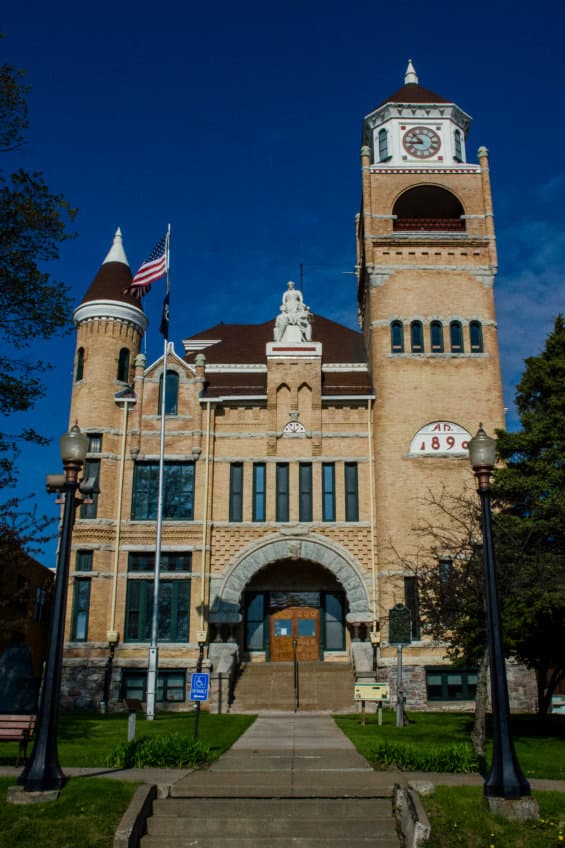
The Iron County Courthouse rises above Superior Avenue like a stone stronghold, and in Crystal Falls it still marks the point where county power settled on this hill. Built in 1890 and 1891 after voters moved the county seat from Iron River, the courthouse turned a hard-fought political decision into the most visible address in Iron County.
A hilltop courthouse that commands the skyline
Set at the head of Superior Avenue on a high hill, the courthouse looks out over the Paint River valley and the surrounding countryside. Its west-end perch gives it the kind of presence that makes it feel less like a routine office building and more like a civic lookout over the town below. On a clear day, the tower balcony can even take in Iron Mountain, about 20 miles away across the hills.
That height has long been part of the building’s identity in downtown Crystal Falls. Visitors who climb or simply stand back to take it in can see why the courthouse has never blended into the streetscape: it crowns the town, rather than merely sitting in it. The bell tower, still part of the building’s public character, reinforces that sense of a place that belongs to the county as both government center and shared landmark.
How a county-seat fight ended in brick and stone
Iron County was created in 1885, and Iron River first served as the temporary county seat. The rivalry between Iron River and Crystal Falls lasted about four years, with local history preserving the contest as one of the county’s defining civic struggles. A historical marker says the government was shifted to Crystal Falls in 1889 after a celebrated struggle, and the Society of Architectural Historians notes that county voters elected to move the seat from Iron River to Crystal Falls.
Crystal Falls lore also includes the “stealing of the courthouse” story, though the city’s own history page treats it carefully as a tale where fact and fiction are hard to untangle. What is not in dispute is the outcome: once voters chose Crystal Falls, the county board of supervisors built a courthouse to substantiate that decision. The building became the physical proof of the vote, and that is why the courthouse remains central to the town’s political identity.

What the building is made to say
The courthouse is a Richardsonian Romanesque, or Romanesque Revival, structure, and its design makes that style legible from the street. It is a 2½-story, towered and turreted building with reddish-brown brick, stone trim, and a rubble-masonry foundation. The massing, arches, and heavy materials give it a fortress-like feel that suits the hilltop site and the seriousness of the county government inside.
The details matter. SAH Archipedia describes polished diorite columns quarried from the Paint River area, and the building includes statuary representing Law, Mercy, and Justice. Those elements make the courthouse more than a functional structure: they present county government as something permanent, symbolic, and deliberately public. Built for about $40,000 and designed by J. C. Clancy of Wisconsin, the courthouse was completed in 1891 and was praised in its day as one of the finest buildings north of Milwaukee or Detroit.
What to notice when you stand in front of it
A visit to the courthouse rewards close looking as much as distance viewing. The building’s materials and scale are easiest to appreciate from the lower approaches on Superior Avenue, where the hill and the tower work together to make the structure feel larger than the block around it.
- The reddish-brown brick and stone trim give the courthouse its warm, rugged color.
- The tower and turreted roofline make the building read as a civic castle from downtown.
- The Law, Mercy, and Justice statuary turns the façade into a statement about public authority.
- The hilltop setting lets the courthouse overlook the town the way county government once looked over a contested seat.
Those features are not decorative extras. They help explain why the building has remained such a durable symbol in a county shaped by mining, timber, and hard local choices.
Why the courthouse still matters to Iron County
Iron County’s early economy made the courthouse possible. Logging began in 1875, and iron ore shipping started in 1882 after the railroad arrived, giving the county the industrial base and confidence to build something that looked permanent. The courthouse came out of that era of expansion, when towns were still competing for influence and public buildings carried political meaning far beyond their walls.
That meaning carried into later preservation milestones. The courthouse was designated a Michigan State Historic Site in 1974 and listed on the National Register of Historic Places on February 24, 1975, the first such Iron County site. Today it remains both a working center of county government and the building that best tells the story of how Crystal Falls became the seat of Iron County, and why the county still reads that decision every time it looks up the hill.
This article was produced by Prism’s automated news system from verified source data, official records, and press releases, then run through automated quality and moderation checks before publishing. The system is built and supervised by the people who set the standards it runs under. Read our full AI policy.
Know something we missed? Have a correction or additional information?
Submit a Tip