Iron River’s mining and logging past still shapes community identity
Mine shafts, log cabins, and preserved rail sites still define Iron River, turning its industrial past into the backbone of daily civic identity.
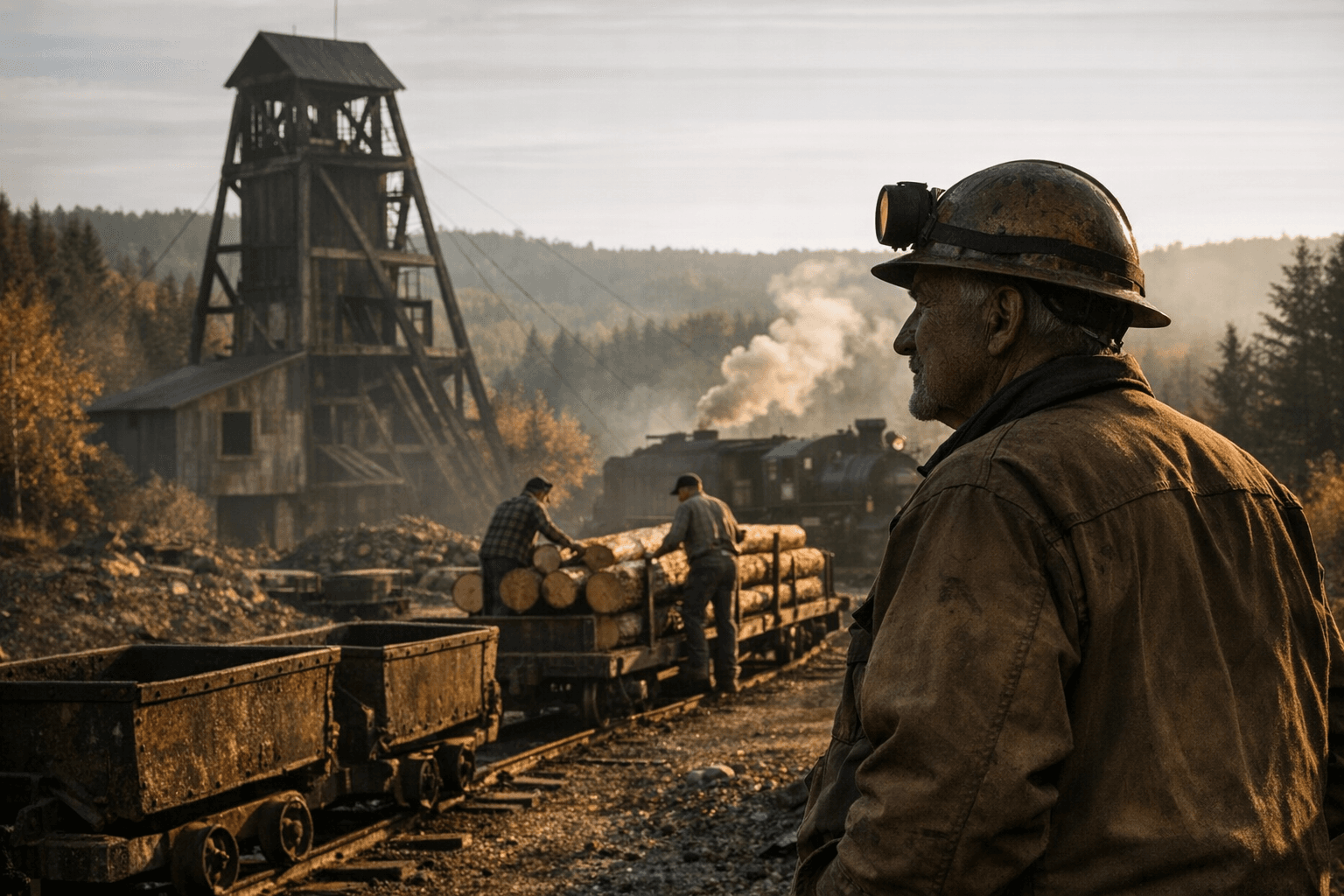
Iron River’s industrial roots are still visible everywhere
Iron River is a town of about 5,000 people in the southwestern Upper Peninsula, but its identity reaches far beyond its size. The community grew out of mining and logging, and those industries did not just build an economy, they shaped how the town sees itself, how it preserves its landmarks, and how it explains its place to newcomers.
That history matters because Iron River was originally settled in 1882 under the name Nanaimo, a reminder that the town’s earliest growth was tied to iron mining. Logging had already begun in Iron County in 1875 along the banks of the Michigamme River, and the two industries together drew workers, families, and investment into the area. County history materials show how dramatic that change was: the county population climbed from 4,432 in 1890 to 20,805 in 1930.
The museum grounds turn county history into a public record
The Iron County Historical Museum gives that story a physical home. Founded in October 1962, the museum grew when Pickands-Mather Company deeded 5.5 acres in 1963 to Iron County, including the Caspian Mine headframe and engine house, so the site could be developed into a museum. It opened in 1968 and has since become one of the county’s most important public institutions for understanding where Iron River and the surrounding communities came from.
Today, the museum describes itself as Upper Michigan’s largest local museum, and the scale matches that claim. It sits on nearly 10 acres and includes 26 buildings, more than 100 major exhibits, and two special art galleries. That collection matters because it preserves not just objects, but the layout and feel of a working county built around extraction, transportation, and settlement.
The grounds also show how local memory is maintained by people as much as by buildings. Erika Sauter, identified in another profile as director of the Iron County Historical & Museum Society in Caspian, has been associated with community development and historical preservation. Her role reflects the broader work of the museum itself, which keeps artifacts, stories, and photographs in circulation as part of the county’s civic memory.
Why Iron River is known as Michigan’s Log Cabin capital
One of the clearest signs of Iron River’s identity is its official standing as the Historic Log Cabin Capital of Michigan. That title is not just a slogan, it is tied to the museum grounds, where the community has preserved an unusually large concentration of log structures that reflect the region’s lumbering era.
Among the named buildings are the Homestead Complex and Barn, The Peterson House, The Beechwood Cabin, The Kaleva Puotinen Barn, The Koski Cabin, The Playhouse, The Maki Sauna, and the Logging Camp. The museum’s own materials emphasize that these structures give visitors a concrete sense of how people lived, worked, and organized family life in a frontier economy shaped by timber and mining.
A regional report also noted that the 9-plus-acre facility has acquired more historic log structures than any other site in Michigan. That helps explain why the log cabin identity still carries weight locally, and why Michigan’s Log Cabin Day, celebrated on the last Sunday in June, fits naturally into Iron County’s historical calendar. For residents, the designation is not a novelty. It is a public expression of the same heritage that built homes, camps, and local institutions here in the first place.
The built environment still tells the story
The most powerful part of Iron River’s history is that it is not locked in archives. It is visible in the preserved structures and exhibits that anchor the museum grounds, including the 1921 mining headframe on the National Register, the 1890 Stager railroad depot, and the 1890 home of composer Carrie Jacobs-Bond. Those sites broaden the story beyond mining alone and show how rail, culture, and settlement all became part of the county’s identity.
That matters in a town where history is often read through place names, landmark buildings, and local institutions rather than through textbook dates. The museum and its preserved structures give residents a way to connect modern Iron River to the generations that worked the mines, cut the timber, and built the county’s early civic life. The result is a community where the past is not ornamental. It is part of the landscape.
Why the history still shapes daily life now
This is why Iron River does not present itself like a polished tourist town. Its character comes from a working-town heritage that still shows up in architecture, museum programming, school lessons, historical displays, and neighborhood pride. The city’s identity is grounded in the practical realities that shaped it, from the mining headframe that still stands on the museum grounds to the log buildings that keep the lumber era visible.
For longtime families, that heritage offers continuity. For new residents, it offers a map for understanding why the town looks and feels the way it does. Iron River’s past is not a backdrop to its present. It is the framework that explains why the community values preservation, remembers its working roots, and continues to define itself through the industries that made it.
This article was produced by Prism’s automated news system from verified source data, official records, and press releases, then run through automated quality and moderation checks before publishing. The system is built and supervised by the people who set the standards it runs under. Read our full AI policy.
Did this article answer your question?