Mansfield Pioneer Church marks Iron County’s mining past and restored history
Mansfield Pioneer Church keeps Iron County’s worst mining tragedy visible beside a restored landmark. Volunteers, a memorial bridge, and the old mine site turn one small building into public memory.
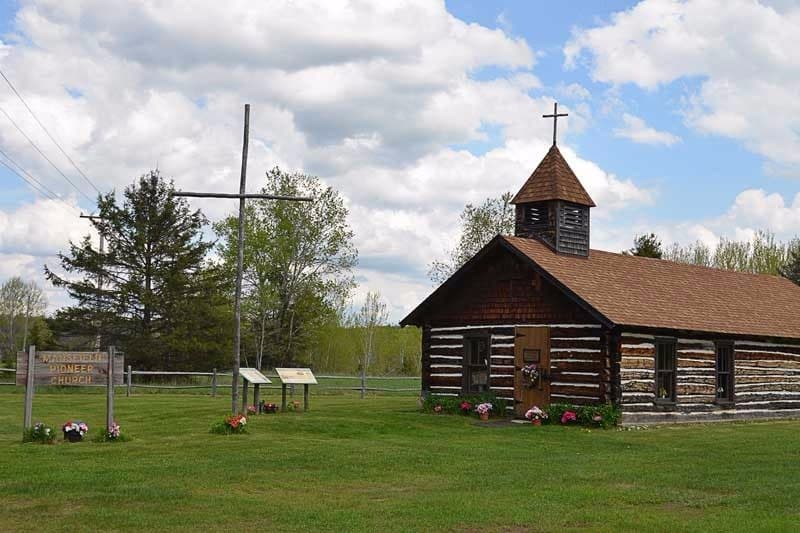
Mansfield Pioneer Church stands where Iron County’s mining boom, ruin, and recovery still meet in one landscape. Just beyond the restored building, the Michigamme River and the Mansfield Mine site hold the story of the September 28, 1893 disaster, when floodwater broke into the underground mine and killed 27 men. What survives now is not only a church, but a place where the county has chosen to keep a fatal chapter in view.
A landscape shaped by loss and preservation
The church sits in a part of Mansfield Township that still reads like a history lesson in the open air. The village was platted along the Michigamme River after iron ore was discovered in 1889 by William Calhoun, and a railroad spur was extended from Crystal Falls to the mine in 1890. The township itself was created in 1891, at the height of that rapid industrial push, and the mine would eventually produce 1,462,504 tons of iron ore during its lifetime.
That rise did not last long. On September 28, 1893, the Michigamme River broke through and flooded the mine, killing 27 men. The following year, a forest fire wiped out 25 buildings and destroyed practically every home in the village. The result is a place where the scale of the loss is still legible, even now, because the surviving buildings and memorial sites were not left to disappear into the woods.
From temperance hall to church to ruin and back again
The building now known as Mansfield Pioneer Church was never originally built as a church. Township history says it began as a temperance hall, the sort of community space that advertised “Plenty to Eat and Smoke,” and it stood among saloons. It later hosted services for different faiths and became associated with Finnish Lutheran worship, which helps explain why the building carries layers of local use rather than a single religious identity.
After the disaster and the fire, the structure sat empty for years and later served as a shingle mill. That practical reuse kept it from vanishing entirely, but it also stripped it of the function that had once tied it to village life. By the time preservation work began, the building had already lived several different lives, each one tied to a different era in Mansfield’s rise and collapse.
The Mansfield Memories Committee began rebuilding the church in 1986. The effort used salvaged logs from other structures, and the restored church was completed in 1988. That restoration matters because it turned a surviving shell into a place that could once again hold gatherings, remembrance, and the kind of informal visitation that keeps local history accessible to people who may never enter a museum.
Today, the church can be rented for weddings, christenings, funerals, and memorial services. The township lists a $100 donation plus a $100 refundable security deposit, which places the building in an unusual civic role: it is both a preserved landmark and a working community space. In Iron County, that combination is part of what keeps the site alive instead of merely protected.
The bridge makes the setting part of the story
The church is only one part of the Mansfield story. Nearby, the Mansfield Road-Michigamme River Bridge adds another layer of public memory to the same landscape. The bridge, built in 1915, was a filled spandrel arch with an elliptical profile, set on concrete abutments. It measured 102 feet long, 20 feet wide, and had an 85-foot main span.
That bridge was listed in the National Register of Historic Places in 1999, then replaced by a replica in 2007. The National Park Service describes the National Register as the official list of the nation’s historic places worthy of preservation, and the Mansfield bridge fits that standard as more than a piece of road infrastructure. It helps frame the area as an outdoor history site, where visitors can move from the church to the river crossing to the mine landscape without losing the thread of what happened here.
The bridge also matters because it extends the story beyond the church building itself. A restored landmark can become isolated if it stands alone, but the bridge, river, and mine site give visitors more than one point of entry into Mansfield’s past. Together, they show that the township has preserved tragedy as a landscape, not just as a plaque.
Why Mansfield still matters now
Mansfield is still part of Iron County’s visitor story because it is maintained by local stewards who treat memory as a shared public asset. The township’s recreation planning points to the site as part of a broader heritage-based strategy, which means the church is not being preserved only as an old structure. It is being kept as a place where county history remains visible, walkable, and meaningful.
That public-memory function is especially important in a county shaped by mining, logging, and settlement patterns that often left little behind. Mansfield Township covers 107.7 square miles, with 99.3 square miles of land and 8.4 square miles of water, and it had a population of 243 in the 2000 census. The Michigamme Reservoir alone is listed at 6,400 acres, a reminder that the township includes a wide rural landscape where historic sites can easily disappear from everyday view unless someone continues to maintain them.
The church endures because volunteers and local preservation groups have treated it as a civic responsibility rather than a nostalgia project. The Mansfield Memories Committee’s rebuilding work in 1986, the completed restoration in 1988, and the continued use of the building for community ceremonies all show the same thing: one surviving structure can carry the memory of an entire settlement if people keep returning to it. In Mansfield, that memory includes the 27 miners who died, the fire that erased most of the village, the workers who built the mine’s brief prosperity, and the residents who chose not to let the story fade with the ruins.
This article was produced by Prism’s automated news system from verified source data, official records, and press releases, then run through automated quality and moderation checks before publishing. The system is built and supervised by the people who set the standards it runs under. Read our full AI policy.
Did this article answer your question?