Bloodworks declares Code Red as Whidbey blood supply hits emergency levels
Whidbey patients needing surgery, trauma care or cancer treatment faced tighter blood supplies after Bloodworks Northwest declared Code Red and sought 1,000 donors a day.

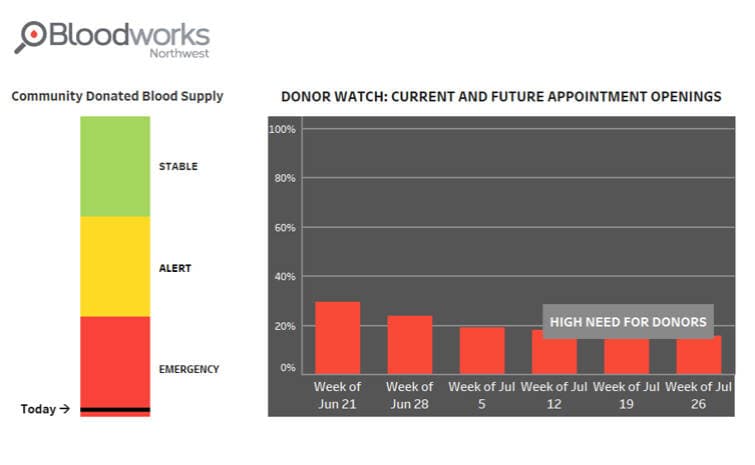
Whidbey patients needing surgery, trauma care, cancer treatment or emergency transfusions were left more vulnerable after Bloodworks Northwest declared Code Red as Western Washington’s blood supply fell to emergency low levels. The organization said it had less than a one- to two-day supply of critical blood types and platelets, a margin that can turn routine care into a crisis if demand spikes.
Bloodworks said the shortage came from a seasonal drop in donations, heavy use at local hospitals and the added strain of summer visitor traffic. Curt Bailey, Bloodworks’ president and chief executive officer, said the organization was doing everything it could to build inventory, but the system still needed about 1,000 donors every day to stay stable. More than 48,000 appointments remained open through July, and Bloodworks said only about 3% of eligible people donate.
The group said donations move quickly into the system: blood components can reach local hospitals within 24 hours. That speed matters for Island County, where an estimated 86,478 people lived in 2024 and the donor pool is smaller than on the mainland. July mobile blood drives were planned in Oak Harbor, Clinton and Langley, giving residents a direct way to help nearby hospitals before the shortage deepened.

Bloodworks said the need is especially urgent for platelets, which last just 5 to 7 days. Red blood cells last 42 days, but rebuilding a depleted supply still takes time. Whole blood donors may give every 56 days, while apheresis platelet donors may donate every 7 days, up to 24 times a year. The organization said 1 in every 7 hospital patients will need a blood transfusion at some point, underscoring how quickly a shortage can touch everyday care as well as emergencies.
The appeal also landed in local politics. Island County Councilmember Bryan Stucky donated blood June 17 and described giving as a practical, apolitical way to help others. Washington residents can now voluntarily add their blood type to a driver’s license or ID card, a state option that took effect Jan. 1, 2026, under Senate Bill 5689.
Bloodworks supplies blood to more than 95% of hospitals in the Pacific Northwest, so a shortfall in one region can ripple across the rest. Bailey said the nonprofit was pushing to increase inventory, but without more donors hospitals could face hard choices about how to stretch limited blood supplies.
This article was produced by Prism’s automated news system from verified source data, official records, and press releases, then run through automated quality and moderation checks before publishing. The system is built and supervised by the people who set the standards it runs under. Read our full AI policy.
Did this article answer your question?