Freeland warehouse becomes growing hub for South Whidbey arts education
A Freeland warehouse is becoming South Whidbey’s new arts backbone, with lessons, rehearsals and youth programs now sharing one roof.

A warehouse on East Main Street is quietly becoming civic infrastructure
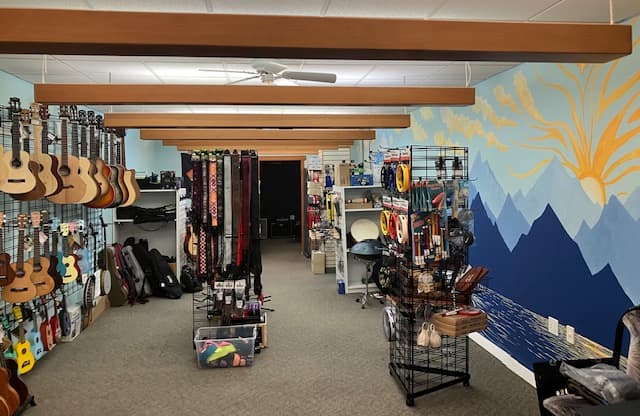
At 1694 East Main Street in Freeland, a warehouse that looks understated from the road is turning into one of South Whidbey’s most practical arts assets. Inside, teachers, students and youth ensembles are beginning to share the kind of space the island has long needed: rooms for lessons, places to rehearse, and a setting where performance can happen without a trip off-island.
The building is already home to Tiny House of Strings, Whidbey Island School of Music and Dance, Blue Sound Music and the Salish Youth Symphony, with the Whidbey Island Language, Arts and STEM Center planning to use the site for summer programs. That mix makes the property more than a rental address. It is becoming a working arts center, one that fills daily gaps in the island’s cultural life rather than waiting for a big institutional buildout.
Aniela Perry’s path to Whidbey shaped the project’s scale
The effort centers on Aniela Perry, who came to Whidbey Island in 2021 after more than 20 years working in Los Angeles as a studio musician. Her background includes playing on feature film and television scores, and her work on the island has quickly spread across multiple institutions, from the Saratoga Orchestra of Whidbey Island to the Whidbey Island Waldorf School and the Salish Youth Symphony.
According to Tiny House of Strings, Perry’s move started in the summer of 2021 when an old friend offered her a cottage to rent on Whidbey Island. She had been looking to relocate back to the Pacific Northwest, and once she arrived she moved fast. She joined the Saratoga Orchestra, became the strings teacher at Whidbey Island Waldorf School, formed Trio Rasa and began playing bass with Buried Blond. Her bios also identify her as principal cellist of the Saratoga Orchestra, director of the strings program at the Waldorf school and director of the Salish Youth Symphony.
That breadth matters because the warehouse is not being built around one program. It is being organized around a working network Perry already knows from inside the island’s music scene.
The practical gap it is filling is easy to see
Perry has said she noticed that some of the island’s music education pathways had fallen apart and wanted a physical place where instructors and students could reconnect. The Freeland space is built around that idea. It is not just a recital hall or an office suite. It is a place where people can study, rehearse and eventually perform under the same roof.
The programs tied to the site already cover a wide range of instruction: classical, jazz, rock, cello, violin, piano, drums, bass, blues and marimba. That mix reflects how island music education often works in practice, with young players moving between classical training, band experience and ensemble work as they grow. It also gives adults a place to keep learning without having to leave South Whidbey.
The Salish Youth Symphony is already using the building in a concrete way, with young cellists rehearsing weekly at the Freeland space. That detail matters because it shows the project is not merely a plan on paper. It is already functioning as part of the island’s youth music pipeline.
Among the teachers and collaborators connected to the space are Sheila Weidendorf, Linda Vogt, Gloria Ferry-Brennan, Roxanna Patterson and Doug Kelly, a roster that points to a broader community effort rather than a single-person studio. Perry’s co-op model is meant to invite more instructors and students into that network as the building comes into fuller use.
Freeland’s history makes the model feel especially rooted
The choice of Freeland is not accidental. Local history sources trace the town’s roots to the Free Land Association, a socialist cooperative community that platted five-acre lots and filed incorporation papers on January 12, 1900. Freeland later became South Whidbey’s commercial center, and it remains an unincorporated community on Whidbey Island.
That cooperative history gives Perry’s project an added layer of context. The warehouse is not being introduced as an imported arts campus or a top-down cultural development. It fits a place that has long been shaped by local initiative, shared responsibility and small-scale organizing. In that sense, the co-op structure is less a branding choice than a continuation of the town’s own civic DNA.
It sits beside a larger island arts ecosystem, not outside it
The Freeland hub is growing in the shadow of a much larger regional institution in Langley. Whidbey Island Center for the Arts says it has been a cultural hub since 1996 and identifies itself as Island County’s largest arts organization and employer. That underscores the reach of the island’s arts economy, but it also shows why a smaller, grassroots space in Freeland matters.
A place like this can absorb demand that larger venues and schools do not always cover. It can host beginners, working musicians, youth players and summer camps in one setting. It can also keep activity local, which is especially important on South Whidbey, where transportation and scheduling often decide whether people participate at all.
The Whidbey Island Language, Arts and STEM Center, now in its third summer camp season, already offers camps for ages 5 to 16. Its plan to use the Freeland site suggests the building could become part of a broader seasonal youth-programming network, not just a one-off rental arrangement. That kind of overlap between music, arts and STEM programming is exactly the sort of practical layering that makes small-community infrastructure work.
The work left in the building is real, but so is the momentum
The warehouse still needs framing, drywall, soundproofing, painting and electrical fixes. Those unfinished details matter, because they show the space is still in transition and still being adapted to the demands of rehearsal, teaching and performance. But they do not hide the fact that the center is already active.
That is the defining feature of the Freeland project. It is not waiting to become useful. It already is. On a stretch of East Main Street that once held the promise of a simple warehouse, South Whidbey is watching a locally built arts commons take shape, one lesson and rehearsal at a time.
This article was produced by Prism’s automated news system from verified source data, official records, and press releases, then run through automated quality and moderation checks before publishing. The system is built and supervised by the people who set the standards it runs under. Read our full AI policy.
Did this article answer your question?