Island County Judge Clarifies How Small-Claims Court Actually Works
About 95% of Island County small-claims cases never reach a judge — Island County District Court Judge Ronald Costeck explains what actually happens.

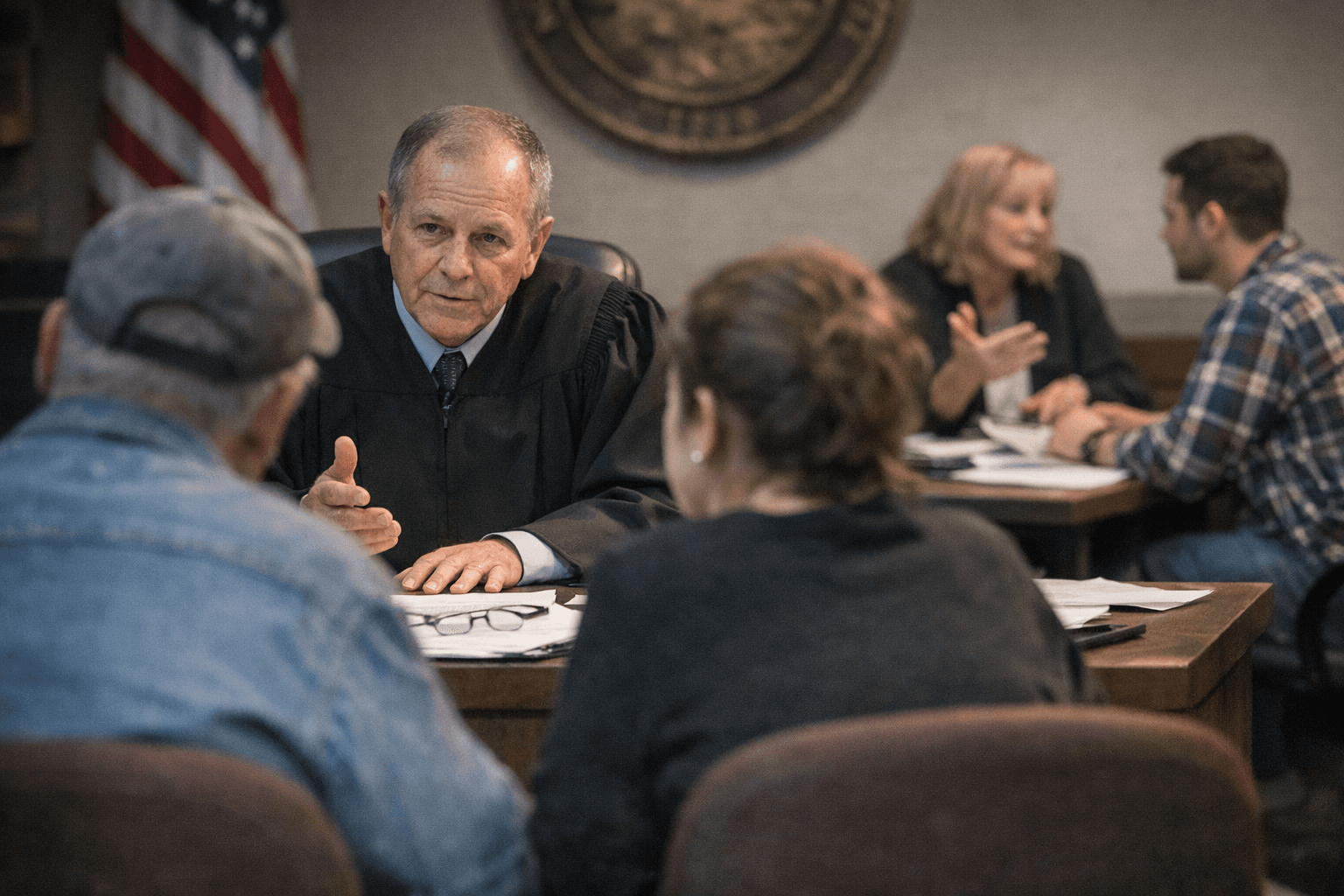
Forget Judge Judy. The reality of small-claims court in Island County looks almost nothing like the televised version, and Island County District Court Judge Ronald Costeck wants residents to understand what they're actually walking into before they file.
Costeck, who presides over Island County District Court, wrote a practical explainer for the community laying out how the local small-claims process works from first filing to final resolution. The picture he paints is one where courtroom drama is largely beside the point: "The small claims process in Island County District Court begins with stating and filing of a civil action," he writes, and in the vast majority of cases, it never gets much further than a conversation between two neighbors and a neutral mediator.
Filing and Service: Where It Starts
Every small-claims action at Island County District Court opens the same way, with the claimant stating and filing a civil action. Once that paperwork is submitted and service is achieved on the opposing party, the court takes an approach that surprises many first-time filers. Rather than scheduling an immediate hearing before a judge, the court routes the matter to its own mediation team. As Costeck puts it, "once service is achieved, the matter is initially handled through court provided mediators."
That routing is not a detour or a delay tactic. It is, in practice, where most Island County small-claims cases begin and end.
The 95% Number That Defines the Process
The statistic Costeck cites is striking: "about 95% of these cases are resolved through the mediation process." For a community that tends to handle disputes with a degree of directness and goodwill, that number may not be entirely surprising, but it carries real implications for anyone expecting a courtroom showdown.
The mediation is conducted by a neutral mediation team provided by the court, meaning neither party needs to locate or pay for an independent mediator. If the parties reach an amicable agreement, they sign a binding contract memorializing the terms. The enforceability of that outcome is built into the process from the start.
What makes the model work, according to Costeck, is its flexibility. "The flexibility of the mediation process allows the litigants to control the outcome of their case." Unlike a judicial ruling, which imposes a result, mediation lets the parties shape the resolution themselves. That distinction matters enormously in a close-knit island community where the person you're disputing with today may be your contractor, neighbor, or fellow volunteer tomorrow.
What Settlements Actually Look Like
Costeck notes that Island County District Court "has seen every variation of settlements, from a handshake, to exchange or repair of goods and services, to a mutual compromise on damages." That range reflects the practical texture of disputes on Whidbey Island and Camano Island: not every case is about cash, and not every resolution looks like a check being written.
A claimant might file because shoddy work was done on their home and they want it fixed properly, not just compensated. A landlord-tenant disagreement might resolve with a payment schedule rather than a lump sum. Two parties who started with hardened positions might land on something neither originally proposed. The mediation framework accommodates all of it.
A Court That Sees the Full Spectrum
Costeck's explainer also pushes back against any assumption that small-claims cases are inherently trivial. The court draws a meaningful distinction between what he calls "principled cases," where the damages sought are actually less than the filing fee itself, and "restorative cases," where the amount claimed represented a significant impact on a family's finances.
Both types deserve serious treatment, and both reflect something real about the community. As Costeck writes, "the complexities of small claims reflects the diversity and dynamics of our island community." A dispute over a few hundred dollars may be a matter of principle for one party and a matter of survival for another. The court's stated commitment is to treat each case on its own terms.
That commitment extends to how litigants are treated as people, not just as case numbers. "We do our best to treat every case with personalized attention and the litigants with understanding and respect," Costeck writes, a standard that runs through his description of the court's broader philosophy.
The "Island County Way"
Costeck is candid that small-claims disputes, even seemingly simple ones, can be complicated. "Despite these challenges the court approaches, small claim matters in a judicial manner in the Island County way." That phrase, the Island County way, carries weight in the context of a community where institutions are expected to reflect local values rather than operate as distant bureaucracies.
The emphasis on mediation over adjudication, on flexibility over rigidity, and on resolution over procedure is consistent with that sensibility. It also has a practical payoff: when 95 out of every 100 small-claims cases resolve without a hearing, the court's docket stays manageable and residents get faster outcomes.
How to Learn More or File
For anyone considering a small-claims action to resolve a civil dispute, Costeck points directly to two resources. The Island County District Court's small-claims page at islandcountywa.gov/984/Small-Claims-Civil-Action provides procedural information specific to the local court. The governing state statute, RCW 12.40, outlines the legal framework for small-claims actions in Washington more broadly.
Both resources are worth reviewing before filing. Understanding that the process will almost certainly move through mediation first, and that the outcome will likely be something both parties agreed to rather than something imposed from the bench, changes how a claimant should prepare and what they should expect.
"Please remember that Island County District Court is your community court," Costeck writes in closing. "We are here to assist both in large and small issues within our community." For Whidbey and Camano Island residents navigating a civil dispute, that's not just a courtesy line. It's a description of a court that has built its small-claims process around the people who actually live here.
This article was produced by Prism’s automated news system from verified source data, official records, and press releases, then run through automated quality and moderation checks before publishing. The system is built and supervised by the people who set the standards it runs under. Read our full AI policy.
Did this article answer your question?