Island County museum ties Whidbey history to America 250 exhibit
Whidbey’s America 250 exhibit links Coupeville to George Washington, local Native history and July Fourth traditions, all inside a free museum show.

The Island County Historical Museum is using America 250 to place Whidbey Island inside the nation’s founding story, not outside it. The free exhibit, opening July 5 in Coupeville, connects local family lines, Indigenous history and Revolutionary-era memory in a way that makes familiar island names look newly national.
Why Whidbey belongs in America 250
The exhibit, titled *America 250: Moments That Made Us*, is part of the nationwide America 250 commemoration and is listed on the Washington State Historical Society’s America250 calendar from July 1 through November 20. It is built around five Declaration of Independence themes: Created Equal; Life, Liberty, and the Pursuit of Happiness; Free and Independent States; Consent of the Governed; and We Mutually Pledge.
That framework matters on Whidbey because the island’s history has never been isolated from the larger American story. The museum’s permanent exhibits already stretch from the last Ice Age to recent generations, and its collection includes tens of thousands of items, with only a small percentage on display at any one time. America 250 adds another layer by showing how early settlement on the island connects to the country’s founding, then carries that connection into the way Americans still mark Independence Day.
Executive Director Dalva Church said the show is meant to push visitors to think about the country’s past and what it means for the future. She also said early Independence Day celebrations could be “creative and over-the-top,” adding that “Americans like a good party.”
Revolutionary-era links with Island County roots
The strongest local thread runs through family history. The exhibit highlights Capt. Hezekiah Lovejoy, Col. Hugh Crockett and George Ebey II, whose family lines reach back to people who served alongside George Washington. That link gives Island County a direct, if surprising, connection to the Revolutionary era, one that reaches beyond ceremonial patriotism and into actual genealogy.
The show also uses the Fourth of July to trace how national traditions moved west. By the time Independence Day celebrations reached the Pacific Northwest, the holiday had already traveled a long way from the original colonies, picking up local customs and new meaning along the way. On Whidbey, that evolution turns into a larger story about how national rituals land in a place shaped by islands, shipping routes and settlement patterns that followed centuries of Indigenous presence.
Church said the exhibit is meant to help people understand where the community came from so they can better understand where it is going. She also said the timing matters because a shared celebration can bring people together during a divisive moment.
What the exhibit shows inside the museum
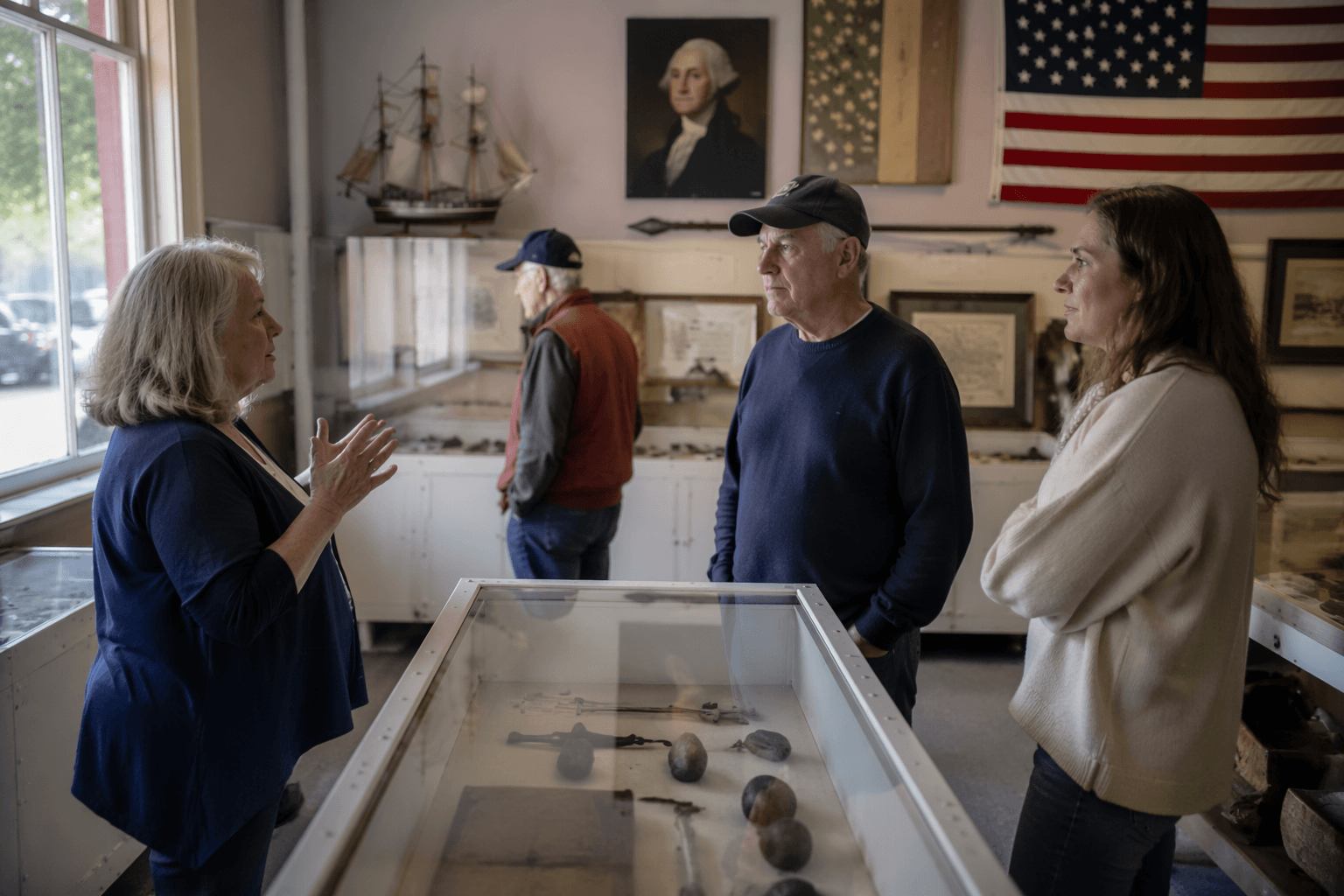
Visitors will see artifacts that span two and a half centuries, including items preserved from the country’s bicentennial celebration in 1976. That mix of old and newer material is part of the point: the museum is not treating America 250 as a static history lesson, but as an ongoing conversation between past commemorations and present-day questions.
A community Wish Wall will also be part of the exhibit. The interactive display invites visitors to write hopes for America’s future, turning the show into something more than a gallery of objects. It gives the museum a civic role as well as a historical one, tying Revolutionary-era memory to the way island residents think about the country now.
The exhibit’s local context goes deeper than pioneer genealogy. It places the Revolutionary era beside the Native village that once stood on the museum site and the early trading ships that encountered Indigenous communities along the coast. That shift matters, because it keeps the story from becoming a simple celebration of settlers alone. It shows the island as a place where Indigenous life, maritime contact and later American expansion were already overlapping long before Coupeville looked like the town visitors know today.
A museum that treats local history as a long timeline
The museum’s broader interpretation helps explain why this exhibit fits in Coupeville. Island County history, as the museum presents it, runs from Native peoples who lived on the islands for about 10,000 years through early European exploration, Anglo-American colonization, Native history, maritime history and immigrant communities. Whidbey Island was first recorded by Europeans in 1792, when George Vancouver explored Puget Sound, and the island later took the name of Joseph Whidbey.
That longer view also connects to one of the region’s best-known landmarks: Ebey’s Landing National Historical Reserve. Created by Congress in 1978, it remains the first and still only historical reserve in the United States. Together, those markers show that Island County is not a side note in Washington history. It is a place where federal memory, local land use and Indigenous presence all sit close together.
Plan your visit
The Island County Historical Museum is at 908 NW Alexander St. in Coupeville. Regular hours are Monday through Saturday from 10 a.m. to 4 p.m. and Sunday from 11 a.m. to 4 p.m., and admission to the America 250 exhibit is free.
With the July Fourth holiday approaching, the show gives residents and visitors a reason to see Whidbey’s past as part of the country’s larger founding story, not separate from it. In Coupeville, America 250 becomes a local history exhibit with national reach, built from artifacts, family lines, Indigenous memory and the kind of shared civic questions that still shape the island today.
This article was produced by Prism’s automated news system from verified source data, official records, and press releases, then run through automated quality and moderation checks before publishing. The system is built and supervised by the people who set the standards it runs under. Read our full AI policy.
Did this article answer your question?