Langley Arts Program Brings Low-Cost Creative Classes to Whidbey Residents
Create Space Langley offers collage, painting, and ink workshops at the South Whidbey Community Center for near-nothing, with a new arts council partnership expanding its reach.
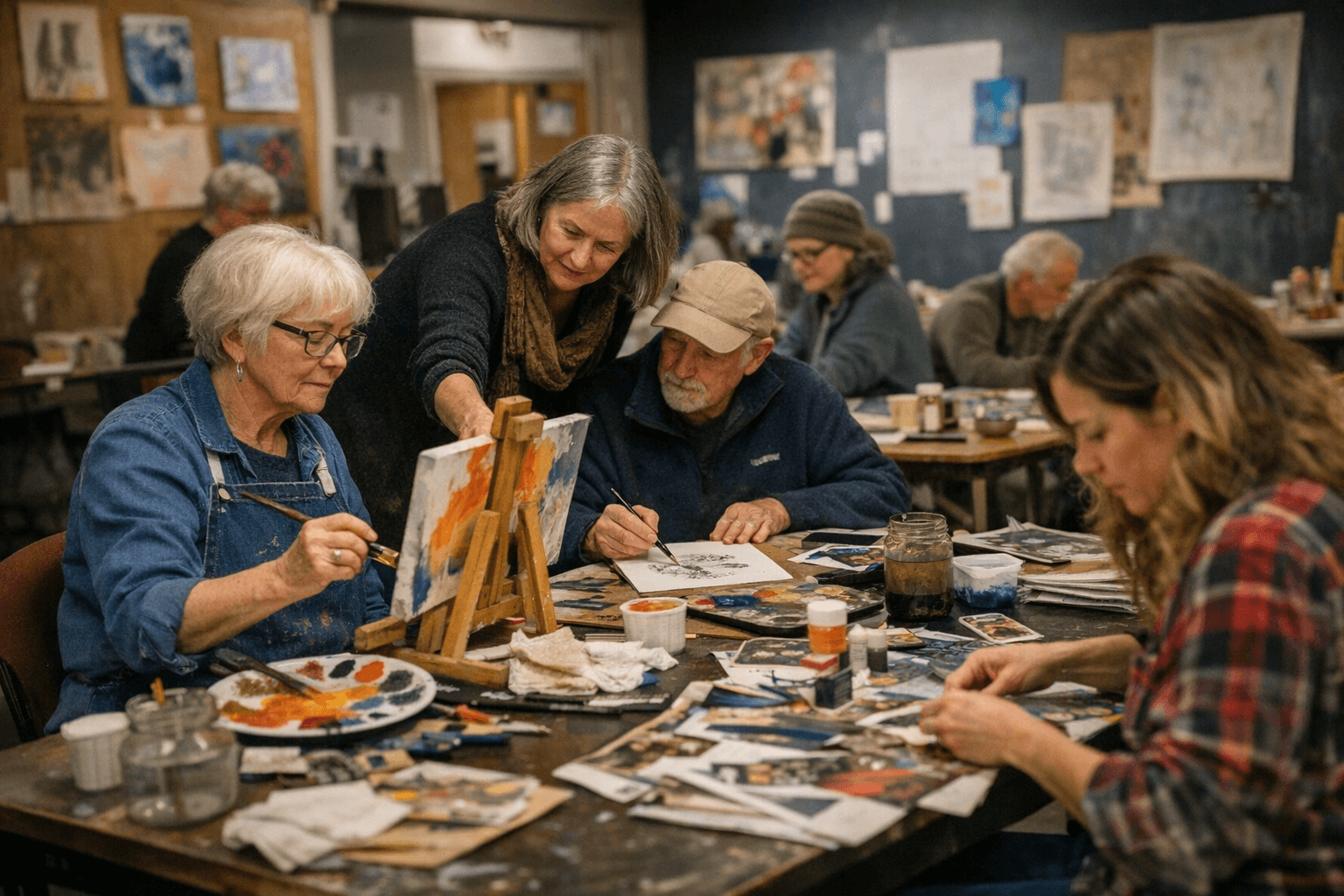
Tucked inside the South Whidbey Community Center in Langley, a volunteer-run program is quietly doing something rare: making serious arts education available to nearly anyone who walks through the door.
What Create Space Offers
Create Space Langley runs a rotating slate of hands-on classes covering collage, painting, and ink techniques, alongside a weekly open studio session that functions as both a creative workspace and an informal study hall. Co-founder Jackie Amatucci built the program around the idea that access to art-making shouldn't hinge on disposable income or prior training. Classes are intentionally priced low and staffed entirely by volunteers, stripping away two of the most common barriers to arts participation: cost and the intimidating gatekeeping of formal instruction.
The weekly open studio is a particular draw. Unlike a structured class, it invites participants to bring their own projects, borrow tools, and work alongside others at whatever pace suits them. The social dimension is built into the model: people share materials, swap techniques, and offer each other feedback in a setting that feels more like a neighborhood workshop than a classroom.
The Philosophy: Experiment, Don't Perfect
What sets Create Space apart from more traditional arts instruction is its explicit rejection of perfectionism. Instructors encourage students to try unfamiliar techniques without self-judgment, treating each session as an opportunity to explore rather than produce a polished result. That approach has made the program particularly welcoming to adults returning to creative practice after long gaps, people who might otherwise feel too self-conscious to enroll in a formal class.
Ann Hooe, one of the program's participants, describes herself as a "relapsed art student," a phrase that captures exactly the kind of person Create Space was designed to serve. The program gives people like Hooe a place to learn, stumble, and experiment in a setting where that process is the point, not a detour from it.
Jackie Amatucci and the Volunteer Model
Jackie Amatucci, Create Space's co-founder, is the organizing force behind the program's class lineup and community ethos. Running an arts education program entirely on volunteer labor is logistically demanding, but it is also what keeps costs low enough to serve a genuinely broad cross-section of island residents. The model depends on instructors who are invested in the community rather than compensated by it, and it operates inside a shared public space that keeps overhead minimal.
That approach, community volunteers in a public building, is a deliberate expression of the program's values. Create Space isn't trying to replicate a private art school; it's trying to build a node in South Whidbey's peer-to-peer creative network, where knowledge and skill circulate freely across ages and backgrounds.
A New Partnership With the Whidbey Island Arts Council
Create Space recently formalized a partnership with the Whidbey Island Arts Council, a move that meaningfully expands what the grassroots program can accomplish. The Arts Council provides nonprofit status support, which opens the door to grant funding that would otherwise be out of reach for a volunteer-run organization. It also offers promotional infrastructure and administrative assistance, the behind-the-scenes capacity that small programs often struggle to sustain on their own.
The affiliation represents a blueprint for how small, community-rooted arts organizations can scale their impact without losing their character. By joining a larger institutional network, Create Space gains access to resources while preserving the informal, accessible spirit that makes it work. For other grassroots programs on the island, the partnership signals a viable path forward.
Why It Matters on South Whidbey
In a community like South Whidbey, where formal arts institutions are limited by geography and population, programs like Create Space fill roles that go well beyond basic arts instruction. Participants develop confidence, form lasting friendships, and become more active contributors to the island's creative economy. The arts scene here runs on volunteer energy and shared enthusiasm, and Create Space acts as connective tissue in that ecosystem.
The broader implications extend to mental health, social connection, and even tourism appeal. A visible, active arts culture draws visitors and supports local galleries, studios, and makers markets. By keeping the threshold to participation as low as possible and centering craft and curiosity over elite technique, Create Space cultivates the next wave of makers and arts supporters on the island.
The South Whidbey Community Center location is itself significant. Situating the program in a shared public facility rather than a private studio reinforces its civic character. This is arts education as a public good, not a luxury, and that distinction matters in a rural island community where resources and access are perennial concerns. With the Whidbey Island Arts Council now in its corner, Create Space is better positioned than ever to keep that door open.
Know something we missed? Have a correction or additional information?
Submit a Tip

