South Whidbey Girl Scout teaches 4-H about service dogs and therapy dogs
Kira’s dog-training Gold Award project is teaching Island County youth the difference between service dogs and therapy dogs while building toward the Whidbey Island Fair.

Kira turns a personal passion into public service
South Whidbey teen Kira is turning dog training into more than a hobby. Her Girl Scout Gold Award project is built around hands-on learning, public education and a message that reaches beyond her own dogs: working animals have a real place in daily life, but they are not all the same.
That distinction was front and center when she gave a presentation to 4-H in Oak Harbor at the Whidbey Island Fairgrounds. Her talk explained the difference between service dogs and therapy dogs, a topic that matters on Whidbey Island because so many young people already move through 4-H, the county fair circuit and local animal programs. Kira’s project is not just about earning an award. It is about giving island families, pet owners and youth exhibitors a clearer understanding of how dogs are trained, where they fit in public service and what kind of responsibility comes with working with animals.
Why the project matters on Whidbey
The local setting gives Kira’s work immediate relevance. Island County 4-H currently has 11 active clubs, including dog-focused groups such as All American Puppy Paws, Happy Hounds and K-9 Korps. That network creates a ready audience for a project centered on dog training, obedience and public education.
The Whidbey Island Fair adds another layer. The fair, scheduled for July 23-26, 2026, lists 4-H exhibitors among its major attractions, making it one of the island’s most visible stages for youth animal projects. Kira and her dogs are expected to take part this summer, tying her Gold Award work to the broader seasonal rhythm of the island’s agricultural and youth exhibition calendar. The fair’s parade is set for Saturday, July 25, at 10 a.m., another sign that this is not a narrow club exercise but part of a larger community event that draws public attention.
That visibility is part of what makes the story resonate. Kira’s project connects South Whidbey, Oak Harbor, 4-H and the fair circuit in one thread, showing how a teenager’s interest can become a public-facing effort with practical value for other island residents.
What she is learning and teaching
The heart of Kira’s presentation was a basic but important lesson: service dogs and therapy dogs are not interchangeable. Service dogs are trained to help people with disabilities with everyday tasks, while therapy dogs serve a different role in offering comfort and support. On Whidbey Island, that distinction has local relevance because Summit Assistance Dogs trains mobility service dogs for people with disabilities and helps show what working-dog training looks like in real life.
That nearby example helps explain why Kira’s topic matters beyond the show ring. When young people understand how working dogs are trained and deployed, they are better prepared to interact with them appropriately in public and to appreciate the skill, discipline and patience behind the work. It also broadens the value of 4-H by showing that dog projects can teach responsibility, communication and service, not just handling technique.
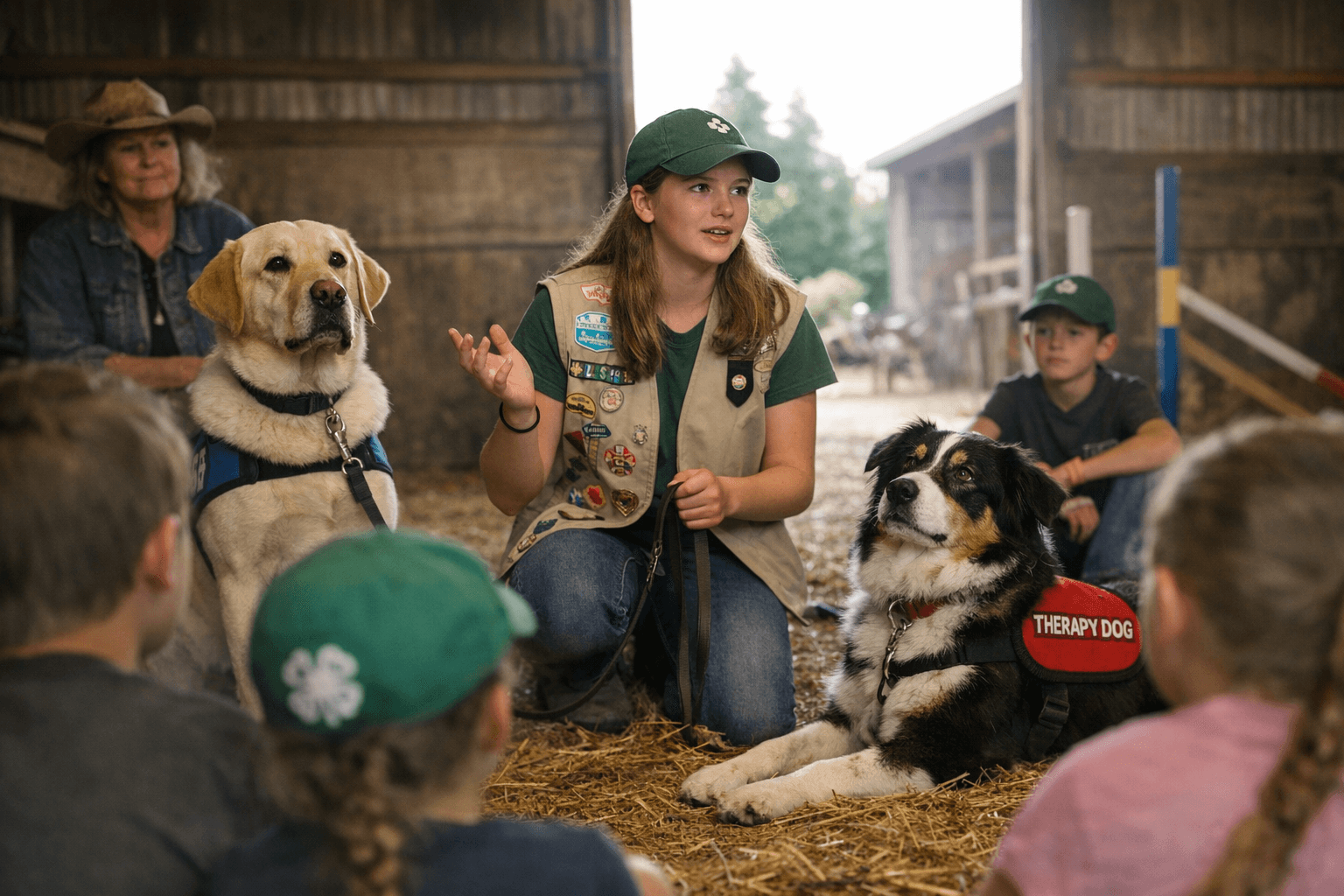
Kira’s project also appears to be building confidence as much as competence. A Gold Award project requires more than personal enthusiasm; it asks a student to research, teach and create something that lasts. In Kira’s case, the lesson is both literal and practical: she is learning to handle dogs, and she is also learning how to explain those distinctions to other young people in a way they can use.
What the Gold Award requires
Girl Scouts describes the Gold Award as the highest award for girls in grades 9-12 at the Senior and Ambassador levels. The work goes beyond completing activities or logging volunteer hours. A qualifying project requires research, a team of trusted adults and community leaders, and a plan for sustainable change.
Kira’s project fits that framework closely. She has been preparing for the award since she joined Girl Scouts years ago, and her dog-training effort now combines study, community presentation and a public outcome that can be carried forward. For the class of 2026, final Gold Award reports and projects are due by September 30, 2026, which gives her project a clear horizon and reinforces that this is a sustained undertaking rather than a one-day presentation.
That deadline also helps explain why the project has such a deliberate shape. Gold Award work is meant to show focus and perseverance, and Kira is meeting that challenge through repeated training, public speaking and participation in island events. The result is a project with structure, accountability and a community benefit that reaches beyond her own résumé.
What comes next at the fair and beyond
Kira and her dogs are expected to return to the Whidbey Island Fair this summer with an eye on state fair competition in September. The categories are showmanship, obedience and agility, all of which demand preparation, consistency and a strong handler-dog relationship. Those are not only competition skills. They are also the same habits that make a dog project useful to the wider community: patience, precision and trust.
That next step matters because it extends the project’s timeline. Instead of ending with a presentation in Oak Harbor, the work continues through the summer and into fall, linking a South Whidbey teen’s effort to a larger path of county and state-level youth competition. In a county where youth stories can easily get lost between bigger civic and political headlines, Kira’s project stands out for a simple reason: it produces something tangible that other people can use.
The public-facing part of her Gold Award is already doing that. It gives young islanders a clearer understanding of service dogs and therapy dogs, connects 4-H to the practical world of dog training, and shows how one student can turn a personal interest into community knowledge. On Whidbey Island, that kind of work has a lasting value that goes well beyond a single award season.
This article was produced by Prism’s automated news system from verified source data, official records, and press releases, then run through automated quality and moderation checks before publishing. The system is built and supervised by the people who set the standards it runs under. Read our full AI policy.
Did this article answer your question?