USS Ashland Completes Wartime Repair Drill in Philippines, Honoring Whidbey Island Legacy
USS Ashland's crew repaired battle damage in Cebu harbor last Saturday, a real-world survivability drill for the ship bearing Whidbey Island's name.
Across the Indo-Pacific and thousands of miles from Oak Harbor, the Whidbey Island-class dock landing ship USS Ashland isn't just a name on a hull: it's a crew training to repair their ship under simulated wartime conditions and bring the sailors inside it home.
USS Ashland (LSD 48) completed a ship wartime repair and maintenance exercise, known as SWARMEX, on April 5 during a scheduled port visit to Cebu in the Philippines. Think of it as a battle-damage fire drill: the kind of mechanical failure, hull fracture, or electrical fault that in a real conflict must be fixed on the spot, far from the nearest American shipyard, by the crew itself alongside allied technicians.
The exercise ran three concurrent tracks: an expeditionary repair availability putting maintenance teams to work on real systems; a battle damage assessment and repair table-top exercise walking officers through wartime casualty decisions; and a continuous maintenance availability keeping the ship's routine work moving in parallel without losing operational tempo.
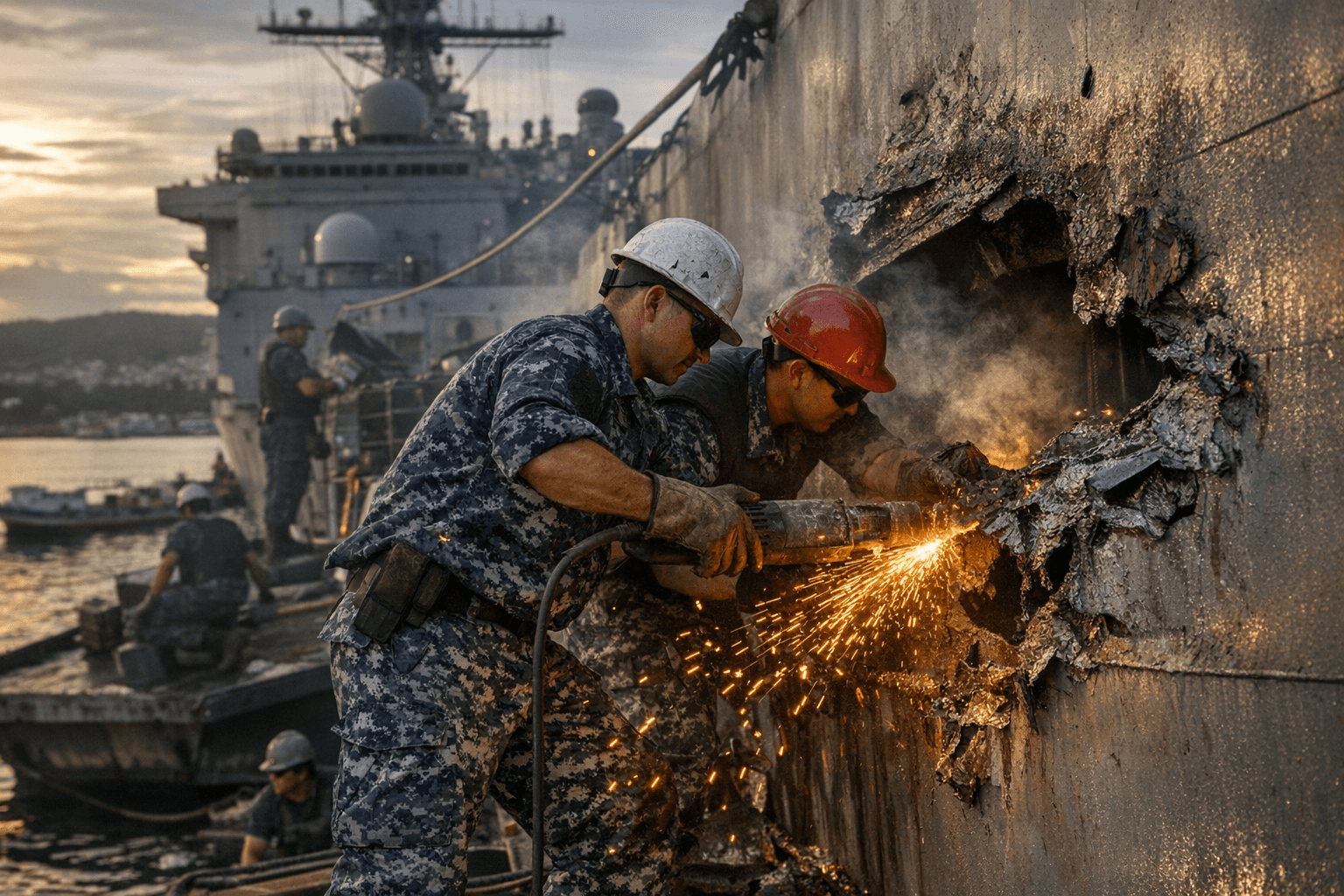
What that looked like on the deckplates: Hull Maintenance Technician 2nd Class Christian Deang, assigned to the Southwest Regional Maintenance Center, ground and then welded a fractured fan unit bracket aboard Ashland in Cebu harbor. Electrician's Mate 2nd Class Wyatt Rimmer, one of Ashland's own assigned crew, performed valve and circuit breaker maintenance alongside a Southwest Regional Maintenance Center partner and a Philippine Navy contractor. Enginemen from the maintenance center replaced a component directly in the main engine room. Each task rehearses the same question: when the ship takes damage far from home, can the crew fix it and keep fighting?
"Our Sailors really came together as a team to meet the challenges of this exercise," said Cmdr. Adam Peeples, Ashland's commanding officer. "The skills we learned increase our capability to keep USS Ashland in top material condition and help our forces maintain peace through strength."
Philippine Navy Rear Adm. Juario C. Marayag, Commander of Naval Sea Systems Command, toured the ship during the exercise alongside Capt. Wendel Penetrante of the Ship Repair Facility and Japan Regional Maintenance Center. Their participation reflects the alliance-building that SWARMEX formally incorporates, designed specifically to strengthen ties with the skilled workforce of allied and partner nations in the region.
Ashland and its embarked Marines from I Marine Expeditionary Force form Task Force Ashland, currently conducting routine operations in U.S. 7th Fleet, the Navy's largest forward-deployed numbered fleet. The task force is built to function independently or integrate with broader naval assets as a component of Distributed Maritime Operations.
For Island County, the ship's class name carries more than heritage. The Whidbey Island-class ships were named for this island, and USS Ashland, the last of the eight vessels in that class, carries that designation into every port of call across the Pacific. Families tracking the deployment can reach NAS Whidbey Island's Fleet and Family Support Center in Building 2556 at Ault Field in Oak Harbor, which provides deployment counseling, financial services, and readiness programming for spouses and children during exactly these extended Indo-Pacific operations. When Electrician's Mate Rimmer and his shipmates practice diagnosing and fixing wartime damage in Cebu harbor, the proficiency they build is what brings the crew of the ship bearing Whidbey Island's name safely back.
This article was produced by Prism’s automated news system from verified source data, official records, and press releases, then run through automated quality and moderation checks before publishing. The system is built and supervised by the people who set the standards it runs under. Read our full AI policy.
Did this article answer your question?