Whidbey scientist documents hidden habits of river otters
River otters are becoming a live test of Whidbey’s water health, and Heide Island’s long-running fieldwork shows why their habits matter far beyond the shoreline.

What Whidbey’s otters are telling us
River otters are doing more than charming beachgoers and creekside walkers. On Whidbey Island, they are also offering a readable sign of how connected the island’s fresh water, shoreline habitat, and food web still are.
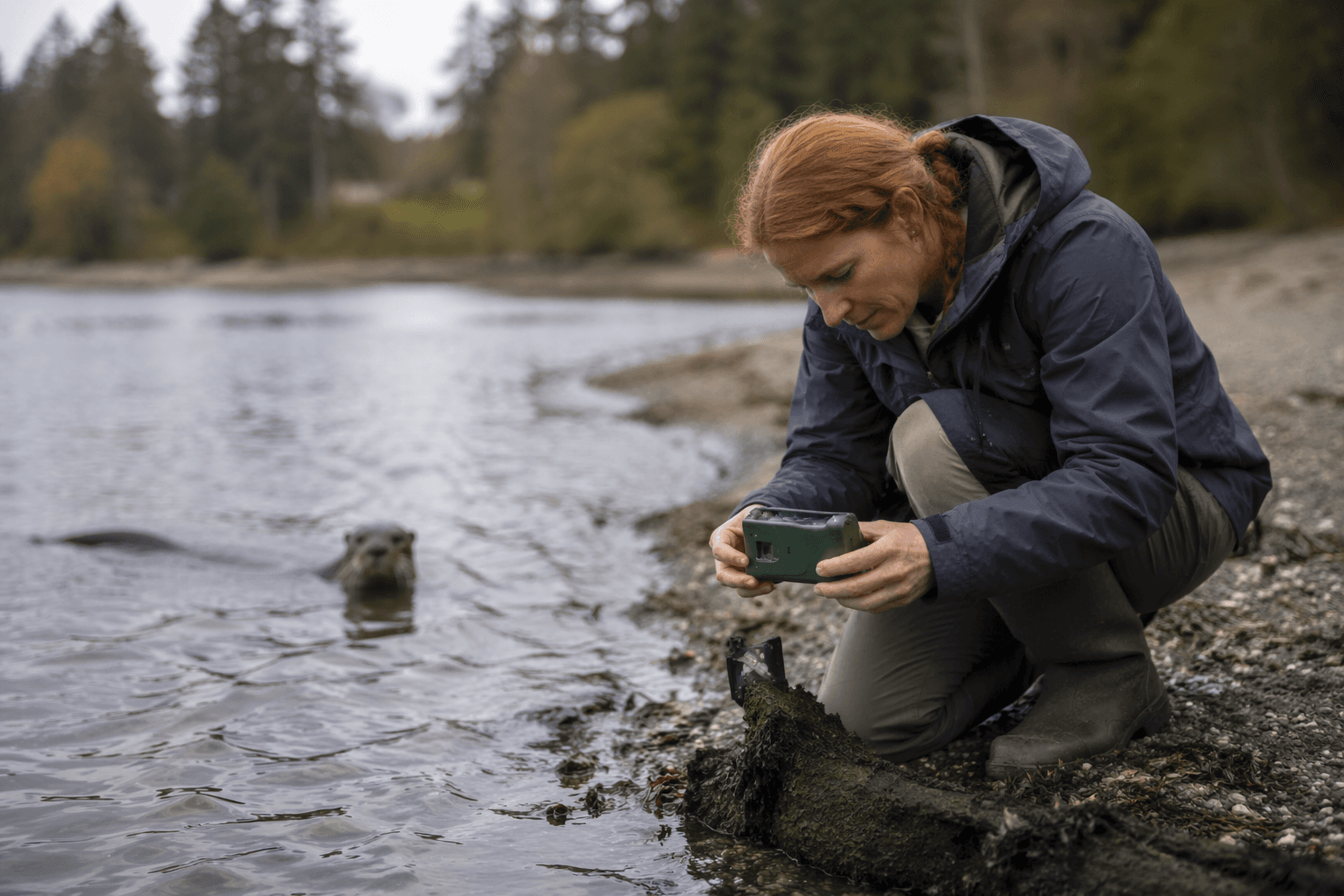
That is the value of Heide Island’s work. The comparative animal behaviorist and Pacific University professor has spent years watching river otters on Whidbey, and her observations point to a larger local question: if otters can move between lakes, streams, estuaries, and the Salish Sea, what does that say about the condition of the waters they depend on?
A Whidbey research site shaped by geography
Whidbey was a natural fit for this kind of study because the island sits in the Salish Sea and also holds numerous lakes and freshwater sources. That mix of habitats makes it one of the better places in the region to watch river otters use different kinds of water in a single landscape.
That matters locally because river otters are not just shoreline animals. Washington Department of Fish and Wildlife says they can live in fresh, brackish, or salt water and travel overland for considerable distances, which means they are built for a landscape like Island County, where water is everywhere but not always connected in obvious ways. When those routes stay open, otters can follow fish and move through the same creek mouths, wetlands, and sheltered edges that help define Whidbey’s quality of place.
The years of fieldwork behind the story
Island’s Whidbey observations began in 2018, and earlier coverage described the work as continuing for at least a year. A 2019 report added more detail from the field: she had been studying a family group at Crockett Lake Preserve and Admiralty Cove, identified 12 different otters in one year, and still had only about a 25% success rate when she went out looking for them.
That low sighting rate is part of what makes the project interesting. Otters may feel common to people who spot a slick head in a lagoon or a shape cutting through the water, but they are still elusive enough that patient observation matters. The scarcity of clean sightings also helps explain why local residents, trail cameras, and sample collection became part of the project rather than a scientist working alone from a distance.
Neighbors helped build the record
This is one of the more important local details in the story: Whidbey residents were not passive onlookers. Community members hosted trail cameras, collected samples, and joined outreach events, while the Whidbey Camano Land Trust and the Whidbey Environmental Action Network partnered in the work.
That kind of collaboration gives the research a different weight in Island County. It turns otter watching into a shared practice, one that connects land protection groups, scientists, and people who live near the water every day. It also shows how environmental knowledge is built here, not just in classrooms or offices in Forest Grove, Oregon, but through hands-on attention to local creeks, preserves, and shorelines.
Why river otters matter to creek health and stormwater
River otters are not a formal water test, but they are a useful indicator of a living system. Because they depend on fish and other aquatic prey, their presence suggests there is enough food moving through the water web to support a predator near the top of it.
That is why otter sightings should make residents look more closely at the condition of nearby creeks and runoff channels. If stormwater carries too much pollution into small waterways, or if shoreline habitat is simplified so much that fish and amphibians lose cover, the food base that supports otters can thin out as well. In that sense, an otter in a lagoon or estuary is not just a wildlife moment. It is a reminder that Whidbey’s shoreline health starts upstream, in the smaller waters that feed the larger system.
The connection to salmon habitat is just as practical. Salmon, like otters, depend on connected freshwater and estuary corridors. When those corridors are healthy enough to support a predator that eats fish, they are often healthier for the rest of the food web too.
What otters eat and why that matters
Washington Department of Fish and Wildlife describes river otters as opportunists. Fish make up most of their diet, but they also eat mussels, crayfish, amphibians, birds, eggs, and small mammals.
That broad menu helps explain why they are so adaptable in coastal Washington. Adult males average about 4 feet in length, including the tail, and weigh roughly 20 to 28 pounds, so they are substantial predators even when people only catch a glimpse of them. Their ability to switch between prey types also means they can thrive in places where the water is rich enough to support multiple layers of life, from invertebrates to fish to the birds that move around the same edges.
For local observers, that is the practical lesson: otters do not appear in isolation. They show up where the food web is still producing enough variety to keep an energetic, mobile mammal going.
The conservation story behind the comeback
The Whidbey otter story fits into a much bigger recovery arc. Conservation literature cited in the research notes says river otters were reduced across more than 75% of their historical U.S. range by the early 1900s, largely because of unregulated trapping and water pollution. Recovery came later through reintroductions and improved water quality.
That history matters because it changes the way local sightings should be read. Seeing otters on Whidbey is not just seeing an animal that happens to be around. It is seeing a species that was pushed back in much of the country and has returned in places where habitat and water quality recovered enough to support it again.
A book that extends the Whidbey work
Island’s new book, *Romp! A Journey Through the Natural History of Otters and Why They Matter*, was published last month and blends memoir, field observation, and conservation science. It also moves beyond Whidbey to cover the world’s 14 otter species, placing the island’s family group in a much broader natural history.
That broader frame is useful for Island County readers because it shows how local observation scales up. A handful of years spent tracking one family of otters at Crockett Lake Preserve and Admiralty Cove can illuminate not only Whidbey’s waterways, but also the global story of how otters survive, adapt, and signal environmental change.
What to take from a Whidbey otter sighting
The most important lesson is simple: an otter in sight is also a question about what lies beneath the surface. Is the creek still carrying fish? Are the shoreline edges intact enough for movement? Is stormwater being handled well enough to keep the food web working?
Whidbey’s otters have become a way to read those answers in real time. Thanks to years of patient fieldwork, and to residents who helped with cameras, samples, and outreach, Island County now has a story that is about wildlife, but also about the condition of the waters that shape daily life here.
This article was produced by Prism’s automated news system from verified source data, official records, and press releases, then run through automated quality and moderation checks before publishing. The system is built and supervised by the people who set the standards it runs under. Read our full AI policy.
Know something we missed? Have a correction or additional information?
Submit a Tip