Alicia Salinas library archive preserves Jim Wells County history online
Students, families, and local researchers can search more than 300,000 pages of Alice newspapers online to trace Jim Wells County's civic memory. The archive makes names, dates, and events easier to verify.
A practical way to search Jim Wells County history
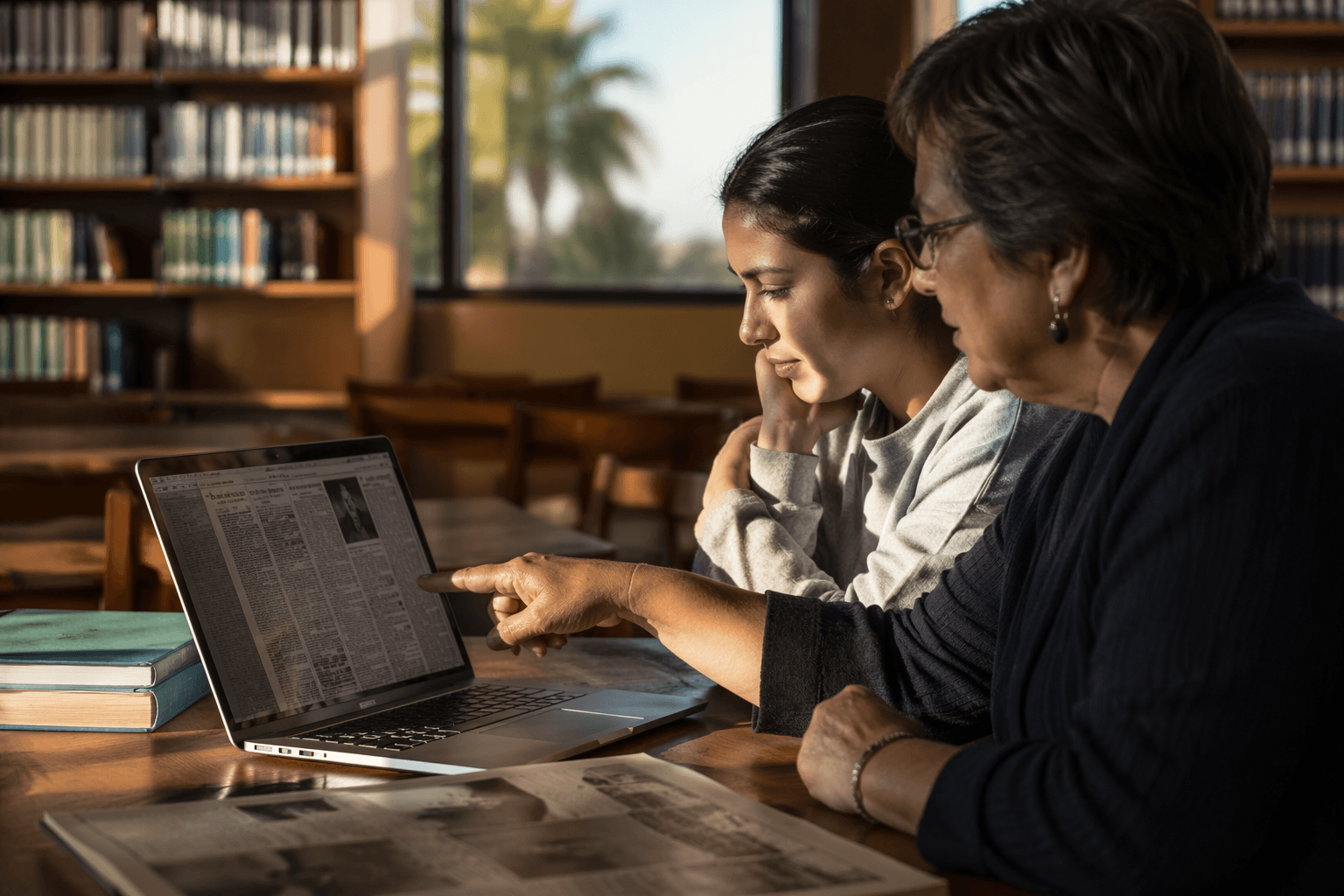
A student working on a county-history assignment, a family tracing surnames through old obituaries, and a resident trying to verify a past election or civic decision can all start in the same place: the Alicia Salinas Public Library’s online history archive. The free, keyword-searchable collection gives Jim Wells County residents a fast way to look up names, dates, family connections, and local events without relying only on memory or brittle paper files.
The archive is more than a nostalgia project. It is a working public-access tool that turns Alice’s newspaper record into searchable primary-source material, making it easier to compare eras, track community change, and document how the county’s center evolved over time.
What the archive contains
The digital archive sits inside the Alicia Salinas City of Alice Public Library’s broader collection, which the City of Alice says serves Jim Wells County residents and includes more than 40,000 items. The archive itself is freely available online and keyword searchable, giving users direct access to the city’s historical newspaper run.
- The Alice Echo, 1899 to 1947, 16,243 pages
- The Alice Daily Echo, 1947 to 1969, 64,552 pages
- The Alice Echo News, 1969 to 2002, 173,031 pages
- The Alice Echo News Journal, 2002 to 2025, 62,549 pages
The interface lists four major newspaper segments:
Together, those runs add up to more than 300,000 searchable pages. That scale matters because it lets users trace a topic across generations instead of searching one paper at a time or piecing together fragments from separate collections.
The library page describes the archive as the city’s comprehensive historical circulation collection, and that breadth is what makes it useful for everyday research. A reader can search a surname, a street name, a business, a church, an election, or a civic milestone and move quickly from one decade to another.
Why Alice’s history belongs to the county story
The archive is rooted in Alice, the county seat of Jim Wells County, but its value reaches far beyond city limits. Alice grew out of the defunct community of Collins after the San Antonio and Aransas Pass Railway shifted its route west when local landowners would not sell. The Alice post office opened in 1888, and by 1892 the town already had a hotel, two saloons, two general stores, a weekly newspaper, and a cotton gin.
By 1894, the Texas State Historical Association says, Alice was the busiest shipping point in South Texas. By 1896 it had a library, a bank, a second weekly newspaper called El Eco, and an estimated population of 885. Those details show why the city became such a strong center for recordkeeping, printing, and commercial life. The archive preserves that paper trail in a way that makes the town’s growth visible to anyone with a search term and a screen.
Jim Wells County was created on March 11, 1911, and organized on May 6, 1911. Alice was chosen as county seat shortly after that organization, placing the town at the center of local government just as the county itself was taking shape. During the 1912 to 1916 border raids, Alice also served as headquarters for Texas Rangers operating in South Texas, which adds another layer to the record that residents can now trace through newspaper coverage.
A county hub built around business, oil, and circulation
The city’s own history shows how quickly Alice expanded after becoming the county seat. By 1914 it had an estimated population of 3,500, two banks, a cottonseed oil mill, a cotton gin, an ice plant, and two weeklies, the Alice Echo and the News. That kind of growth created a dense local record of business, public meetings, social life, and community milestones, much of it captured in the newspapers now preserved online.
Alice later adopted the slogan “Hub City of South Texas” during the 1920s oil boom, a label that reflected its role as a regional distribution point. That context helps explain why the archive matters to Jim Wells County today. The paper record does not just chronicle events in Alice; it documents how a railroad town became a shipping center, then an oil-linked regional hub, and finally the county’s main historical memory bank.
The archive also reflects the institutional history of the library itself. The Alicia Salinas City of Alice Public Library was established in 1954 and renamed in 1974 in honor of Alicia Salinas. That history matters because the archive is not an outside project imposed on the community. It is a local public institution preserving local records for local use.
How people can use it now
For residents, the most immediate benefit is speed. Instead of digging through boxes, waiting on limited staff time, or traveling long distances, users can search the archive from home and compare different eras in minutes. That is especially valuable in a county with a 2020 population of 38,891 and in Alice, which had 17,891 residents in 2020. A searchable archive saves time across a community large enough that paper-only research would be slow and uneven.
- students working on local history projects
- genealogists tracing family lines
- residents checking obituaries and names
- researchers comparing civic events across decades
- journalists documenting elections, public issues, and community changes
The archive is especially useful for:
Because the collection is built from primary-source newspaper material, it helps users verify details instead of relying solely on family memory or secondhand retellings. That makes it useful for both personal discovery and public accountability.
Why preserving this access matters
In Jim Wells County, access to old newspapers is about more than looking back. It is about preserving civic memory in a place where many of the strongest records once lived in print and where family stories can be scattered across generations. The archive keeps that history in one place and makes it searchable, which strengthens education, public access, and historical accountability at the same time.
That is the practical value of the Alicia Salinas archive: it gives Jim Wells County a working record of how Alice and the county changed, who mattered in those changes, and when those changes happened. For a community shaped by railroads, county government, oil, agriculture, and South Texas commerce, that searchable record is not ornamental. It is part of the county’s public infrastructure, and it preserves the evidence residents need to understand where they live now.
This article was produced by Prism’s automated news system from verified source data, official records, and press releases, then run through automated quality and moderation checks before publishing. The system is built and supervised by the people who set the standards it runs under. Read our full AI policy.
Know something we missed? Have a correction or additional information?
Submit a Tip