Jim Wells County landmarks anchor local history, identity and heritage
Three landmarks, the courthouse, Collins Cemetery, and the South Texas Museum, reveal how Jim Wells County remembers power, place, and people.
Jim Wells County in three places
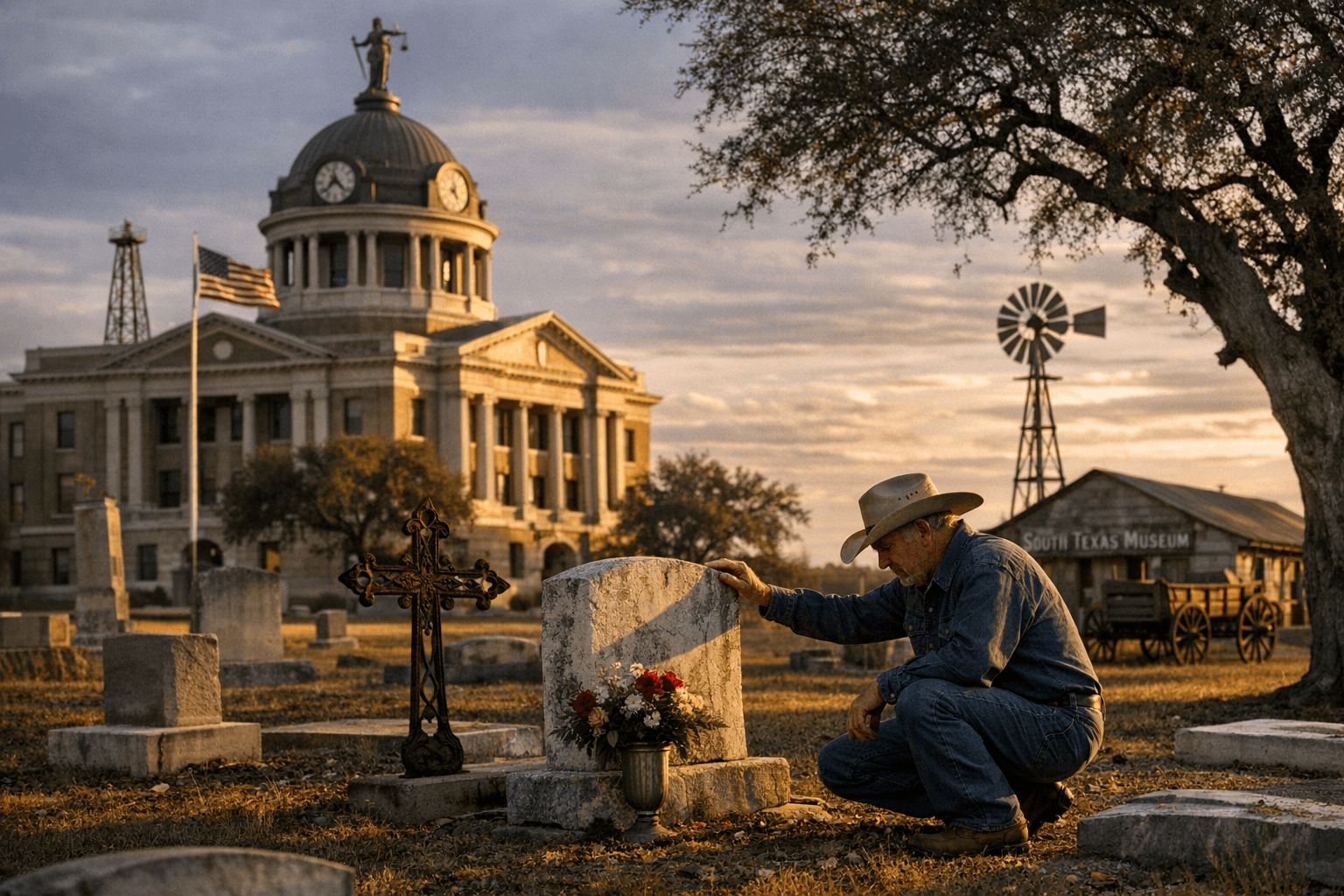
The story of Jim Wells County is easiest to read walking its downtown square, tracing names in old stones, and touring a small local museum: the Jim Wells County Courthouse in Alice, Collins Cemetery (Old Collins), and the South Texas Museum. These three sites combine civic function, family memory, and cultural interpretation, and together they explain why a county created in 1911 and home to 38,891 people as of the 2020 census still orients itself around townsite, rail, and ranch histories. If you plan one short visit, bundle the courthouse, the nearby cemetery sites, and the museum into a half-day heritage loop to see how public records, gravesites, and artifacts shape local identity.
Jim Wells County Courthouse, Alice
The courthouse sits at the heart of downtown Alice, anchored to a civic role that began with a public spectacle: its cornerstone was laid July 25, 1912, in a celebration that drew more than 2,000 people and included music, barbecue, rodeo, and baseball. Architecturally the building is credited to Atlee B. Ayres and later saw major additions and remodeling in 1948–1949 by Addis E. Noonan and Associates, a record that explains the courthouse’s blend of Texas Renaissance and Prairie-classical influences. Today the courthouse functions as the county’s working civic center and public records hub, listed for wayfinding at 200 N. Almond St in downtown Alice, and it appears in architectural records under a second address in archival listings, reflecting its long institutional history.
- What to do: Visit the Jim Wells County Clerk’s office to request land records, probate files, and older dockets; attend courthouse-square events when scheduled; photograph the courthouse façade and the historic marker.
- Who will enjoy it: Genealogists, civic-minded residents, architecture fans, and anyone needing public records or permits.
- Share hook: Tell out-of-town family that more than 2,000 people turned the cornerstone ceremony into a full civic festival, a reminder that county courthouses once served as the county’s chief public stage.
What you can do there now, who will enjoy it, and a share-worthy fact:
Why it matters for policy and civic life: The courthouse is not only a landmark; it is the repository for land titles, probate, and court dockets that structure property rights, local governance, and electoral administration. For journalists and citizens interested in institutional accountability, those records are the first order of business: confirm which records are held by the County Clerk versus the District Clerk, call ahead about access and copying fees, and treat the courthouse as essential civic infrastructure that supports transparency.
Collins Cemetery (Old Collins) and Alice Cemetery
The county’s cemeteries map settlement shifts from the old Collins community to the rail-centered townsite of Alice. Collins Cemetery, recorded in the Texas Historical Commission atlas as Cemetery ID JW-C010 and listed under additional names Old Collins and New Collins, sits within city limits at or near 135 S. Flournoy Rd, at the intersection of S. Flournoy Rd and Sain Dr. The Alice Cemetery links directly to the townsite transition: Frederic B. Nayer donated land in 1903 for what was first called Alice Fraternal Cemetery, and in 1925 the Alice Cemetery Association organized to manage burials and grounds.
- What to do: Walk the grounds to locate family plots, photograph headstones dating back more than a century, and confirm plot records with the cemetery association or County Clerk for genealogical research.
- Who will enjoy it: Family historians, students of settlement geography, and photographers seeking visual cues of place.
- Share hook: Residents still point to the 100 oak trees planted in 1952 under Alice Cemetery Association president Martha Fawcus as a visible, living link to local stewardship.
What you can do there now, who will enjoy it, and a share-worthy fact:
Practical considerations and civic context: Cemeteries are working landscapes; be respectful of ongoing services and neighboring private property. Use the THC atlas entry for Collins Cemetery to confirm exact coordinates before visiting, and for Alice Cemetery look for marker locations on Martin Luther King Road south of Encinal Street when mapping a route. These burial grounds are primary sources for family history and for understanding how the Collins-to-Alice shift reorganized community space.
South Texas Museum, McGill Brothers Building
The South Texas Museum anchors the county’s cultural interpretation in a Recorded Texas Historic Landmark, the 1911 McGill Brothers Building at 66 S. Wright St in downtown Alice. The museum curates artifacts and rotating exhibits that trace ranching, railroad, agricultural, and civic life; it is an active educational partner with schools and youth programs such as 4-H and FFA, and local profiles note the museum’s role in school tours and community programming. Typical public hours have been listed historically as afternoons Tuesday through Friday and Saturday mornings, and the museum can be reached by phone at (361) 668-8891; call ahead to confirm current hours and exhibit schedules.
- What to do: See rotating exhibits, bring students or grandchildren for an afternoon program, and admire the McGill Brothers Building itself as a 1911 landmark.
- Who will enjoy it: Teachers, students, visitors who want context for the courthouse and the cemeteries, and anyone interested in local agricultural and railroad history.
- Share hook: The museum’s home dates to 1911, the same era that shaped the county’s earliest public buildings, so a single downtown block can tell a full century of Jim Wells County life.
What you can do there now, who will enjoy it, and a share-worthy fact:
Institutional role and civic value: The South Texas Museum performs civic memory work that complements the courthouse’s documentary record and the cemeteries’ burial rolls. For county leaders and civic organizations, the museum is a partner in heritage tourism and education, which translates to school programming and modest economic activity around downtown Alice.
A practical heritage loop and visitor logistics
Alice lies at the crossroads of U.S. 281 and Texas Highways 44 and 359, about 44 miles west of Corpus Christi, a geography that makes a day trip feasible and that encourages bundling visits to the courthouse, museum, and cemetery sites. Start downtown at the courthouse and County Clerk’s office at 200 N. Almond St to confirm records and copying options, then walk or drive to the South Texas Museum at 66 S. Wright St for context, and finish with Collins Cemetery at 135 S. Flournoy Rd to read the stones that predate the new townsite.
- Call the Jim Wells County Clerk’s Office before you travel to determine which records you need and any fees.
- Use the Texas Historical Commission atlas entries and the Alice Cemetery marker information to pinpoint graves and marker texts.
- Respect cemetery property lines and scheduled services when visiting Old Collins and Alice Cemetery.
- Verify South Texas Museum hours by calling (361) 668-8891 before planning a visit.
Tips for researchers and visitors:
Politics, memory, and what residents might tell a visitor
Jim Wells County was created in 1911 and named for James B. Wells Jr., a prominent South Texas political figure, and the county’s physical record reflects contested politics as well as civic celebration. The courthouse’s archival life intersects with a national story: architectural histories note the courthouse’s connection to the 1948 Democratic U.S. Senate primary controversy involving Lyndon B. Johnson, Coke Stephenson, and local boss George Parr, an episode residents sometimes cite to explain the county’s outsized role in midcentury Texas politics. That mixture of local festivity, institutional record keeping, and contested electoral history is central to how the county understands itself.
Conclusion
Walk these three sites and you will see how Jim Wells County turns public buildings, family plots, and small museums into a single civic narrative: a courthouse that still manages the legal and property records that structure daily life, cemeteries that preserve family and migration stories from Collins to Alice, and a museum housed in a 1911 landmark that translates artifacts into classroom lessons. Those concrete facts—the 1912 cornerstone celebration that drew over 2,000 people, Frederic B. Nayer’s 1903 land gift, the planting of 100 oak trees in 1952, and the museum’s 66 S. Wright St address—are not relics; they are working pieces of civic infrastructure that matter for genealogy, governance, and local identity into the present.
This article was produced by Prism’s automated news system from verified source data, official records, and press releases, then run through automated quality and moderation checks before publishing. The system is built and supervised by the people who set the standards it runs under. Read our full AI policy.
Did this article answer your question?