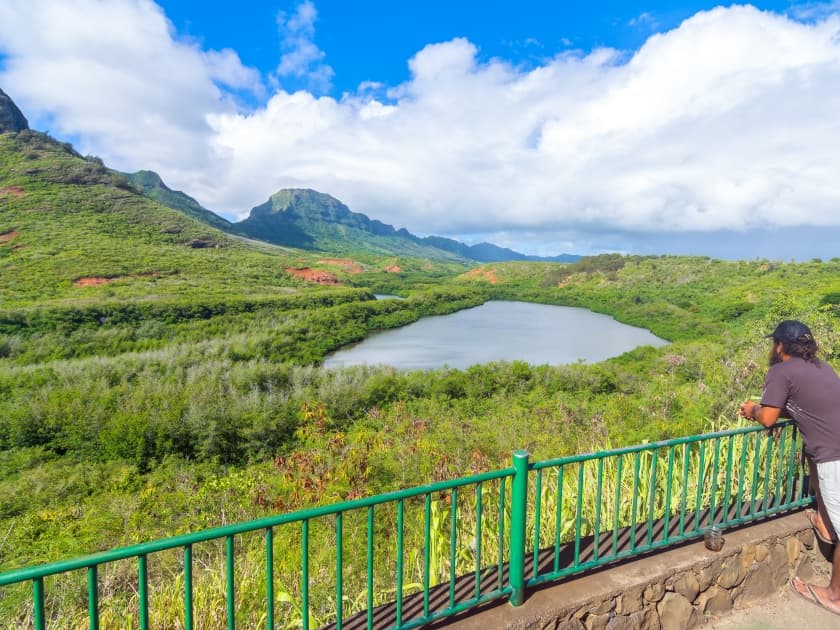
4.1 Magnitude Earthquake Strikes Off Kauai Southwest Coast, No Tsunami Threat
A magnitude 4.1 quake was reported about 49 km SSW of Kaumakani, Kauai; initial reports say no damage and no tsunami warnings, but agency data on time and depth conflict.
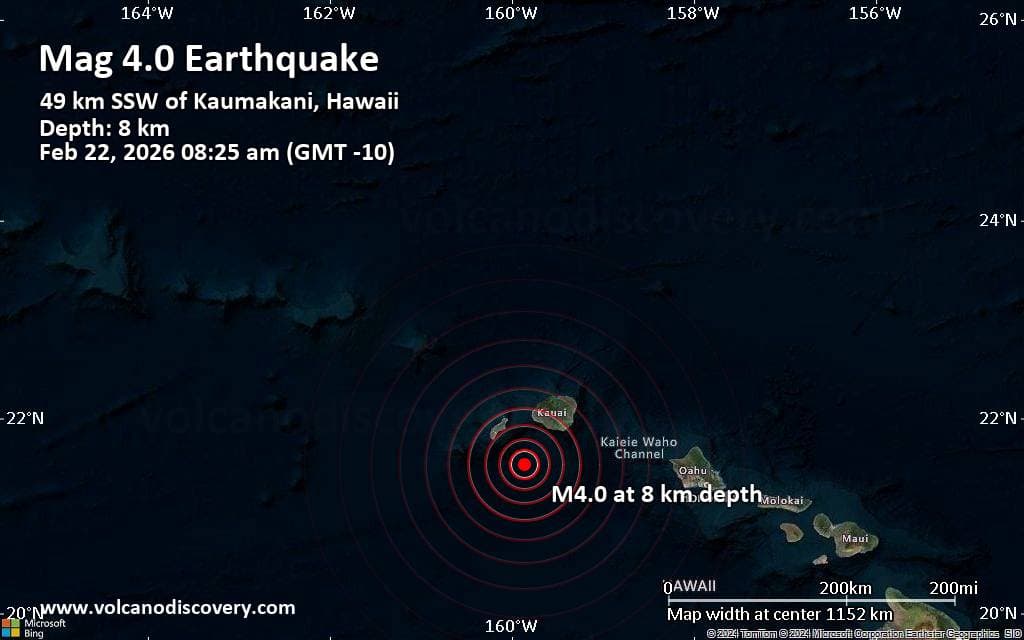
A magnitude 4.1 earthquake was reported roughly 49 km SSW of Kaumakani, Kauai, at a depth of 8 km on Feb. 22 evening, and there were no reports of damage or tsunami warnings issued, according to an initial report. That account places the shock well offshore of Kauai’s southwest coast and describes the location as unusual, noting that most Hawaii quakes occur near the Big Island.
A separate seismic bulletin from VolcanoDiscovery described a different set of parameters for what appears to be the same Feb. 22 event: “A very shallow magnitude 4.0 earthquake was reported in the morning near Kekaha-Waimea, Kauai County, Hawaii, USA,” and added that “According to the United States Geological Survey, the quake hit on Sunday, February 22nd, 2026, at 8:25 am local time at a very shallow depth of 4.9 miles.” VolcanoDiscovery cautioned that “The exact magnitude, epicenter, and depth of the quake might be revised within the next few hours or minutes as seismologists review data and refine their calculations, or as other agencies issue their report.”
The two accounts disagree on time of day, depth and a small but consequential shift in epicenter: one places the shock in the evening about 49 km SSW of Kaumakani at 8 km depth, the other places it near Kekaha-Waimea in the morning at 4.9 miles depth and summarizes the location as “32 miles southwest of Kekaha-Waimea.” Those discrepancies mean official parameters remain unsettled until a primary federal feed confirms coordinates, magnitude and UTC/HST timestamp.
The practical effect for communities along Kekaha, Waimea and Kaumakani is shaped by quake depth: VolcanoDiscovery’s report notes that “Shallow earthquakes are felt more strongly than deeper ones as they are closer to the surface.” Despite that, the Original Report recorded “No reports of damage or tsunami warnings issued.” For historical context on tsunami assessment and agency response, the U.S. Geological Survey’s Hawaiian Volcano Observatory previously relayed that “According to the Pacific Tsunami Warning Center, there is no tsunami threat from this earthquake” after a separate magnitude-4.1 event beneath Kīlauea on Feb. 12, 2016. HVO also recorded that “Kīlauea's south flank has been the site of 28 earthquakes of magnitude-4.0 or greater during the past 25 years” and explained that “Most are caused by abrupt motion of the volcano's south flank, which moves to the southeast over the oceanic crust as a result of magma being injected into the East Rift Zone.”

HVO Scientist-in-Charge Christina Neal said in that 2016 bulletin: “HVO monitoring networks have not detected any significant changes in activity at the summit or along the rift zones of Kīlauea or at other Hawaiian volcanoes resulting from the earthquake.” HVO geologists also reported feeling the 2016 quake near the Pu‘u ‘Ō‘ō cone but “noted no change in the eruption.”
At this stage, seismologists are reviewing data and local officials have yet to reconcile differing reports. The record compiled from initial sources underscores two priorities for public health and emergency planning: confirm official magnitude, depth and epicenter through the national seismic network and Pacific Tsunami Warning Center, and communicate clearly to Southwest Kauai communities, Kekaha, Waimea and Kaumakani, about any verified aftershocks or changes in hazard status. VolcanoDiscovery’s advisory that “the exact magnitude, epicenter, and depth of the quake might be revised” captures the provisional nature of these early reports; officials and residents should expect updated, authoritative values from federal and state monitoring agencies.
This article was produced by Prism’s automated news system from verified source data, official records, and press releases, then run through automated quality and moderation checks before publishing. The system is built and supervised by the people who set the standards it runs under. Read our full AI policy.
Did this article answer your question?