Kaimana lychee season gets boost from reused bird netting
Reused bird netting helped protect Kaimana lychee on Kauai, where a 340-pound harvest became both market fruit and a fundraiser in Līhue.
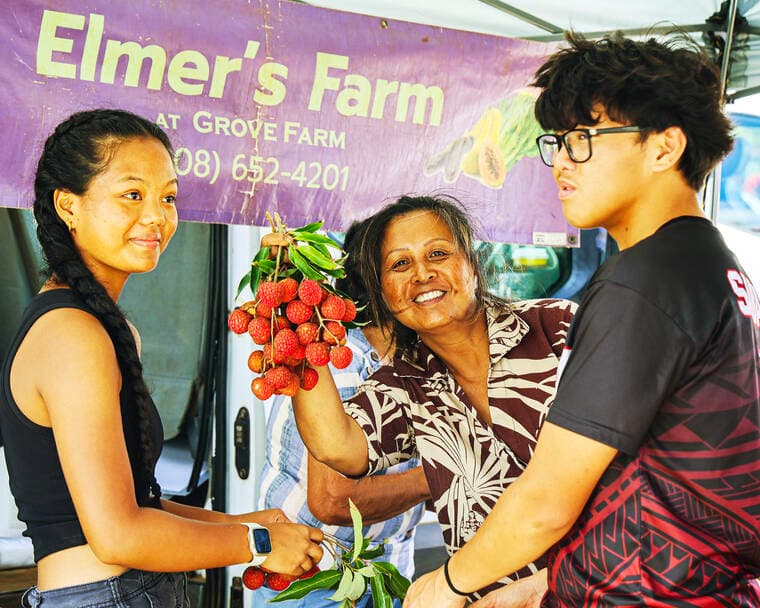
Used bird netting kept the green birds off Kaimana lychee trees, and that small defense mattered. At the same time, Gary Ueunten brought about 340 pounds of fruit to the Pau Hana Market at Kukui Grove, turning one harvest into both local sales and a Farm Bureau fundraiser in Līhue.
A small fix with outsized value
For Kauai growers, a few missing clusters can change the economics of a season fast. Lychee is a limited, highly seasonal crop, and fruit that gets pecked or spoiled before it reaches the stand cuts directly into yield, pricing, and the amount available for neighbors who are waiting for the first bags of the year.
That is why reused netting has practical value well beyond the cost of the mesh itself. The crop can be protected without treating every tree as a one-time setup, and on an island where small-acreage farming often depends on sharing equipment, donated materials, and community help, a second use can still protect a profitable harvest.
Why Kaimana matters in Kauai’s lychee season
Lychee in Hawaii typically bears fruit from May to August, and Ueunten Farm in Lawai lists its lychee season from May to July. That window is brief enough that timing matters at every step, from picking to market day, which is one reason the Kaimana cultivar has such a strong following.
The University of Hawaii at Mānoa Cooperative Extension Service says Kaimana was selected in Hawaii in 1955 from Hak Ip seedlings planted at the Poamoho experimental farm. It has been valued for earlier fruiting and heavier crops than other lychee cultivars grown in Hawaii, two traits that help explain why it remains a useful variety for growers trying to move fruit quickly during a short season.
Lychee itself has deep roots in Hawaii agriculture. The first lychee plant brought to the islands was imported from China in 1873, and the crop has since become part of the state’s summer rhythm, when people look for it at farms, stands, and farmers markets before the season closes.
Bird netting is not a luxury on a fruit tree
The Extension Service’s guidance on lychee fruit bagging makes clear why netting is so common around mature trees. Bird netting laid over an entire tree can help deter birds, but it is not a perfect shield. Once birds adapt or find a gap, fruit damage can resume, and other pests, including moths and fruit flies, can still harm the crop.
That limitation is exactly what gives reused netting its usefulness on Kauai. It is not a complete answer, but it can be enough to keep a home orchard or small farm from losing a meaningful share of fruit during a short harvest window. For growers working with limited acreage, even a modest reduction in damage can mean more boxes for market, steadier cash flow, and less pressure to raise prices to cover waste.
The practical lesson is simple: orchard protection does not need to be elaborate to matter. In a season measured in weeks, not months, keeping birds out can preserve the difference between a full table of fruit and a disappointing pickup.
From the orchard to Kukui Grove
Ueunten’s 340-pound haul to the Pau Hana Market at Kukui Grove shows how harvest season and community fundraising overlap on Kauai. The market, held Mondays from 3:00 to 5:30 p.m. in the Kukui Grove Center parking lot in Līhue, gives local growers a regular retail outlet in a place residents already know and use.
That matters for the island food economy because the same fruit can move through multiple local channels at once. It can support the farm that grew it, help stock a market table, and provide a fundraiser item for the Kauai County Farm Bureau. When that fruit is lychee, a crop that comes and goes quickly, the local market setting becomes even more important. There is no long shelf life to absorb delays, so the infrastructure around the harvest has to work in real time.
Ueunten Farm adds another layer to that picture. The family farm in Lawai has been in existence since 1930, which places this year’s lychee work inside a much longer history of small-scale Kauai agriculture. A farm that old does not survive on one crop alone; it survives on adaptation, seasonal planning, and the ability to make each harvest count.
Education, reuse, and the county network
The netting story also fits into a broader push around fruit-tree protection in 2026. Kauai Grown promoted a Fruit Tree Netting Workshop & Netting Distribution with hands-on demonstrations and free used netting, and the third workshop was scheduled for May 29, 2026 at the Wailua Experiment Station. That mix of instruction and material support shows how agricultural knowledge moves on island: through practical demonstrations, shared supplies, and growers helping one another solve the same problem.
The Kauai County Farm Bureau’s role in distributing used netting through Gary Ueunten points to the same pattern. Instead of treating orchard protection as an individual expense, the system turns it into a shared resource, which is especially important for small growers who cannot afford to lose a large share of a crop to birds, weather, or pests. In a market as small as Kauai’s, preserving one harvest can also help preserve the range of fruit available to residents.
That is the larger value of the season. Kaimana lychee is not just a summer treat at a stand in Līhue. It is a crop shaped by timing, pest pressure, and the strength of local networks, from the farm bureau and Kauai Grown to the weekly market at Kukui Grove. When reused netting keeps birds at bay, it protects more than a few clusters of fruit. It helps keep a small, island food system working through one of its busiest and briefest seasons.
This article was produced by Prism’s automated news system from verified source data, official records, and press releases, then run through automated quality and moderation checks before publishing. The system is built and supervised by the people who set the standards it runs under. Read our full AI policy.
Did this article answer your question?