Kauai grant project maps coconut rhinoceros beetle sites, may guide statewide fight
Kauai’s beetle map will track outbreaks, traps and treatments, aiming to protect palms, farms and landscaping costs while building a statewide model.
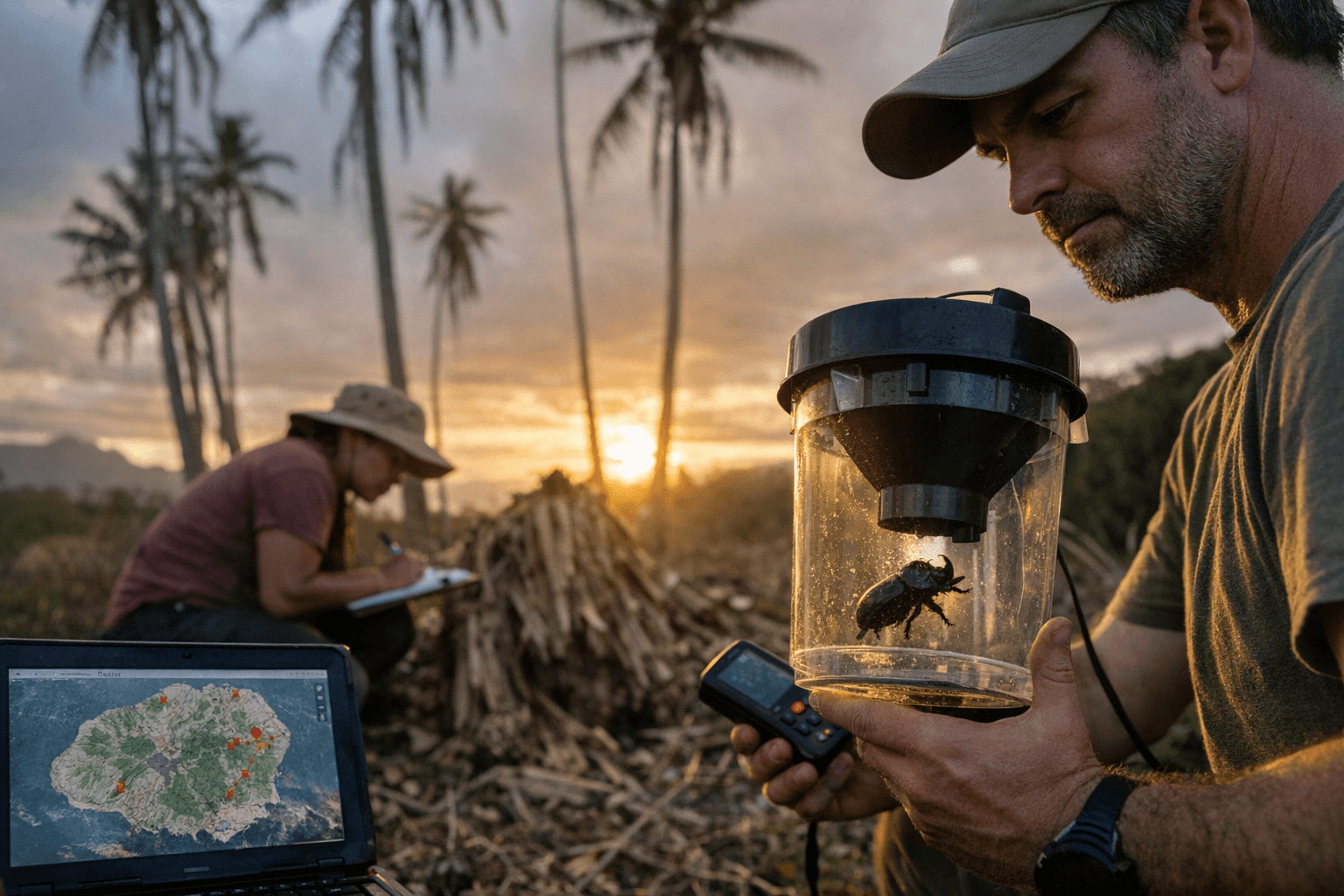
Coconut rhinoceros beetles are no longer just an environmental nuisance on Kaua‘i. The county-backed map now being built will show where the pest is feeding, breeding, getting trapped and being treated, giving homeowners, farmers and landscapers a clearer picture of where palms and other plantings are most at risk.
Kaua‘i County’s FY25-26 Innovation Grant will fund a community network of Moku Alakaʻi, or regional leaders, to survey their areas and collect data on CRB feeding and breeding sites, entrapments and treatment measures. County officials said the grant round backed six projects from 13 proposals after public feedback and committee review, part of a broader effort to choose projects that can be copied in other communities. Kaua‘i County said its FY2024-2025 Innovation Grants totaled $204,025.
The stakes for residents have been clear since June 2023, when two coconut rhinoceros beetles were found in traps near a green waste transfer station close to Līhuʻe Airport. Those were the first detections of CRB outside O‘ahu, and state agriculture officials quickly said the response would include surveys within a one-mile buffer, traps at 25 priority sites, possible fumigation of green waste and possible use of detector dogs. Officials also said green waste provides an optimal breeding environment for the beetle, and they noted at the time that more than 3,000 CRB traps were deployed around O‘ahu as the island battled the infestation.
The county’s new project is part of a larger state push to turn that experience into something repeatable. In July 2024, the Hawai‘i Department of Agriculture awarded about $293,000 in grants for community-based CRB management on O‘ahu and green-waste management on Kaua‘i, Maui and O‘ahu. Then-chair Sharon Hurd said community efforts could be replicated elsewhere in the future. On Kaua‘i, the need for that kind of coordination sharpened in April 2025, when volunteers with Na Kahu o Hoai, Inc. found larvae in mulch at Prince Kuhio Park in Koloa and reported about seven trees had already been lost there.
County response has widened since then. The Office of Economic Development launched a CRB resource page in April 2025 for residents, farmers, businesses and volunteers, and in January 2026 the county announced four newly certified CRB detection dogs. By late February 2026, CRB Action Kauai formed as a community-driven group focused on prevention, early reporting and coordination.
The beetle fight has been years in the making. CRB was first detected in Hawai‘i on O‘ahu in 2013, and officials have said early eradication efforts were slowed by limited money and limited information. Kaua‘i’s latest grant project is meant to turn a stronger evidence base into a practical islandwide model, one that could help protect backyard palms, farm operations, landscaping budgets and the image visitors see across the island.
This article was produced by Prism’s automated news system from verified source data, official records, and press releases, then run through automated quality and moderation checks before publishing. The system is built and supervised by the people who set the standards it runs under. Read our full AI policy.
Did this article answer your question?