Kauaʻi Volunteers Scan 15 Shoreline Sites in 30th Sanctuary Ocean Count
Kauaʻi volunteers staffed about 15 shoreline sites today for the 30th annual Sanctuary Ocean Count, a shore-based community science effort tracking humpback whale activity.
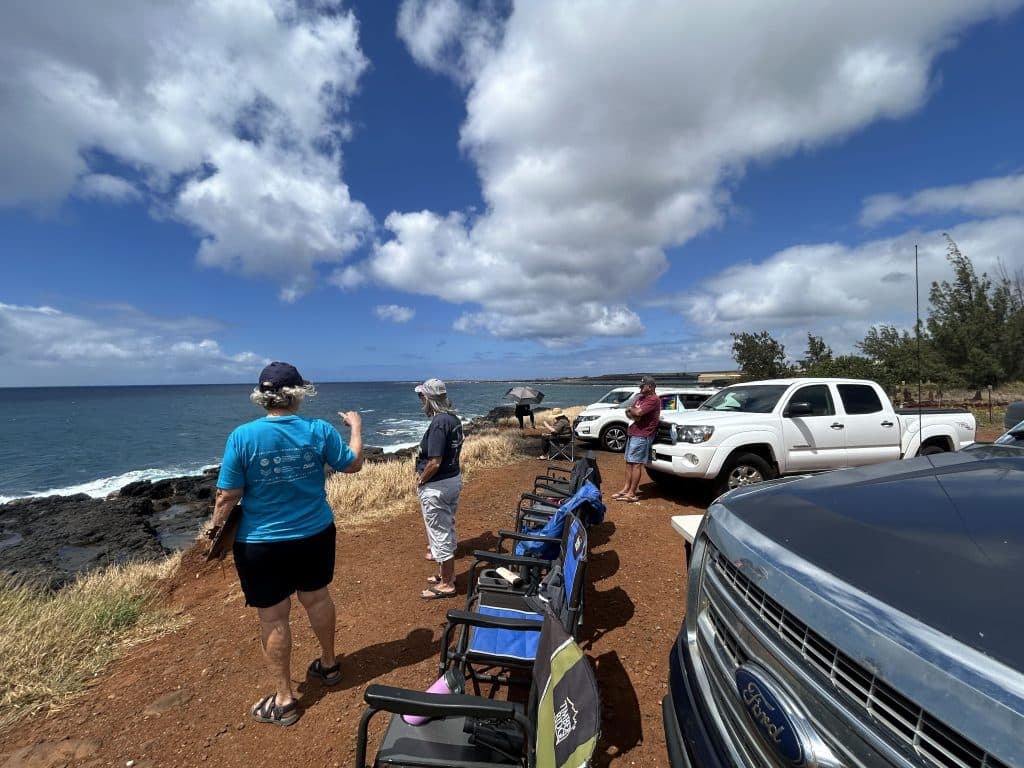
Volunteers across Kauaʻi are staffing roughly 15 shoreline sites today as part of the 30th annual Sanctuary Ocean Count, the Hawaiian Islands Humpback Whale National Marine Sanctuary’s community-science program that marshals shore-based observers during peak humpback season. The count provides a coordinated snapshot of humpback whale presence and surface behavior that managers and residents use to monitor local marine conditions.
The Ocean Count is held on the last Saturday of January, February and March and typically runs from 8:00 a.m. to 12:15 p.m. Site leaders and volunteer observers record sightings and surface behaviors from designated coastal vantage points, adding shore-based data that complement boat surveys and other monitoring. The program began in the early 1990s to address gaps in observational knowledge about whales in Hawaiʻi’s breeding and nursing grounds and expanded from 1996 to 2026 to cover four islands and more than 1,000 volunteers.
The most recently reported coordinated data come from the first joint count of 2025, when Sanctuary Ocean Count efforts were coordinated with the Pacific Whale Foundation’s Great Whale Count. According to local reporting, that coordinated count on Jan. 25, 2025 involved 429 volunteers at 41 shoreline sites across the main Hawaiian Islands and produced a combined statewide observation total of 2,121 humpback whales. Island breakdowns reported for that coordinated effort were Kauaʻi 440, Oʻahu 399, Molokaʻi 87 and Hawaiʻi Island 493, with Maui reporting 702 whales under the Great Whale Count. Observers statewide recorded the most whales during the 10:00 a.m. to 10:15 a.m. interval, with 296 whales counted across all sites and 183 whales reported by Sanctuary Ocean Count volunteers during that time window. Note that the counts may include duplicate sightings of the same whale by different observers at different locations and times.
Operational details vary by partner. Pacific Whale Foundation sites on Maui and Lānaʻi collected data in 15-minute intervals between 8:30 a.m. and 11:50 a.m. during the coordinated count, while NOAA’s Sanctuary Ocean Count maintains the broader 8:00 a.m. to 12:15 p.m. window. Preliminary site-level results are available on the Ocean Count resources page maintained by the program, and the sanctuary lists a volunteer coordinator contact for those seeking more information.

Some reporting conflicts remain unresolved in the published accounts: one local report lists 12 Maui sites plus one Lānaʻi site for the Great Whale Count, while another source states 11 sites across Maui and Lānaʻi. Time-interval snapshot figures from the coordinated count also include an ambiguous subgroup number in the published copy that requires confirmation against the raw data. Those discrepancies underscore the value of final, quality-controlled datasets before using counts to inform policy.
For Kauaʻi residents, the count matters for local planning and stewardship. Shore-based data help NOAA and partner organizations identify seasonal patterns that can influence coastal management, guide responsible wildlife viewing practices, and support decisions about noise, vessel traffic, and habitat protections. The Sanctuary Ocean Count continues with its February and March surveys on the last Saturdays of those months, and program staff encourage trained volunteers to participate as the archive of long-term, shore-based observations grows.
This article was produced by Prism’s automated news system from verified source data, official records, and press releases, then run through automated quality and moderation checks before publishing. The system is built and supervised by the people who set the standards it runs under. Read our full AI policy.
Did this article answer your question?