Coeur d’Alene job growth rises as Idaho unemployment stays at 3.7%
Coeur d’Alene’s job base grew 0.4% even as Idaho’s unemployment held at 3.7%, but job postings slipped and pay averaged $22.95 in northern Idaho.

Coeur d’Alene posted one of Idaho’s strongest metro job gains even as the state’s unemployment rate stayed locked at 3.7%, a sign that the local economy is still expanding but not without pressure. Nonfarm employment in the Coeur d’Alene area rose 0.4%, behind only Twin Falls at 1%, while statewide job growth cooled and the monthly labor force slipped.
Idaho’s labor force fell by 1,683 people in February, a drop of 0.2% to 1,008,136, and nonfarm jobs declined by 2,800, or 0.3%, from January. The unemployment rate was unchanged from January and from February 2025, but the flat headline masked movement underneath it: year over year, the labor force increased only about 0.2% and the number of unemployed Idahoans rose by about 170, or 0.5%. Arts, entertainment and recreation saw the steepest annual decline, down 10.8%, a reminder that not every sector is sharing in the state’s growth.
For Kootenai County, the latest local labor profile shows a market that improved over the past year but is still tighter than the state average. The county’s civilian labor force stood at 92,745 in December 2025, with 88,854 employed residents and 3,891 unemployed. That put the unemployment rate at 4.2%, down from 4.5% in December 2024. The county’s 2024 population was 188,323, median household income was $81,861, per capita personal income was $63,893 and the poverty rate was 9.0%, figures that underscore how much employment conditions shape household spending and business confidence in Coeur d’Alene, Post Falls and Hayden.
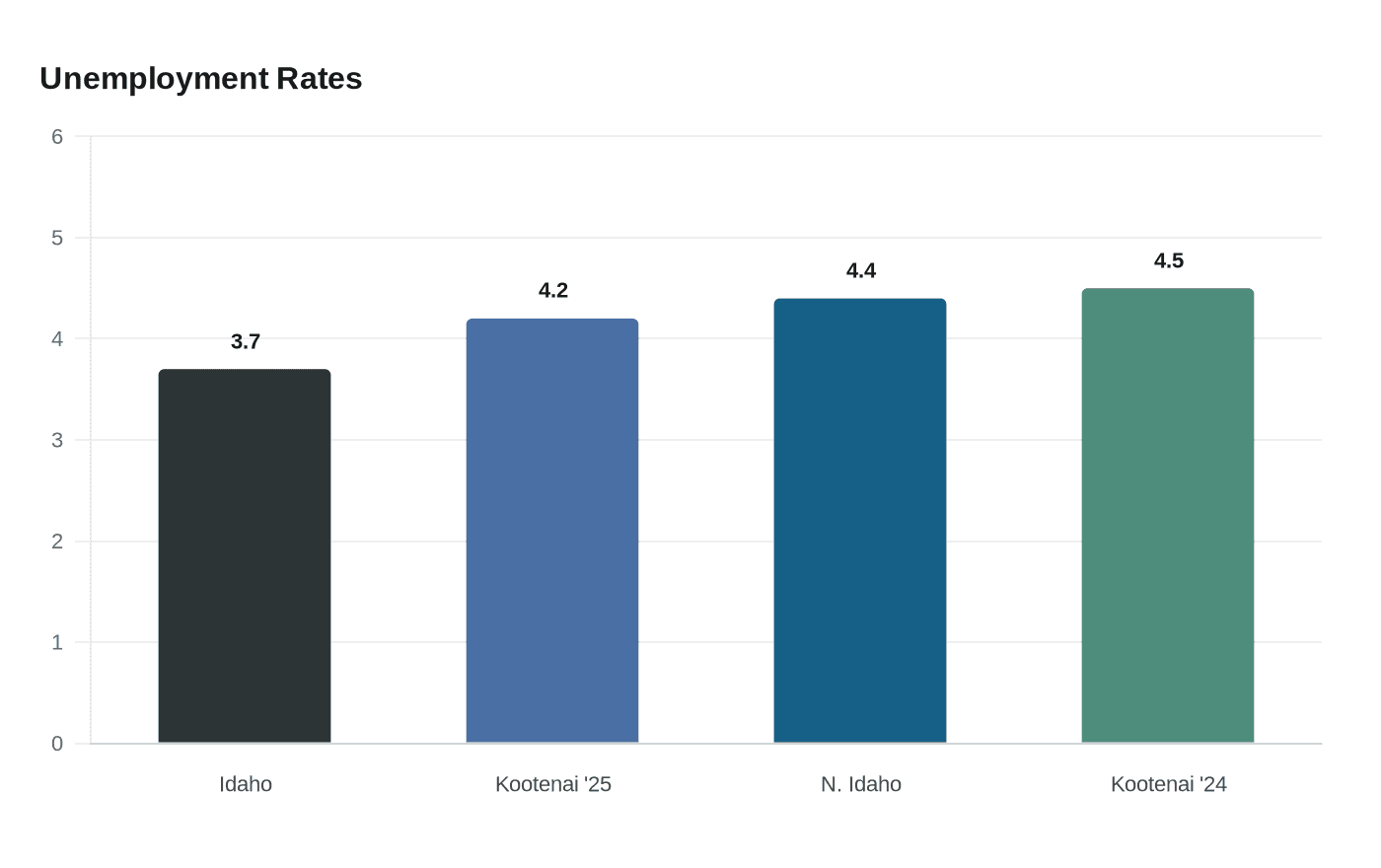
Northern Idaho’s labor market also showed signs of softening hiring. Seasonally adjusted data for December 2025 put the region’s civilian labor force at 133,153, total employment at 127,251 and unemployment at 5,902, for a 4.4% rate. In February 2026, job postings totaled 4,232, down from 4,479 a year earlier, and the average advertised hourly wage was $22.95. The most in-demand occupations were registered nurses, retail salespersons, home health and personal care aides, first-line supervisors of retail sales workers and customer service representatives, suggesting health care, retail and service employers are still struggling to fill key roles even as overall hiring cools.
The next monthly labor force release is expected in April and May, once benchmarking is complete, so the February figures are still a snapshot. But for Kootenai County employers and workers, the signal is already clear: the headline unemployment rate remains low, yet the local job market is still working through slower hiring, sector shifts and a labor pool that is not expanding as quickly as business demand.
This article was produced by Prism’s automated news system from verified source data, official records, and press releases, then run through automated quality and moderation checks before publishing. The system is built and supervised by the people who set the standards it runs under. Read our full AI policy.
Did this article answer your question?