Coeur d’Alene woman turns mother’s ashes into memorial stones
Rebecca Merrigan turned her mother’s ashes into smooth stones she can carry, a deeply personal way to hold on after Alzheimer’s loss in Coeur d’Alene.

A memorial you can carry
One of Rebecca Merrigan’s mother’s ashes now lives in a small pouch in her backpack, and that simple detail says as much about grief as any grand monument could. After her mother died from Alzheimer’s disease following a long and heartbreaking decline, the Coeur d’Alene woman chose to have the ashes transformed into about 20 smooth stones through Parting Stone, a memorial she can touch, hold and keep close.
For Merrigan, the appeal is practical as well as emotional. Instead of one urn on a shelf, she now has a set of stones that can move with her through daily life, which makes remembrance feel less like a single ritual and more like an ongoing connection.
Why this choice feels right for Mother’s Day
Mother’s Day is often framed as a day of flowers, brunches and celebration, but for many families in Kootenai County it also carries loss, especially when a mother’s life ended after dementia. Merrigan’s story captures that split vividly: a holiday meant for honor can also become a day for memory, reflection and small private acts of care.
That matters in Coeur d’Alene because Alzheimer’s is not an abstract diagnosis here. It changes family routines, strains caregiving networks and leaves behind the kind of grief that does not end when the funeral does. A memorial like Merrigan’s speaks to that reality by offering something tangible, portable and personal for people who want more than a traditional keepsake.
How the memorial stones work
Parting Stone says it solidifies 100% of cremated ash into a collection of smooth stones that typically ranges from 40 to more than 80 pieces. In Merrigan’s case, her mother’s remains became about 20 stones, each one shaped into a form that can be held rather than scattered or stored in a single vessel.
The company says the process usually takes 8 to 10 weeks and costs $2,495. It also says it uses barcode-based chain-of-custody tracking, a detail meant to give families confidence that remains are handled securely from start to finish.
Parting Stone says its patented process was validated with Los Alamos National Laboratory. The company also says a study with the lab found that scattering solidified remains has negligible environmental impact compared with scattering traditional cremated ashes.
For families weighing memorial options, those details matter. The choice is not just about aesthetics; it is about trust, handling, timing and whether a memorial actually fits the way a family grieves.
The comfort of one stone at a time
Merrigan’s most revealing gesture is also the simplest: she keeps one stone in a pouch in her backpack because it comforts her to know it is there. That kind of daily ritual turns mourning into something lived rather than locked away, and it helps explain why memorial stones are resonating with people who want a physical reminder that can travel with them.
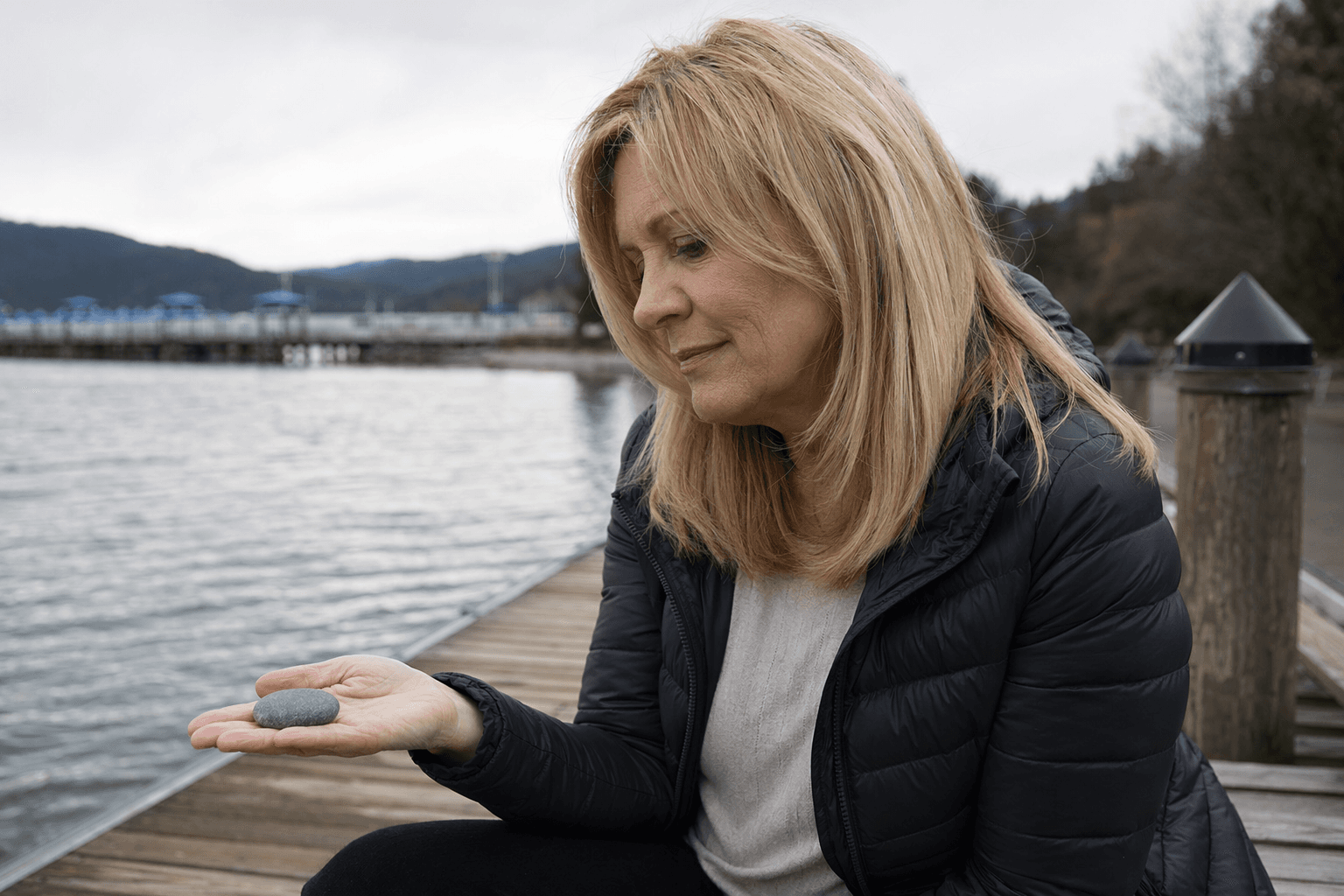
The texture of the stones matters, too. Ashes are often kept in one place, but stones can be touched, carried and shared among family members. For someone processing a parent’s death after dementia, that tactile quality can feel less clinical and more human.
Alzheimer’s adds a second layer of loss
Merrigan’s mother did not die suddenly. She died after a long decline, which is the kind of experience many dementia families know too well, marked by years of caregiving, shifting roles and the gradual loss of recognition. That long goodbye changes the meaning of memorials, because the grief begins before death and continues after it.
Idaho’s numbers show how many families live with that burden. The Idaho Alzheimer’s Association fact sheet says 29,900 Idaho residents age 65 and older were living with Alzheimer’s in 2020, representing 9.8% of adults over 65. The same fact sheet says Idaho had 74,000 caregivers and 118 million hours of unpaid care in 2026.
Nationally, the scale is even larger. The Alzheimer’s Association says more than 12 million Americans provide unpaid dementia care, and its 2026 report estimates the cost of caring for people with Alzheimer’s and other dementias at $409 billion.
Those figures help explain why a story like Merrigan’s resonates beyond one family. Alzheimer’s is both a private heartbreak and a public health issue, and the memorial choices families make often reflect the long caregiving journey that comes before loss.
A broader shift in how families say goodbye
Merrigan’s decision also fits into a larger change in funeral practices. The National Funeral Directors Association projected the U.S. cremation rate at 61.9% in 2024 and 63.4% in 2025, with rates expected to keep rising over the next two decades. As cremation becomes more common, families are looking beyond the old model of a single urn or cemetery plot.
That shift helps explain the growing interest in memorial products that are portable, shareable and more personally expressive. For some families, that means jewelry, keepsake containers or scattering ashes in a meaningful place. For others, like Merrigan, it means transforming remains into something that can be held in the hand and carried through everyday life.
What stands out for Kootenai County families
In Kootenai County, where so many families have navigated Alzheimer’s caregiving, Merrigan’s choice offers a quiet but powerful model. It recognizes that memory is often physical: a stone in a pocket, a reminder in a backpack, a presence carried through errands, holidays and ordinary days.
It also shows that grief does not have to be resolved to be honored. For Merrigan, the memorial stones do not replace her mother, but they give shape to remembrance in a way that feels immediate and real. In a community where loss and caregiving are part of many households’ lived experience, that kind of memorial can carry more meaning than any traditional display ever could.
This article was produced by Prism’s automated news system from verified source data, official records, and press releases, then run through automated quality and moderation checks before publishing. The system is built and supervised by the people who set the standards it runs under. Read our full AI policy.
Did this article answer your question?